traditionBatok
batok · Kalinga
Tapped, not poked — a thorn set crosswise on a stick and struck
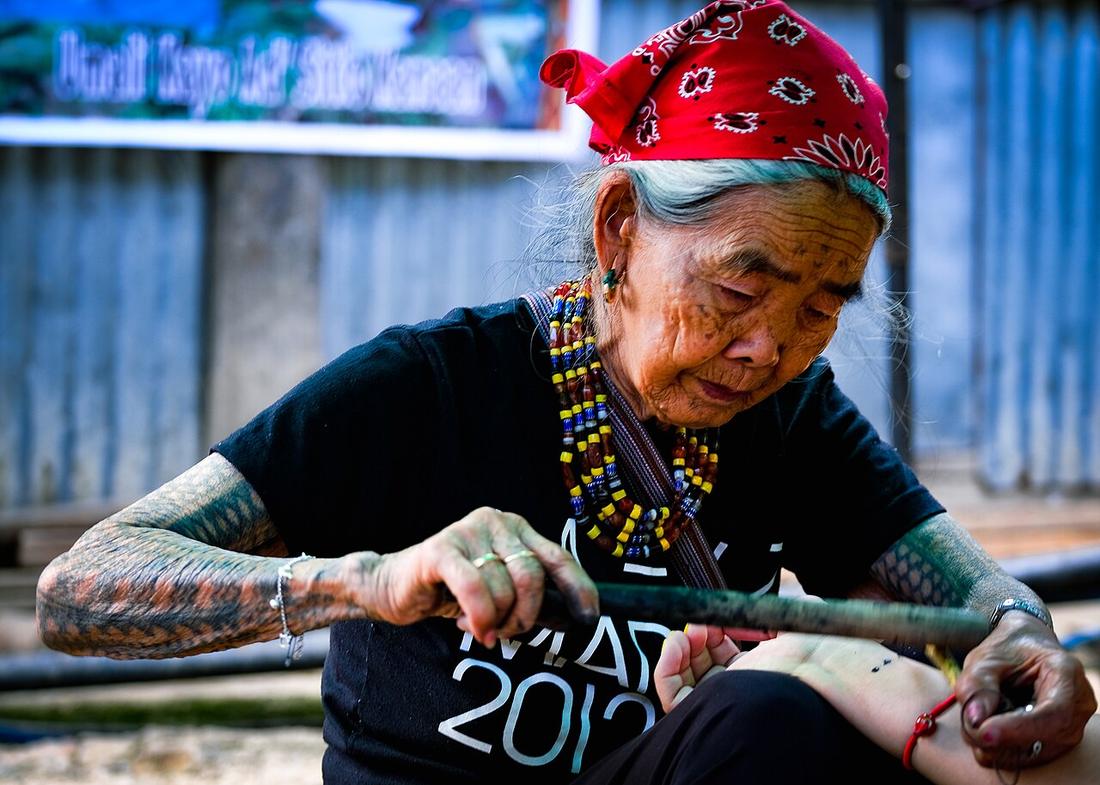 CharMel Creations · CC BY-SA 4.0
| Where it goes | arms, chest, hands, back, legs |
|---|---|
| How long | acquired over years, a panel at a time |
| Notes | Men's chest work was earned by taking a head; women's arms by other measures. |
| Tool | Gisi and pat-ik |
| Ink | Soot and water |
about 1,500 BCE – 2,026 · Hafted tattoo tools at Arku Cave before 1500 BCE; still being tapped in Buscalan
17.3000, 121.1000 · OpenStreetMap
What it is
The Philippine traditions, tapped with a hafted thorn at ninety to a hundred and twenty strikes a minute.
The long version
The Spanish called the Visayans Pintados, the painted ones, and recorded the tattoo as dress: a naked man "appears to be dressed in a kind of handsome armor engraved with very fine work" — worn at home with nothing but a loincloth, because the marks were the clothes.
The method is Austronesian and it is not poking. A needle — thorn, bone, horn, bamboo — is set perpendicular to a wooden handle in an L, and a second stick taps the handle. The hand that holds the tool never pushes; it positions. Ink is soot or ash in water, oil, cane juice or pig bile, and the design is laid out first in ink with a blade of grass or a length of string.
Among Cordilleran peoples tattoos were a form of clothing in the same explicit sense: to have none was to be naked. Chest work was not applied to a man until he had taken a head — which is why copying those designs today is held to be a bad idea, and why the men who fought in the 1960s and 70s were advised by elders not to take them.
Now
Whang-od is ninety-something and tattooing in Buscalan; her apprentices are women, which breaks the inheritance rule her own community ran on, and her community accepted it. Around her there is a revival with a problem inside it: which designs are open.
Connected to
- Tap The method, and why this site does not call it hand-poke.
- Whang-od Oggay Who is still doing it.
- The tattoo is clothing "Dressed in a kind of handsome armor" — the third of the three.
- The Arku Cave tools The tools, dug up, older than the Roman Empire by a millennium.
Named here by
- Cordilleran whatok The wider Philippine family this sits inside.
- Konyak marks Same structure, different island: the chest is earned.
- Tap Where it is still being done daily.
- Gisi and pat-ik What it makes.
- The centipede The tradition it belongs to.
- Whang-od Oggay The tradition.
- The tattoo is clothing Handsome armor.
- The painted ones The tradition.
Where each claim comes from
| Field | Tier | Source | Note |
|---|---|---|---|
| default | cited | Batok — Wikipedia (en) | |
| text_th | inference | written in Thai by this project, not machine-translated |
Sources
- Batok — Wikipedia (en)
- Whang-od — Wikipedia (en)
- Kalinga (province) — Wikipedia (en)
cited Cited — a named source, linked · harvested Harvested — fetched from an open dataset, with its licence · tradition Tradition — general knowledge of the tradition, hedged · inference Inference — this project's own reasoning from the above · field Field — someone stood there