traditionChin facial tattooing
Ming · Chin
Lines and dots set across a woman's face, by tribe
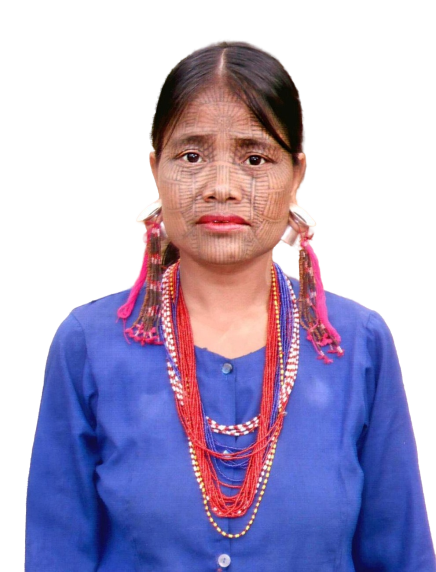 AungLaytu · CC BY-SA 4.0
| Where it goes | face |
|---|---|
| Stopped by | banned in the 1960s by Burma's Union Revolutionary Council; discouraged by Christian and Buddhist missionaries |
| Notes | Girls of fifteen to twenty. The design says which tribe, not which family. |
| Ink | Indigo |
| Years between | 1965–2026 (61) |
about 1,800 – 1,960 · Banned in the 1960s; the last tattooed women are elderly
21.5000, 93.6000 · OpenStreetMap
What it is
Women's faces, marked between fifteen and twenty, in a pattern that names the tribe: full-face, part-face, dots, lines, or both.
The long version
The designs differ by group and the differences are the point. M'kaan, Daai and Yin Du women are tattooed across the whole face; N'men and Matu women on certain parts of it; the Uppriu cover the face in dots; Ngagah mix vertical lines with dots; Daai set dots among vertical and horizontal lines on forehead and cheeks. Mro women wear small marks or stars on cheek, forehead or breast and tie them to fertility.
The explanation attached to the custom in almost every outside source is abduction: that a king took a beautiful Chin woman, that she disguised herself to get home, and that families marked their daughters so that no one would carry them off. The nineteenth-century British gazetteer repeats the abduction story and then adds that the anxiety "seems hardly justified by any beauty in the women themselves."
Inference — that sentence is worth leaving in. It is the clearest single demonstration on this site of what the colonial record is: the only written source for a great deal of this, and written by men who held the people they were describing in contempt. Read the fact, discount the frame.
Now
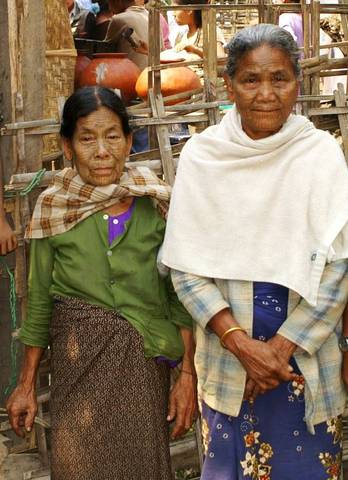
Banned in the 1960s and discouraged by missionaries before that, the practice ended inside one generation. The women who carry it are elderly, and they are photographed constantly by visitors to the Chin hills. Whether that is documentation or a trade in faces is not a question this site settles.
Notes
Northern and southern Chin groups differ; this record does not flatten sixty sub-groups into one design.
Connected to
- Htoe kwin The other Burmese tradition, and the one that was not banned.
- Who wrote it down The clearest case of the problem with the only sources there are.
- Derung face marks Another women's facial tattoo with an abduction story attached to it.
- Atayal ptasan And another, banned by another government in another decade.
Named here by
- Atayal ptasan Another face, another government, thirty years apart.
- Derung face marks The same story told about another set of women.
- The face grids The tradition it belongs to.
- The Chin ban What was banned.
- Who wrote it down Where the contempt is on the page.
Where each claim comes from
| Field | Tier | Source | Note |
|---|---|---|---|
| default | cited | Chin people — Wikipedia (en) | |
| text.story | cited | Gazetteer of Upper Burma and the Shan States, Part I Vol. I — scanned by the Internet Archive |
Sources
- Chin people — Wikipedia (en)
- Tattooing in Myanmar — Wikipedia (en)
- Gazetteer of Upper Burma and the Shan States — scanned by the Internet Archive
- Gazetteer of Upper Burma and the Shan States, Part I Vol. I — scanned by the Internet Archive
cited Cited — a named source, linked · harvested Harvested — fetched from an open dataset, with its licence · tradition Tradition — general knowledge of the tradition, hedged · inference Inference — this project's own reasoning from the above · field Field — someone stood there