traditionHtoe kwin
ထိုးကွင်း · Burmese
htó-kwìn — the pricked rings
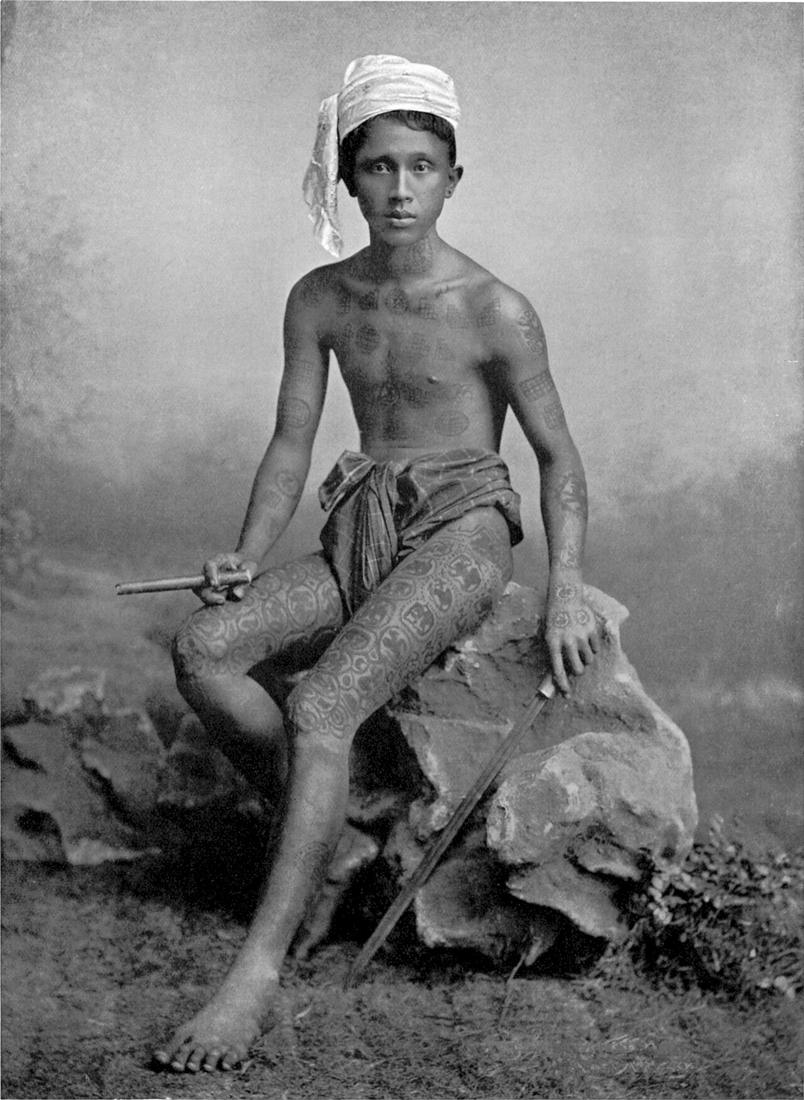 Philip Adolphe Klier · Public domain
| Where it goes | waist to knee, legs, knees, thighs |
|---|---|
| How long | three to six days for the whole; three or four figures at a sitting |
| Stopped by | no ban — colonial rule and town life, in Shway Yoe's own account and the Wikipedia summary of it |
| Notes | Boys of eight to fourteen, waist to just past the kneecap, in framed animals. |
| Tool | Hnitkwasok |
| Ink | Lampblack |
about 1,100 – 2,026 · Tang-dynasty notice of tattooed Pyu dancers; thinning after 1900, still done
21.9600, 96.0900 · OpenStreetMap
What it is
Every up-country Burmese man wore one: a sheet of dark-blue animals from the navel to below the knee, begun in boyhood.
The long version
Shway Yoe — the pen name of Sir James George Scott, who lived in Burma and wrote the fullest account of it in English — opens the chapter flatly: a Burmese youth counts his thigh tattooing as important as his entry into a monastery, and until it is done "there may be doubts as to his thorough manhood."
The finished work runs from a line level with the navel to just past the kneecap, and he reaches for a garment to describe it: not a marking of the skin so much as "a skin-tight pair of caleçons, fitting better than the best glove ever made." The figures are tigers, cats, monkeys, elephants, nats and bilus — each one framed in an oval of letters, each frame its own setting, the gaps filled with the same tracery.
The frame is the tell. The animals are not a scene; they are a repeating field of self-contained units, which is why the whole reads at a distance as cloth rather than as a picture.
Attested — a good saya carried a sample book of drawings so the boy could pick his patterns and their places before the opium went in. A tattoo studio's flash sheet, in Burma, in 1882.
Now
Lethwei fighters — Burmese bareknuckle boxers — carry the leg work as the sport's own mark, and the Wikipedia article on tattooing in Myanmar records fighters describing the sitting, up to 24 hours across both legs, as the thing to be endured without showing it. Outside the ring it is a thinning tradition rather than a general one.
Notes
Shway Yoe reports and then refuses a claim: that the custom began for a "shameful reason assigned by foreign writers." He does not repeat the reason and says no Burman believes it. This site does the same.
Connected to
- Sak kha lai The same garment of skin, one border east, and far less written down.
- Hnitkwasok The two-foot brass pricker that made it.
- Shan leg tattooing Who Shway Yoe says did the charm work, and did more of it.
- Shway Yoe Who wrote it down, and what that costs the record.
- The tattoo is clothing "A skin-tight pair of caleçons" — one of the three.
- Vermilion The other colour: charms, in red, which fade.
Named here by
- Chin facial tattooing The other Burmese tradition, and the one that was not banned.
- Sak kha lai The same garment of skin, one border west. The Burmese work is the better recorded of the two.
- Shan leg tattooing Who they learned it from, if Milne is right — and she hedges.
- The design block The sample book, 1882.
- Hnitkwasok What it makes.
- Lampblack What it drew.
- Cats and monkeys The tradition it belongs to.
- The framed animal The tradition it belongs to.
- Bearing it Where the opium comes in.
- When it is done Stacked with ordination.
- Saya Chein His work.
- Shway Yoe What he described.
- Mandalay The tradition.
- The tattoo is clothing Caleçons.
- The leg-tattoo zone The Burmese side.
- The sample book The work it was for.
Where each claim comes from
| Field | Tier | Source | Note |
|---|---|---|---|
| default | cited | The Burman: His Life and Notions — scanned by the Internet Archive | |
| text.today | cited | Tattooing in Myanmar — Wikipedia (en) | |
| text.story | cited | The Burman: His Life and Notions — scanned by the Internet Archive | |
| text_th | inference | written in Thai by this project, not machine-translated |
Sources
- The Burman: His Life and Notions — scanned by the Internet Archive
- Tattooing in Myanmar — Wikipedia (en)
- Gazetteer of Upper Burma and the Shan States, Part II — scanned by the Internet Archive
- Shans at Home — scanned by the Internet Archive
cited Cited — a named source, linked · harvested Harvested — fetched from an open dataset, with its licence · tradition Tradition — general knowledge of the tradition, hedged · inference Inference — this project's own reasoning from the above · field Field — someone stood there