traditionIrezumi
入れ墨 · Japanese
ire-zumi — inserting ink
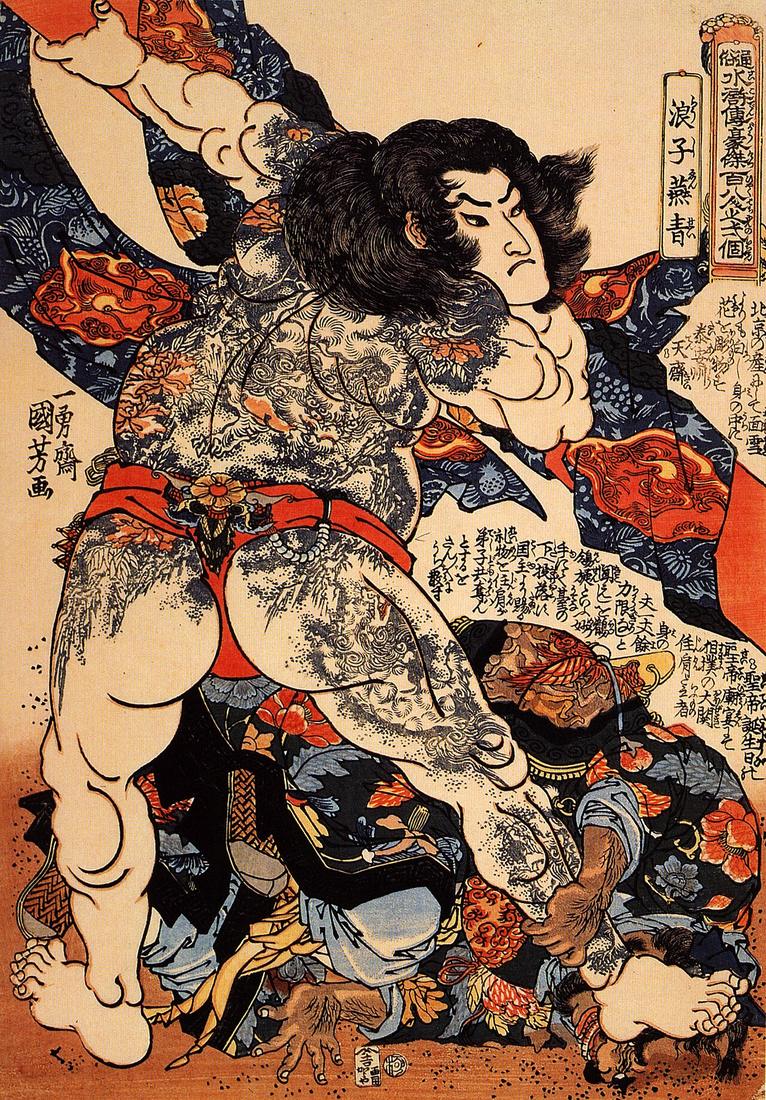 Utagawa Kuniyoshi · Public domain
| Where it goes | back, chest, arms, legs, whole body |
|---|---|
| How long | years of weekly sittings for a full suit |
| Stopped by | outlawed at the opening of the Meiji period; legalised by the occupation in 1948 |
| Notes | Needles bound to a wooden handle with silk thread, pushed by hand at an angle. |
| Tool | Nomi |
| Ink | Nara ink |
1,700 – 2,026 · Outlawed in the Meiji period, legalised in 1948, still marked as criminal
35.6800, 139.6900 · OpenStreetMap
What it is
Japan: needles bound with silk to a wooden rod, worked by hand — tebori, carving by hand — over years, in a design that covers the body like a garment.
The long version
The word says the method: irezumi, inserting ink. Nara ink goes grey-blue under the skin. A full back piece is not a session but a relationship, and the shape it takes — shoulders, chest panels, a gap down the sternum — is a suit of clothes that can be closed over.
The Meiji government outlawed it while courting foreign opinion, and foreigners promptly came to Japan to be tattooed. The occupation legalised it in 1948. Japanese law then held for decades that tattooing needed a medical licence, until a 2020 decision ended that. The criminal association it acquired under the ban has outlived the ban by seventy years.
Connected to
- Nomi The tool.
- Japan outlaws it The ban that made it criminal.
- Ainu anchi-piri The other tradition in the same islands, which the word also covers.
Named here by
- Ainu anchi-piri The other Japanese tradition, and the one the word usually means.
- Hajichi Banned by the same state, twenty-seven years apart.
- Nomi What it makes.
- Nara ink Where it goes.
- Japan outlaws it What was banned.
Where each claim comes from
| Field | Tier | Source | Note |
|---|---|---|---|
| default | cited | Irezumi — Wikipedia (en) | |
| text_th | inference | written in Thai by this project, not machine-translated |
Sources
cited Cited — a named source, linked · harvested Harvested — fetched from an open dataset, with its licence · tradition Tradition — general knowledge of the tradition, hedged · inference Inference — this project's own reasoning from the above · field Field — someone stood there