traditionSak kha lai
สักขาลาย · sak kha lai
ᩈᩢ᩠ᨠᨡᩣᩃᩣ᩠ᨿ · Northern Thai (Tai Tham script)
sàk khǎa laai — to tattoo the legs in patterns
 Takeaway · CC BY-SA 3.0
| Where it goes | waist to knee, waist to ankle, belly, back, arms, fingers |
|---|---|
| How long | days for one pattern; months or years for a whole body |
| Stopped by | nobody banned it — the volume this site quotes blames electric light and the end of the night courtship it lit up |
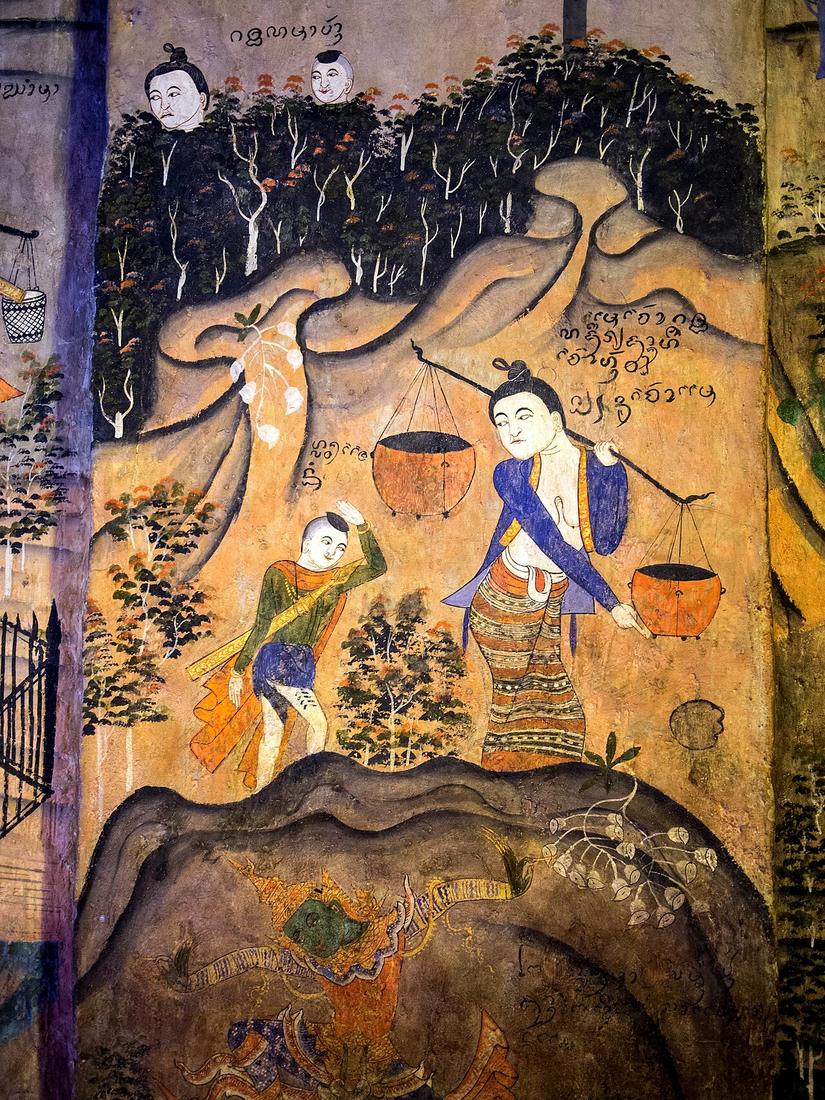
| Notes | Northern Thai men, waist to knee or waist to ankle, in patterns dense enough that a mural paints them as trousers. |
| Tool | Lek char |
| Ink | Lampblack |
about 1,500 – 1,930 · Mural evidence from the 1800s; gone within a generation of electric light
18.7900, 99.0000 · OpenStreetMap
What it is
The Lanna leg tattoo: waist to knee, sometimes to the ankle, dense enough that the murals paint it as a pair of black trousers.
The long version
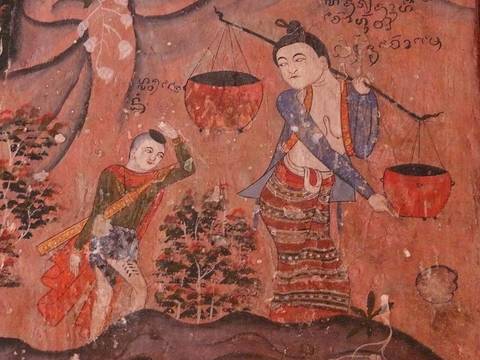
A Lanna volume held in the wichaa.net manuscript corpus puts it plainly: temple murals show northern Thai men tattooed จนดูเหมือนนุ่งกางเกงสีดำ — "until it looked as if they wore black trousers." Elders quoted in the same passage give the extent: the legs in patterns from the waist down to the ankles, the torso front and back, the arms, even the fingers; some as far as the neck and the crown of the head.
The enforcement was talk. A man who did not tattoo his legs and torso "would be gossiped about as being like a woman — lacking the endurance to bear the needle"; if he had no marks he might as well put on a sin, the woman's wrapped skirt. The work went to a master in the community and the fee had a Lanna name of its own, khan tang (ขันตั้ง), where central Thai says khan khru.
Inference — the tradition is described here in the past tense by its own inheritors, not by an outside authority, and nothing in the passage names a law. What it names is electric light: the old night courtship ended, the reason a young man needed to be looked at ended with it, and the marks went out of use within about a generation.
Now
Sak kha lai is not what a visitor to Chiang Mai is offered. What is offered is sak yant — the same needle, a different job. The leg tattoo covered a man; the yant marks him with a formula.
Notes
This site treats sak kha lai and sak yant as two traditions on one hand, not one tradition with two names. That separation is the client's correction, and it is the same separation the Burmese record makes between the thigh work and the charms.
Connected to
- Htoe kwin The same garment of skin, one border west. The Burmese work is the better recorded of the two.
- Shan leg tattooing And the same again to the north, where the tattooers of charms came from.
- Sak yant The other job the same needle does, and the one still being done.
- Khan tang The fee, in the Lanna word for it.
- The tattoo is clothing One of the three traditions whose own sources call the tattoo clothing.
- Lek char The instrument.
Named here by
- Htoe kwin The same garment of skin, one border east, and far less written down.
- Sak yant The other job of the same needle, and the one that stopped.
- Shan leg tattooing The same work on the Thai side of the line.
- Lek char What it made.
- Khan tang The tradition that names it this way.
- Chiang Mai What was ordinary here.
- Wat Phumin What it shows.
- The tattoo is clothing Black trousers.
- Who gets written about The tradition with no article at all.
- The leg-tattoo zone The Thai side.
- Stopped, and started again And the one with nobody left to ask.
- The murals What it shows.
- wichaa.net What the corpus was asked about.
- Who wrote it down And the counter-case.
Where each claim comes from
| Field | Tier | Source | Note |
|---|---|---|---|
| default | cited | อภิมหามนต์คาถา (Supreme Maha Mantra Katha), pp. 19–21 — held and digitised in the wichaa.net manuscript corpus, item 6968 | |
| text.story | cited | อภิมหามนต์คาถา (Supreme Maha Mantra Katha), pp. 19–21 — held and digitised in the wichaa.net manuscript corpus, item 6968 | |
| practice.suppressed_by | cited | อภิมหามนต์คาถา (Supreme Maha Mantra Katha), pp. 19–21 — held and digitised in the wichaa.net manuscript corpus, item 6968 | |
| text.notes | inference | this project's separation of the two traditions | |
| text_th | inference | written in Thai by this project, not machine-translated |
Sources
- อภิมหามนต์คาถา (Supreme Maha Mantra Katha), pp. 19–21 — held and digitised in the wichaa.net manuscript corpus, item 6968
- The wichaa.net manuscript corpus: 4,710 transcribed pages — wichaa.net
- ล้านนา — Wikipedia (th)
- Shans at Home — scanned by the Internet Archive
cited Cited — a named source, linked · harvested Harvested — fetched from an open dataset, with its licence · tradition Tradition — general knowledge of the tradition, hedged · inference Inference — this project's own reasoning from the above · field Field — someone stood there