traditionSak yant
สักยันต์ · sak yant
សាក់យ័ន្ត · Khmer
sàk yan — to prick a diagram
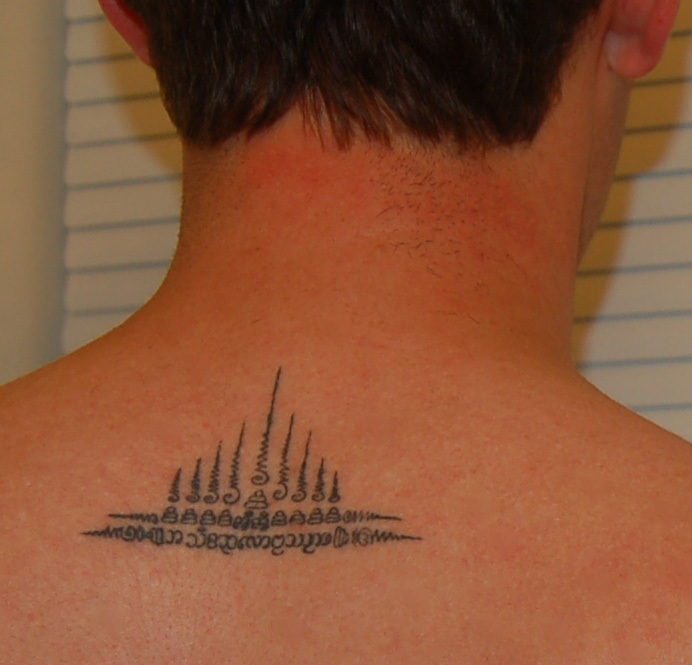 Mikhailovich · CC BY 3.0
| Where it goes | back, chest, arms, neck, legs |
|---|---|
| How long | one design in a sitting; an ajarn or a monk, not a shop |
| Notes | A formula in letters and figures, laid on the skin, held by rules the bearer keeps afterwards. |
| Tool | Khem sak |
| Ink | Lampblack |
about 1,400 – 2,026 · Living, and the one tradition on this site a visitor can walk into
14.5000, 100.6000 · OpenStreetMap
What it is
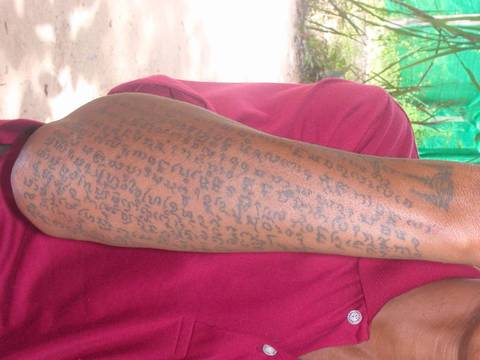
Letters, numbers and figures arranged into a diagram — yant — and pricked into skin with a long needle.
The long version
Sak is the verb: to prick. The Khmer root cɔkʔ means the same, and the Khmer dictionary keeps the word native rather than borrowed from Sanskrit. Yant is the diagram — the same word as Sanskrit yantra, the same family as the yantra drawn on cloth, on brass, on paper.
The Lanna volume explains why it moved to skin at all, and the reason is logistics: a yant on paper or metal is left at home. A yant on the body is carried. Everything else — which formula, which animal, which direction the letters run — follows from that one decision.
Two corrections this site carries, both from the client and both checkable. Most sak yant is not done at Wat Bang Phra. That temple is what the film crews know; the ordinary route is an ajarn or a monk near where you live. And Khom is not "what a yant is written in." Khom script is the central Thai convention. In the north the letters are northern Thai — tua mueang, the Tai Tham script — or Shan, or Tai Lue.
Now
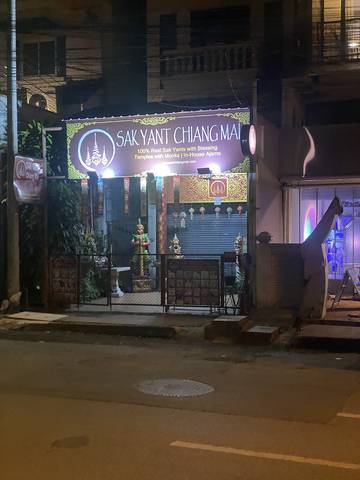
Chiang Mai has working masters, and one operation there publishes the lineage of every one of them — who taught whom, which temple, how many years in the robe and how many out. That published lineage is the closest thing this site has to a family tree for a living hand tradition.
Notes
The designs themselves are indexed on wichaa.net at /yant: 36 named designs across 63 plates, entered by what each one is for.
Connected to
- Sak kha lai The other job of the same needle, and the one that stopped.
- Khem sak The needle itself.
- Khan tang The fee, north and centre.
- The rules The rules that come with it, and what happens if they are broken.
- Sak Yant Chiang Mai The published lineage.
- Shan leg tattooing Where Shway Yoe says the charm specialists came from.
Named here by
- Sak kha lai The other job the same needle does, and the one still being done.
- Shan leg tattooing What the Shan specialists were carrying when they crossed.
- Khem sak What it makes.
- Hanuman The tradition it belongs to.
- The lettered square The tradition it belongs to.
- Khan tang And the living one that still collects it.
- The rules Where the rules attach.
- Ajarn Dang and Ajarn Sak The practice.
- Chiang Mai What is still done here.
- The stencil book The tradition.
- Sak Yant Chiang Mai The tradition.
Where each claim comes from
| Field | Tier | Source | Note |
|---|---|---|---|
| default | cited | Yantra tattooing — Wikipedia (en) | |
| text.story | cited | อภิมหามนต์คาถา (Supreme Maha Mantra Katha), pp. 19–21 — held and digitised in the wichaa.net manuscript corpus, item 6968 | |
| text.today | cited | Sak Yant Chiang Mai — the masters' profiles — sakyantchiangmai.com | |
| text_th | inference | written in Thai by this project, not machine-translated |
Sources
- Yantra tattooing — Wikipedia (en)
- อภิมหามนต์คาถา (Supreme Maha Mantra Katha), pp. 19–21 — held and digitised in the wichaa.net manuscript corpus, item 6968
- Sak Yant Chiang Mai — the masters' profiles — sakyantchiangmai.com
- การสักยันต์ — Wikipedia (th)
cited Cited — a named source, linked · harvested Harvested — fetched from an open dataset, with its licence · tradition Tradition — general knowledge of the tradition, hedged · inference Inference — this project's own reasoning from the above · field Field — someone stood there