traditionTā moko
tā moko · Māori
Carved with a chisel, leaving a groove rather than a smooth surface
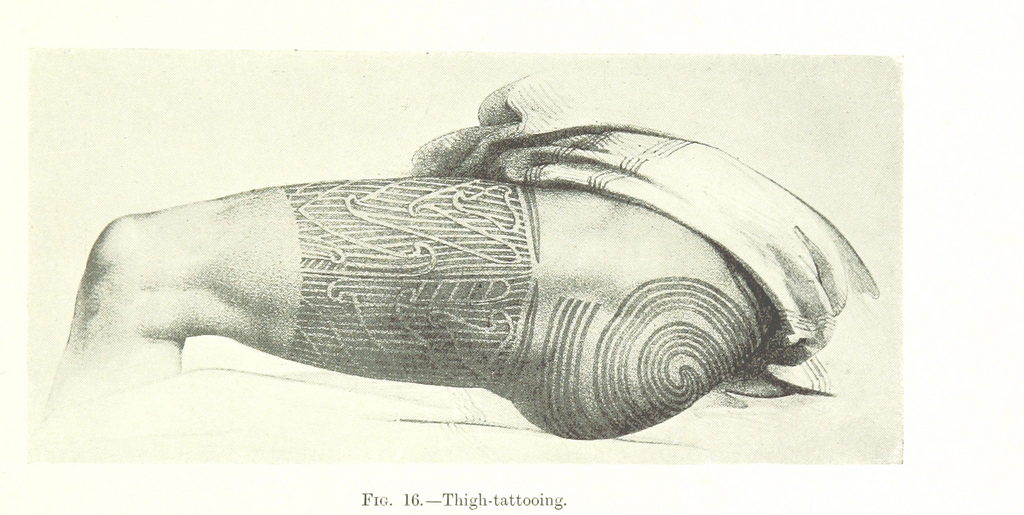 Unknown authorUnknown author · Public domain
| Where it goes | face, chin, thighs, buttocks |
|---|---|
| Stopped by | the Tohunga Suppression Act 1907, and the trade in tattooed heads before it |
| Notes | An albatross-bone chisel struck with a mallet; the skin is grooved, not punctured. |
| Tool | Uhi |
| Ink | Awheto and ngarehu |
| Years between | 1907–1990 (83) |
about 1,500 – 2,026 · Men's moko stopped about 1860; women's continued; revived from 1990
-38.5000, 176.0000 · OpenStreetMap
What it is
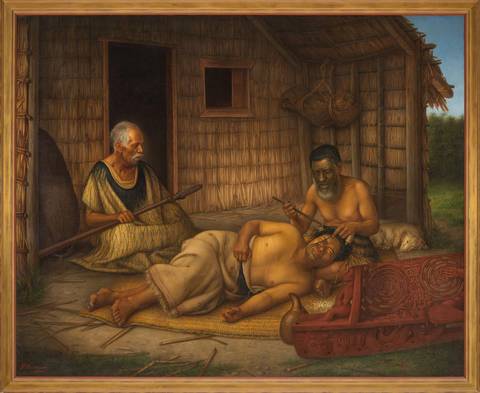
New Zealand: albatross-bone chisels struck with a mallet, cutting a groove that stays visible as texture, not only as colour.
The long version
Tā moko is not a puncture. The uhi — a hafted chisel of albatross bone — is struck, and the skin keeps the furrow. That is why a moko reads in raking light and why a photograph flattens it.
Pigment: awheto, a caterpillar fungus, for the body; ngarehu, burnt timber, for the darker face colour; soot from burnt kauri gum mixed with fat. It was kept in carved vessels called oko which were buried between uses and handed down.
Steel needles arrived with Europeans and were faster and safer, and the groove went. Men's moko had largely stopped by the 1860s; women kept receiving moko kauae into the twentieth century, and Michael King interviewed more than seventy women in the early 1970s who had been marked before the Tohunga Suppression Act of 1907. Since 1990 the practice has come back, machine mostly, chisel too, with women among the practitioners — and a Māori foreign minister and a prime-time news anchor wearing moko kauae on the country's screens.
Connected to
- Uhi The chisel.
- Cut The method.
- Tatau The neighbouring Pacific tradition that taps instead of cutting.
Named here by
- Cut The tradition built on it.
- Uhi What it makes.
- Awheto and ngarehu Where it goes.
- Moko kauae The tradition it belongs to.
- The Tohunga Suppression Act What it caught.
Where each claim comes from
| Field | Tier | Source | Note |
|---|---|---|---|
| default | cited | Tā moko — Wikipedia (en) | |
| text_th | inference | written in Thai by this project, not machine-translated |
Sources
- Tā moko — Wikipedia (en)
- Māori people — Wikipedia (en)
cited Cited — a named source, linked · harvested Harvested — fetched from an open dataset, with its licence · tradition Tradition — general knowledge of the tradition, hedged · inference Inference — this project's own reasoning from the above · field Field — someone stood there