traditionTatau
tatau · Samoan
The word English borrowed, by way of Cook's crew
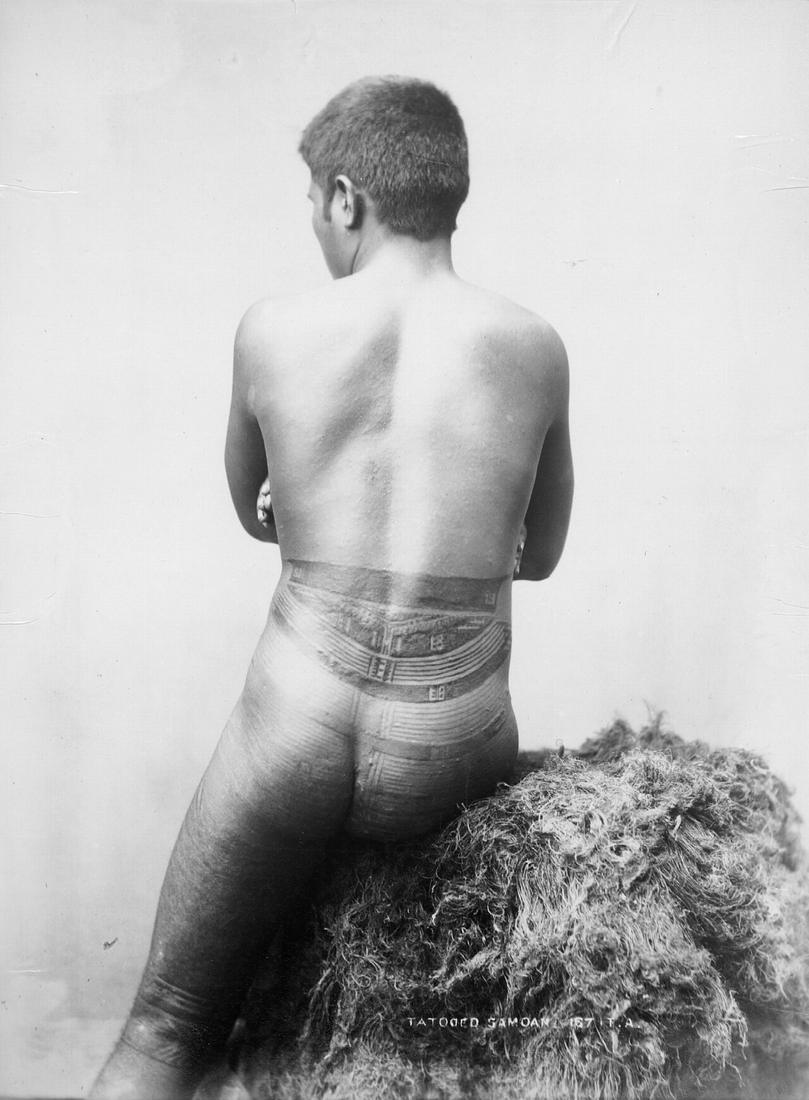 Thomas Andrew (1855 - 1939) · Public domain
| Where it goes | waist to knee, back, thighs |
|---|---|
| How long | days, in several sittings, with assistants stretching the skin |
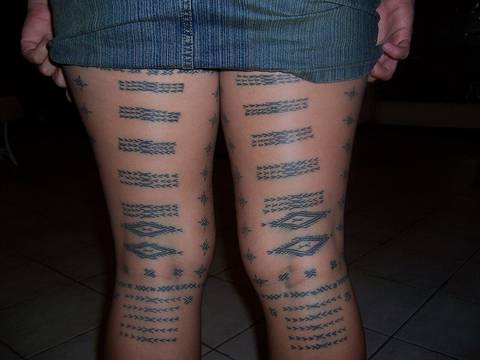
| Notes | The pe'a covers a man from mid-back to the knees; the malu is the women's. |
| Tool | Au |
| Ink | Soot and water |
about 1,000 BCE – 2,026 · Unbroken: the two tufuga families hold the titles still
-13.8000, -172.1000 · OpenStreetMap
What it is
Samoa: a comb of bone and turtle shell, struck with a mallet, covering a man from the middle of the back to the knees.
The long version
The English word tattoo comes from this word. The tufuga tā tatau works with two assistants, the 'au toso, who stretch the skin and wipe; the titles are hereditary in two families, the Sa Su'a of Savai'i and the Sa Tulou'ena of Upolu, and Samoan masters tattooed Tongan and Fijian chiefly families too.
The clothing logic is explicit here as well: an untattooed Samoan man is telefua or telenoa — naked. A man who starts the pe'a and cannot finish carries pe'a mutu, an unfinished tattoo, and that is a mark of shame that the finished work is designed to prevent.
Samoa credits Fiji with the origin, in a song about twin sisters who swam across with a basket of tools, singing that only women should be tattooed — and arrived singing the opposite.
Connected to
- Au The comb.
- Veiqia Fiji, where Samoa says it came from — and where only women were marked.
- The tattoo is clothing An untattooed man is called naked. In the language, not in a metaphor.
- How the word got in How the word got into English.
Named here by
- Tā moko The neighbouring Pacific tradition that taps instead of cutting.
- Veiqia Where Samoa says the tools came from.
- Au What it makes.
- Bearing it And where stopping has a name.
- Who holds you still Where the assistants have a title.
- The Sulu'ape line The practice.
- The tattoo is clothing Naked, in the ordinary word.
- How the word got in The word.
Where each claim comes from
| Field | Tier | Source | Note |
|---|---|---|---|
| default | cited | Peʻa — Wikipedia (en) | |
| text_th | inference | written in Thai by this project, not machine-translated |
Sources
- Peʻa — Wikipedia (en)
- Samoa, a Hundred Years Ago — scanned by the Internet Archive
cited Cited — a named source, linked · harvested Harvested — fetched from an open dataset, with its licence · tradition Tradition — general knowledge of the tradition, hedged · inference Inference — this project's own reasoning from the above · field Field — someone stood there