The Bayeux Tapestry, Unrolled EN | ไทย

พรมผนังบาเยอ · 1066 · 68.58 m

The Bayeux Tapestry, Unrolled

Wool stitched on linen, nearly seventy metres long, telling how William of Normandy took England in 1066. All of it, end to end, and everywhere it has been since.

Every scene, and everywhere it has been
nanobotco.github.io/bayeux-tapestry

Drag the strip. 2017 photographs by the Université de Caen and CNRS, public domain, laid end to end.

Drag, slide, or tap a scene

Every scene

The numbers on the strip's top edge were written on the backing cloth around 1800. The Latin is what the needle says; the line under it, what it means.

–0 m · Metres along

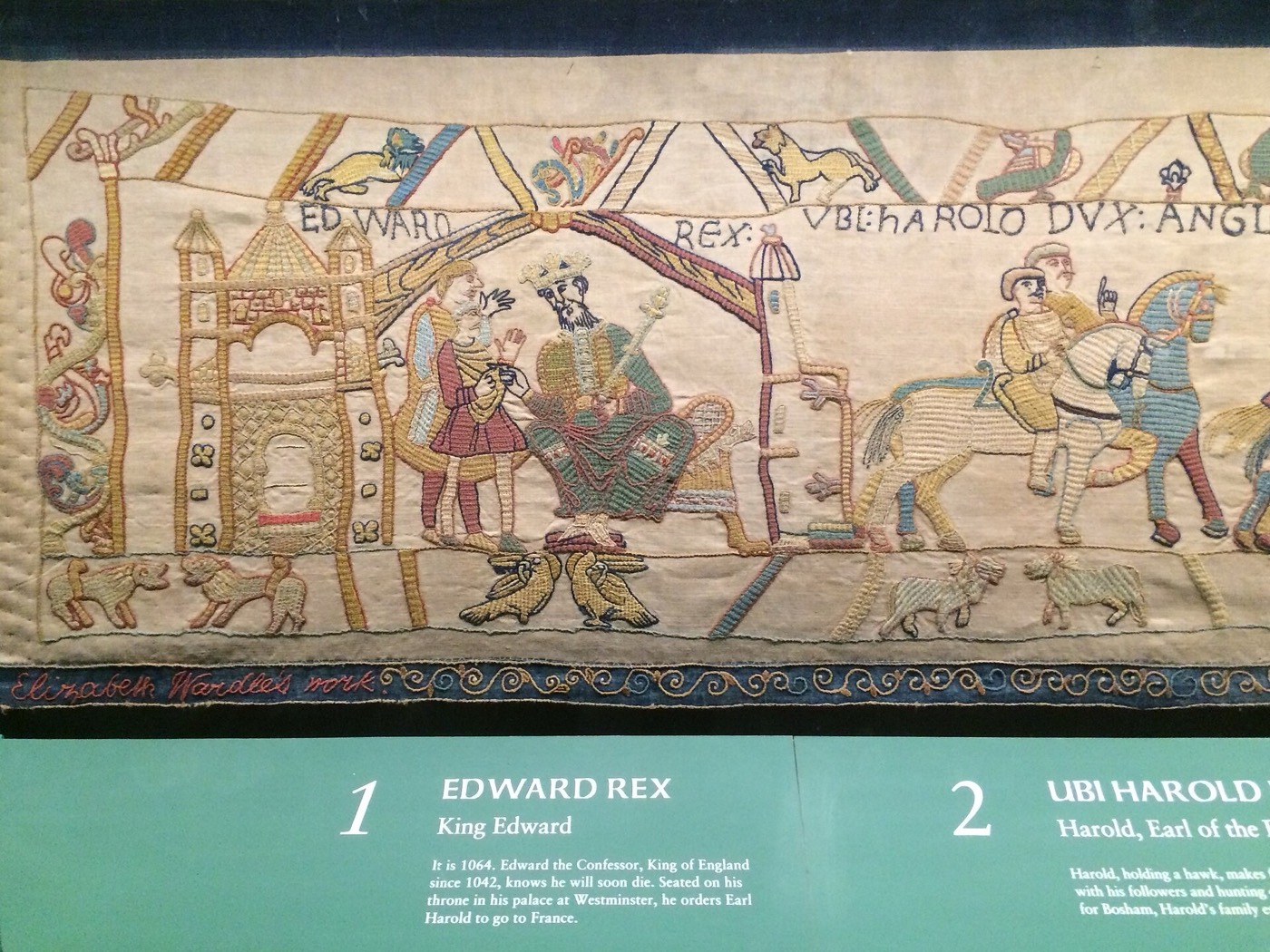
  1. 1EDWARD REXKing Edward the Confessor on his throne. The name EDWARD was stitched in by later restorers.
  2. 2UBI HAROLD DUX ANGLORUM ET SUI MILITES EQUITANT AD BOSHAMHarold, an English earl, rides with his men to Bosham, a hawk on his wrist and hounds running ahead.
  3. 3ECCLESIAThey stop to pray at Bosham church.
  4. 4HIC HAROLD MARE NAVIGAVITA feast upstairs, then Harold wades out to his ship and sails.
  5. 5ET VELIS VENTO PLENIS VENIT IN TERRA WIDONIS COMITISSails full of wind, he comes to the land of Count Guy of Ponthieu.
  6. 6HAROLDHarold steps ashore.
  7. 7HIC APPREHENDIT WIDO HAROLDUMGuy seizes Harold.
  8. 8ET DUXIT EUM AD BELREM ET IBI EUM TENUITAnd takes him to Beaurain and holds him there.
  9. 9UBI HAROLD ET WIDO PARABOLANTHarold and Guy talk.
  10. 10UBI NUNTII WILLELMI DUCIS VENERUNT AD WIDONEM · TUROLDDuke William's messengers reach Guy. The small man holding the horses has his name stitched beside him: Turold.
  11. 11NUNTII WILLELMIWilliam's messengers ride hard.
  12. 12HIC VENIT NUNTIUS AD WILGELMUM DUCEMA messenger comes to Duke William.
  13. 13HIC WIDO ADDUXIT HAROLDUM AD WILGELMUM NORMANNORUM DUCEMGuy hands Harold over to William, Duke of the Normans.
  14. 14HIC DUX WILGELMUS CUM HAROLDO VENIT AD PALATIUM SUUMWilliam brings Harold to his palace.
  15. 15UBI UNUS CLERICUS ET ÆLFGYVAA priest and a woman named Ælfgyva. The sentence has no verb, and nobody knows what this scene is about.
  16. 16HIC WILLELMUS DUX ET EXERCITUS EIUS VENERUNT AD MONTEM MICHAELISWilliam and his army reach Mont-Saint-Michel.
  17. 17ET HIC TRANSIERUNT FLUMEN COSNONIS · HIC HAROLD DUX TRAHEBAT EOS DE ARENAThey cross the River Couesnon, and Harold pulls men out of the quicksand.
  18. 18ET VENERUNT AD DOL ET CONAN FUGA VERTIT · REDNESThey reach Dol. Duke Conan of Brittany escapes down a rope. Then Rennes.
  19. 19HIC MILITES WILLELMI DUCIS PUGNANT CONTRA DINANTESWilliam's knights attack Dinan and set it alight.
  20. 20ET CUNAN CLAVES PORREXITConan hands over the keys of the town on the tip of a lance.
  21. 21HIC WILLELMUS DEDIT ARMA HAROLDOWilliam gives Harold arms: he makes him his knight.
  22. 22HIE WILLELMUS VENIT BAGIASWilliam comes to Bayeux. HIE is a slip of the needle for HIC, 'here'.
  23. 23UBI HAROLD SACRAMENTUM FECIT WILLELMO DUCIHarold swears an oath to William, his hands on two boxes of saints' relics.
  24. 24HIC HAROLD DUX REVERSUS EST AD ANGLICAM TERRAMHarold sails home to England.
  25. 25ET VENIT AD EDWARDUM REGEMAnd comes before King Edward, head bowed.
  26. 26HIC PORTATUR CORPUS EADWARDI REGIS AD ECCLESIAM SANCTI PETRI APOSTOLIKing Edward's body is carried to the church of St Peter, Westminster Abbey. A man fixes the weathercock on the roof.
  27. 27HIC EADWARDUS REX IN LECTO ALLOQUITUR FIDELESEdward, in bed, speaks to his faithful men. The story runs backwards here: the funeral came first.
  28. 28ET HIC DEFUNCTUS ESTAnd here he dies: 5 January 1066.
  29. 29HIC DEDERUNT HAROLDO CORONAM REGISThey give Harold the king's crown.
  30. 30HIC RESIDET HAROLD REX ANGLORUMHere sits Harold, King of the English.
  31. 31STIGANT ARCHIEPISCOPUSArchbishop Stigand.
  32. 32ISTI MIRANT STELLAMThese men marvel at the star: Halley's Comet, spring 1066.
  33. 33HAROLDHarold hears the news. In the border below him, ghostly ships.
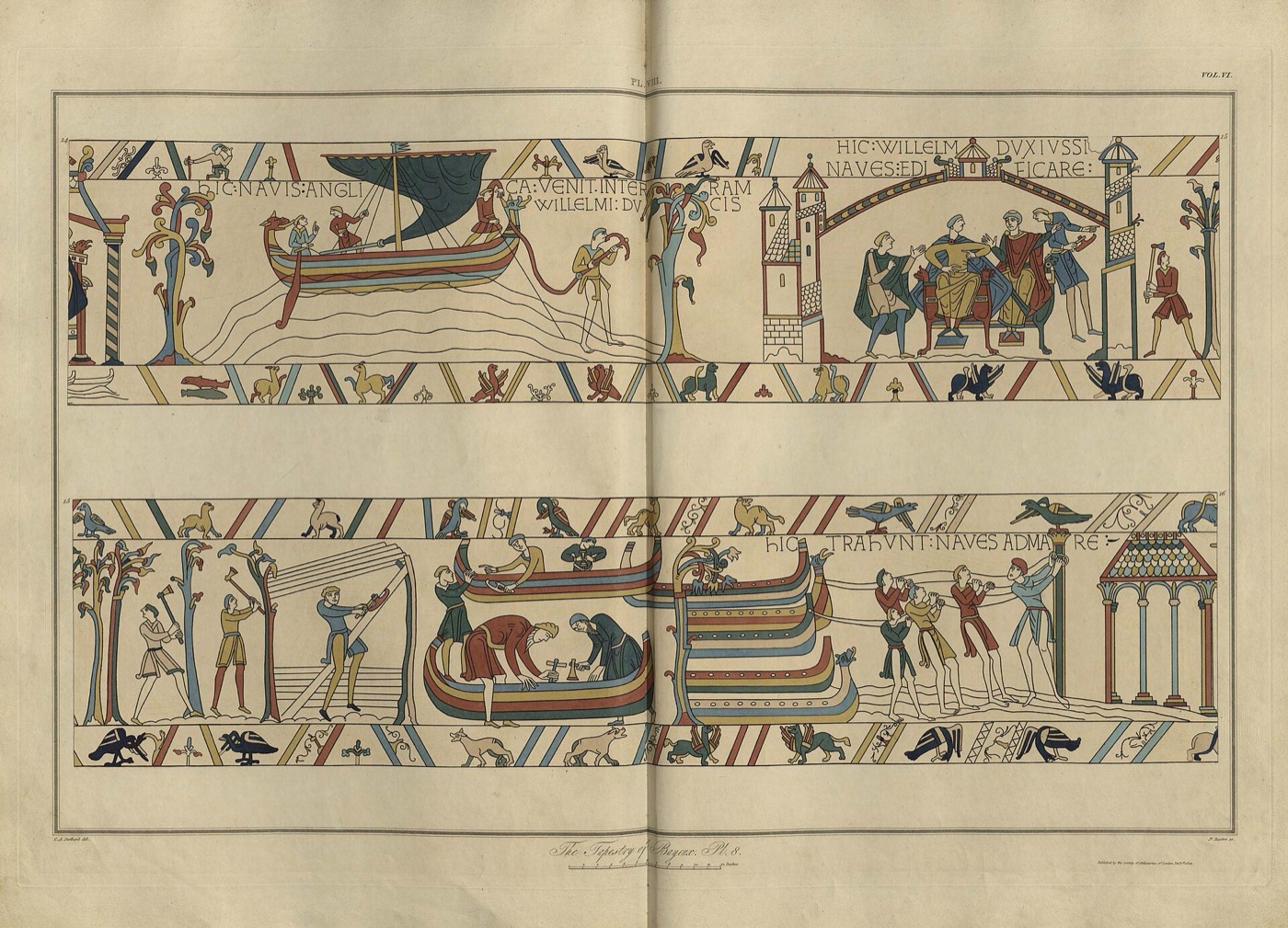
  34. 34HIC NAVIS ANGLICA VENIT IN TERRAM WILLELMI DUCISAn English ship comes to William's land.
  35. 35HIC WILLELMUS DUX IUSSIT NAVES AEDIFICAREWilliam orders ships built. Trees come down, planks are shaped.
  36. 36HIC TRAHUNT NAVES AD MAREThey drag the ships to the sea.
  37. 37ISTI PORTANT ARMAS AD NAVES ET HIC TRAHUNT CARRUM CUM VINO ET ARMISMen carry mail shirts, swords and helmets to the ships, and pull a cart of wine and weapons.
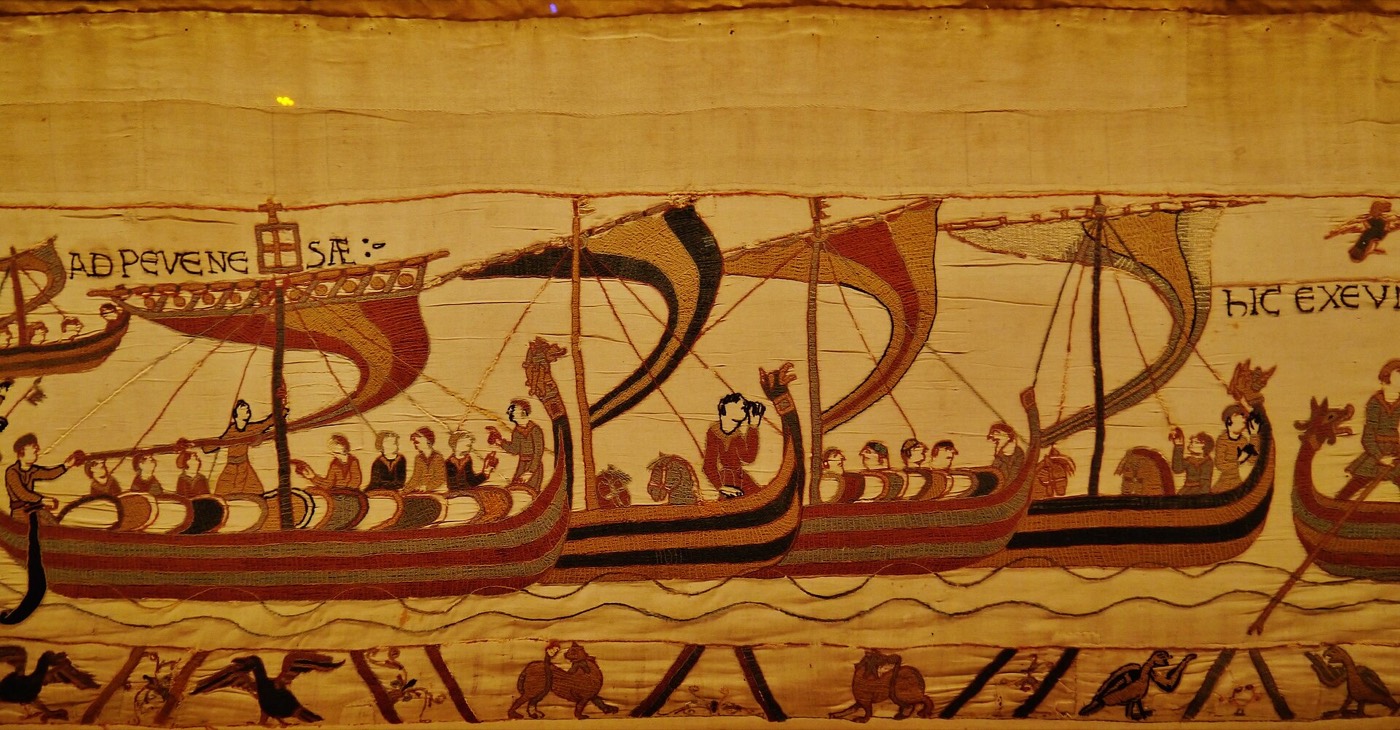
  38. 38HIC WILLELMUS DUX IN MAGNO NAVIGIO MARE TRANSIVIT ET VENIT AD PEVENESAEWilliam crosses the sea in a great ship and lands at Pevensey. The horses come in the boats too.
  39. 39HIC EXEUNT CABALLI DE NAVIBUSThe horses step off the ships.
  40. 40ET HIC MILITES FESTINAVERUNT HESTINGA UT CIBUM RAPERENTURKnights hurry to Hastings to seize food.
  41. 41HIC EST WADARDThis is Wadard, one of Bishop Odo's men.
  42. 42HIC COQUITUR CARO ET HIC MINISTRAVERUNT MINISTRIMeat is cooked, and servants serve it.
  43. 43HIC FECERUNT PRANDIUM · ET HIC EPISCOPUS CIBUM ET POTUM BENEDICITThey feast, and the bishop blesses the food and drink.
  44. 44ODO EPISCOPUS · WILLELMUS · ROTBERTBishop Odo, William, Robert: the duke between his two half-brothers.
  45. 45ISTE IUSSIT UT FODERETUR CASTELLUM AT HESTENGA CEASTRAHe orders a castle mound dug at Hastings camp. CEASTRA is an English word, one clue the makers were English.
  46. 46HIC NUNTIATUM EST WILLELMO DE HAROLDOWilliam gets news of Harold.
  47. 47HIC DOMUS INCENDITURA house is set on fire. A woman leads a child out.
  48. 48HIC MILITES EXIERUNT DE HESTENGA ET VENERUNT AD PROELIUM CONTRA HAROLDUM REGEMThe knights leave Hastings and ride to battle against King Harold.
  49. 49HIC WILLELMUS DUX INTERROGAT VITALEM SI VIDISSET HAROLDI EXERCITUMWilliam asks Vital if he has seen Harold's army.
  50. 50ISTE NUNTIAT HAROLDUM REGEM DE EXERCITU WILLELMI DUCISA scout tells King Harold about William's army.
  51. 51HIC WILLELMUS DUX ALLOQUITUR SUIS MILITIBUS UT PREPARARENT SE VIRILITER ET SAPIENTER AD PROELIUM CONTRA ANGLORUM EXERCITUMWilliam tells his knights to get ready, bravely and wisely, for battle with the English army. 14 October 1066.
  52. 52HIC CECIDERUNT LEWINE ET GYRÐ FRATRES HAROLDI REGISLeofwine and Gyrth, King Harold's brothers, fall.
  53. 53HIC CECIDERUNT SIMUL ANGLI ET FRANCI IN PROELIOEnglish and French fall together in the battle. Horses tumble at a ditch.
  54. 54HIC ODO EPISCOPUS BACULUM TENENS CONFORTAT PUEROSBishop Odo, holding a club, rallies the young men.
  55. 55HIC EST WILLELMUS DUXHere is Duke William. He lifts his helmet to show his men he is alive.
  56. 56EUSTATIUS · HIC FRANCI PUGNANT ET CECIDERUNT QUI ERANT CUM HAROLDOEustace of Boulogne. The French fight on and Harold's men fall. In the lower border, looters strip the dead.
  57. 57HIC HAROLD REX INTERFECTUS ESTKing Harold is killed. Is he the man with the arrow by his eye, or the man cut down by a rider? Historians still argue; perhaps both.
  58. 58ET FUGA VERTERUNT ANGLIAnd the English turn and run. These words were stitched in shortly before 1814; the first ending is lost.

1064–1066

The story

Four people carry it. Edward the Confessor, King of England, old and without a son. Harold Godwinson, the most powerful earl in England. William, Duke of Normandy, across the Channel. And Odo, William's half-brother, Bishop of Bayeux, who most likely paid for the tapestry.

Harold sails to France, is captured, and is handed to William. He fights beside William in Brittany and swears an oath on holy relics. Back home, Edward dies, and Harold takes the crown. A comet appears. William builds a fleet, crosses the sea, and on 14 October 1066 beats Harold's army near Hastings. Harold dies on the field.

The tapestry tells it from the Norman side: Harold broke his oath. But English hands stitched it, and they left Harold brave, rescuing soldiers from quicksand. The end is missing. It probably finished with William crowned in Westminster Abbey on Christmas Day 1066.

Step–
Wool on the front–
Tie stitches–

Wool on linen

Not a tapestry

A tapestry is woven: the picture is built into the cloth on a loom. This one is embroidered: the cloth came first, nine pieces of plain linen sewn into one long band, and the picture was stitched on top in wool. The French call it a tapisserie, and English has followed.

Most of it uses one method, now often called Bayeux stitch. The stitcher lays long threads across a shape, side by side. Then she lays a few threads the other way, over the top, and ties those down with tiny stitches. Almost all the wool stays on the front; very little goes to waste on the back. Outlines and letters are in stem stitch: short stitches, each overlapping the last.

Press the steps to stitch a Norman kite shield.

Ten colours of natural-dyed wool, mostly reds, yellows, greens and blues. A 2022 scan measured 215 shades among them, from fading and repairs.

ISTI MIRANT STELLAM

The star

In spring 1066, a few months after Harold was crowned, a long-tailed star hung in the sky. Scene 32 shows men pointing up at it. People across Europe read it as a sign.

We call it Halley's Comet. It swings out past Neptune and back about every 76 years, the gap changing a little each time as the planets pull on it. Since 1066 it has come back twelve times. The last was 1986; the next, 2061.

The drawing solves Kepler's equation for the comet and puts the Earth on its circle. Distances from the Sun are squeezed by a square root so both fit.

Year1066
From Earth–
From the Sun–
Returns since 10660
Next close to the Sun–

Orbit shape from today's elements (JPL), so positions in 1066 are approximate; this drawing puts the comet about 0.14 AU from Earth in early May 1066. 1 AU is the Earth–Sun distance, about 150 million km.

68.58 m × 50 cm

How long

The nine linen pieces add up to 68.58 m; other measurements give 68.38. The embroidered band is about 50 cm tall. Here it is against a football pitch, and against Chiang Mai's red songthaews parked nose to tail.

Counted

58scenes
623–626people (two counts)
202horses and mules
55dogs
41ships and boats
37buildings
49trees
9pieces of linen
10colours of wool
2,226letters and signs in the captions

950 years, five places

Where it has been

Almost all its life it has stayed in one small Norman town. Before 2026 it had never left France. Tap a row to see it on the map.

  1. c. 1070sCanterburyMade in England, most likely at Canterbury, probably for Bishop Odo of Bayeux, William's half-brother. The place comes from the style and the spelling; nobody wrote it down.
  2. 14 Jul 1077?BayeuxBayeux Cathedral is consecrated. The tapestry may have hung there for the first time that day. No record says so.
  3. 1476BayeuxFirst written record. The cathedral's inventory lists a very long, narrow hanging, embroidered with the conquest, hung around the nave for the Feast of Relics and the week after. The rest of the year it lay in a chest.
  4. 1562BayeuxHuguenots sack the cathedral. The clergy had already hidden the tapestry.
  5. 1728–1730BayeuxBernard de Montfaucon tracks it down. Antoine Benoît draws it in the cathedral, and Paris sees it in print for the first time.
  6. 1792BayeuxThe Revolution. Soldiers leaving Bayeux want it as a cover for a wagon. A local lawyer, Léonard Lambert-Leforestier, stops them and keeps it safe.
  7. 1794BayeuxNearly cut into strips to trim a float for a town festival. The district arts commission takes it into the nation's care.
  8. Dec 1803 – Feb 1804Paris · LouvreNapoleon has it shown in the Apollo Gallery of the Louvre, then called the Musée Napoléon, while he plans to invade England.
  9. 1804BayeuxBack to Bayeux. (One source says 1805.)
  10. 1812–1842BayeuxKept in the town hall, wound on two rollers. A keeper cranked it past visitors scene by scene, which wore out the start.
  11. 1816–1818BayeuxCharles Stothard draws every scene for the Society of Antiquaries of London. A small piece of it leaves with him.
  12. 1842BayeuxFirst permanent display, under glass, in the town's public library.
  13. 1870–1871BayeuxHidden during the Franco-Prussian War.
  14. 1872BayeuxStothard's piece comes back from the South Kensington Museum in London. That autumn Edward Dossetter photographs the whole length on more than 180 glass plates.
  15. Apr 1913BayeuxIts own museum opens, in the Hôtel du Doyen, the old deanery beside the cathedral.
  16. Sep 1939BayeuxRolled up and put in a concrete shelter under the deanery.
  17. Jun 1941BayeuxResearchers from the SS Ahnenerbe study and copy it. Karl Schlabow cuts small samples of the linen. Germany gave two of them back to Bayeux on 14 January 2026.
  18. Aug 1941 – Jun 1944Château de SourchesStored at the Château de Sourches in the Sarthe, with the treasures of France's national museums.
  19. 26 Jun 1944Paris · LouvreThree weeks after D-Day, the Germans send it to the Louvre.
  20. Aug 1944Paris · LouvreHimmler orders it moved somewhere safe. SS men come for it on 21 or 22 August, find the Louvre in Resistance hands, and leave without it.
  21. 10 Nov – 15 Dec 1944Paris · LouvreShown at the Louvre after the Liberation, hung on a 70-metre rail.
  22. Mar 1945BayeuxHome to Bayeux. Back on show at the deanery that October; a new display opens on 6 June 1948.
  23. 1953, 1966BayeuxLondon asks to borrow it, for the coronation and then for the 900th anniversary of Hastings. Both requests fail; it stays in Bayeux.
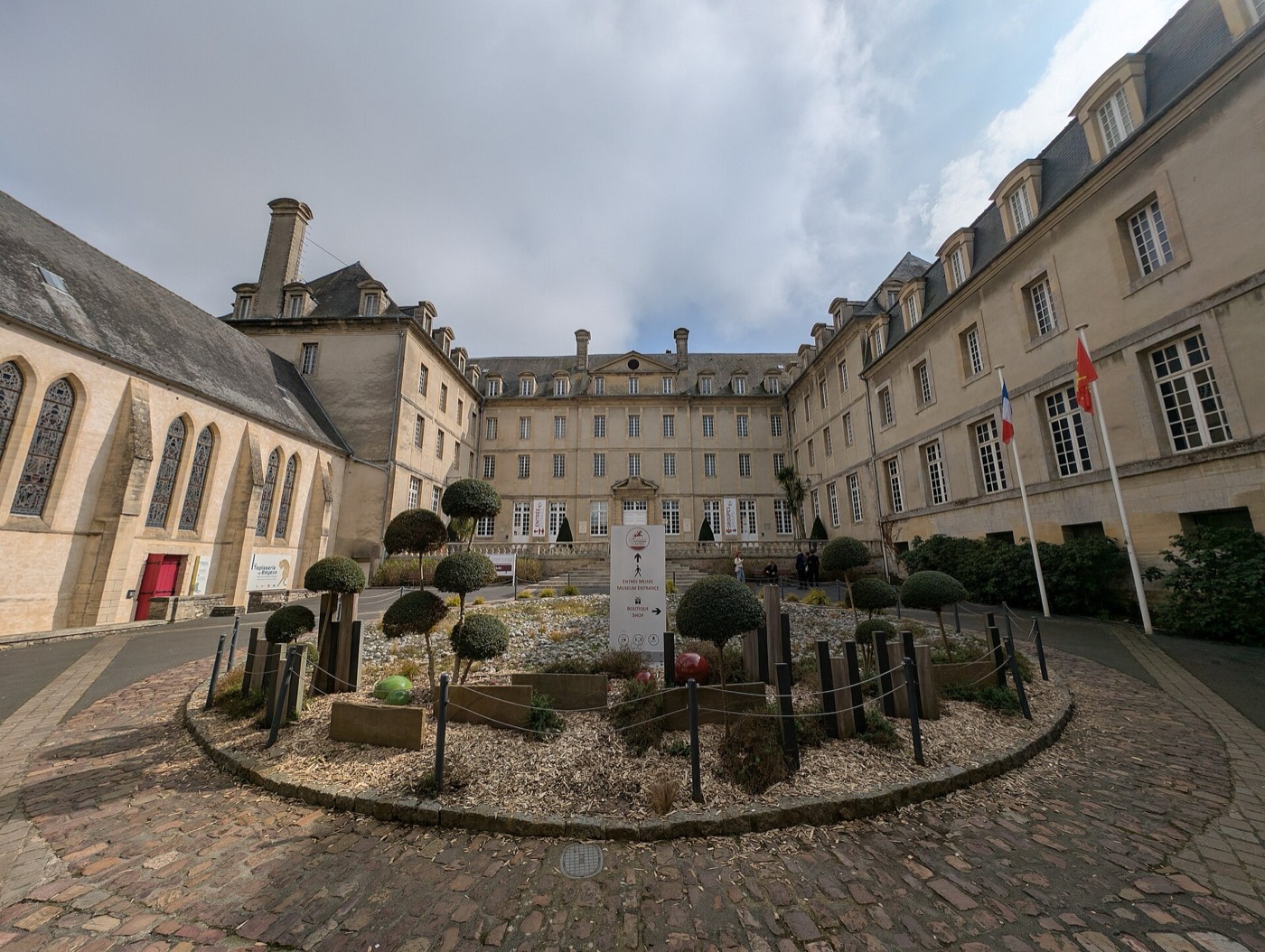
  24. Mar 1983BayeuxMoves to the Centre Guillaume-le-Conquérant, a former seminary on rue de Nesmond, into a horseshoe-shaped gallery.
  25. 2018–2021BayeuxPresident Macron offers Britain a loan. A survey counts 24,204 stains, 9,646 holes and 30 tears, and the plan waits.
  26. Sep 2025BayeuxThe museum closes for rebuilding. On 19 September the tapestry comes down for the first time since 1983: 7 hours 15 minutes, more than 90 people.
  27. 9–10 Jul 2026London · British MuseumTo London by lorry through the Channel Tunnel, folded on a padded screen inside a crate on springs, with a police escort from Folkestone. About 11 hours; it arrives at 2:50 a.m.
  28. 10 Sep 2026 – 11 Jul 2027London · British MuseumOn show at the British Museum, Room 30, lying flat under glass. France reported two broken threads after the trip.
  29. Oct 2027BayeuxDue back in Bayeux, in a new museum in the old seminary, for William's thousandth birthday.

Named in the record

Who came to see it

These are people a source names as seeing the tapestry itself. Being in Bayeux is not enough: on 14 June 1944 de Gaulle spoke in the town while the tapestry sat at Sourches, about 140 km away.

2026, British Museum

King Charles III

พระเจ้าชาลส์ที่ 3

King of the United Kingdom · British Museum, 2 Sep 2026

Walked the whole length with the curators and showed President Macron his favourite scene, the Norman cart of wine. In his speech he joked it might have been called the Canterbury Embroidery.

Source

Queen Camilla

สมเด็จพระราชินีคามิลลา

Queen · British Museum, 2 Sep 2026

On the same private tour.

Source

Emmanuel Macron

เอมานุแอล มาครง

President of France · British Museum, 2 Sep 2026

Opened the exhibition. He noted Britain first asked in 1931, so a loan agreed in eight years was quick by comparison.

Source

Brigitte Macron

บรีฌิต มาครง

Wife of the French president · British Museum, 2 Sep 2026

On the tour.

Source

Andy Burnham

แอนดี เบิร์นแฮม

Prime Minister of the United Kingdom · British Museum, 2 Sep 2026

Thanked Macron for a 70-metre reminder of Britain's biggest defeat.

Source

Marie-France van Heel

มารี-ฟรองซ์ ฟาน เฮล

Wife of the prime minister · British Museum, 2 Sep 2026

On the tour.

Source

George Osborne · Nicholas Cullinan

จอร์จ ออสบอร์น · นิโคลัส คัลลิแนน

British Museum chair and director · British Museum, 2 Sep 2026

Led the tour.

Source

Catherine Pégard

กาตรีน เปการ์

French culture minister · British Museum, 17 Jul 2026

Watched it unrolled after the crossing and said it had arrived in excellent condition.

Source

Before

Antoine Benoît

อองตวน เบอนัว

Draughtsman · Bayeux Cathedral, c. 1729

Drew it for Montfaucon's book, the first full picture of it in print.

Source

Léonard Lambert-Leforestier

เลโอนาร์ ล็องแบร์-เลอฟอเรสติเย

Bayeux lawyer · Bayeux, 1792

Stopped soldiers using it as a wagon cover.

Source

Napoleon Bonaparte · Vivant Denon

นโปเลียน โบนาปาร์ต · วีว็อง เดอนง

First Consul · director of the Louvre · Louvre, 1803–1804

Denon put it on show and wrote that the First Consul looked at it with great interest.

Source

Charles and Anna Eliza Stothard

ชาลส์ และแอนนา อีไลซา สต็อตทาร์ด

Draughtsman · writer · Bayeux, 1816–1818

He drew every scene for the Society of Antiquaries. Years later she was accused of taking a piece, and cleared in The Times.

Source

Thomas Frognall Dibdin

ทอมัส ฟร็อกนอล ดิบดิน

Book collector, writer · Bayeux town hall, 1818

Watched the keeper unroll it, and wrote of the worn first scenes and faded colours.

Source

Edward Dossetter

เอ็ดเวิร์ด ดอสเซตเตอร์

Photographer · Bayeux, 1872

Photographed it end to end for London's Science and Art Department.

Source

Elizabeth and Thomas Wardle

เอลิซาเบธ และทอมัส วอร์เดิล

Embroiderer · silk dyer · Bayeux, 1885

After seeing it, she and about 35 members of the Leek Embroidery Society and others stitched a full-size copy, finished in 1886 and now in Reading.

Source

Herbert Jankuhn · Karl Schlabow · Herbert Jeschke

แฮร์แบร์ท ยังคูน · คาร์ล ชลาโบว · แฮร์แบร์ท เยชเคอ

SS Ahnenerbe researchers · Bayeux, June 1941

Studied, measured and copied it. Schlabow took samples of the linen.

Source

Jacques Jaujard

ฌัก โฌฌาร์

Director of France's national museums · Louvre, 1944

Photographed looking it over in wartime.

Source
Pictures

The Centre Guillaume-le-Conquérant in Bayeux, its home from 1983 to 2025, in March 2025.
The Centre Guillaume-le-Conquérant in Bayeux, its home from 1983 to 2025, in March 2025. Andy Li · CC0
Scene 38 in the dim gallery at Bayeux: the fleet lands at Pevensey.
Scene 38 in the dim gallery at Bayeux: the fleet lands at Pevensey. Zairon · CC BY-SA 4.0
The Leek women's full-size copy, finished in 1886, in Reading Museum. Each stitcher's name runs under the section she made.
The Leek women's full-size copy, finished in 1886, in Reading Museum. Each stitcher's name runs under the section she made. Hotlorp · CC BY-SA 4.0
Stothard's drawing of the English ship and the shipbuilding, engraved for the Society of Antiquaries, 1819–1823.
Stothard's drawing of the English ship and the shipbuilding, engraved for the Society of Antiquaries, 1819–1823. Charles Alfred Stothard · Public domain