
spouts water
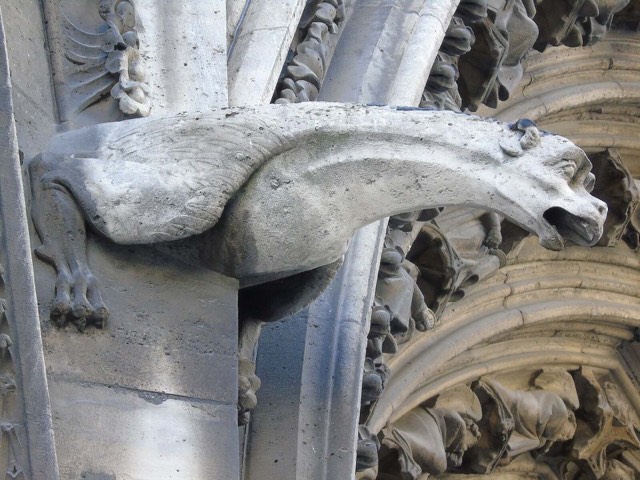
Notre-Dame gargoyle
Notre-Dame de Paris, France · about 1240
A drain with a body. Rain runs along a groove in its back and leaves by the mouth, clear of the wall.
Stone beasts that spit the rain off the roof, and their cousins who only stand guard. Drawn by math, under the sky over Paris right now.
Tap the gargoyle. Tap the sky for rain.
A gargoyle is a drain: water goes in at the roof and out of its mouth. A carved creature that carries no water is a grotesque, or on Notre-Dame, a chimera. Look, guess, then see.
A spout carved as a creature. A groove or pipe runs through it and the water leaves by the mouth.
Any odd carved figure, human or beast, that carries no water. The word comes from the Italian grotta.
The name for the grotesques on Notre-Dame's upper gallery, after the many-part monster of Greek myth.
Guardians at doors and on ridges elsewhere: Thai yaksha and singha, Chinese ridge beasts, Japanese ogre tiles, Kala faces.
Water that runs down a wall washes out the mortar between the stones. A gargoyle sticks out so the water falls free. Make the spout longer or shorter, make it rain harder, and watch where the water lands.
Q = rain × 40 m²The roof gathers the rain falling on 40 square metres and sends it down one spout.
v = √(g·d), d = (q²/g)^⅓Water leaving the end of an open channel flows at its critical depth d. Here q is the flow per metre of a 12 cm groove.
x = v × √(2h/g)From 10 m up, the water falls for about 1.4 seconds. In that time it drifts out x metres more.
Even in a downpour the water leaves the lip slowly, well under a metre a second, and falls nearly straight down. The spout's length does most of the work, so medieval gargoyles were long. Builders also used many of them: Viollet-le-Duc wrote that splitting the roof's water into many falls left each one a thin thread that could not harm the walls. The first gargoyles appeared around 1220 at Laon; Paris used them everywhere by about 1240. In 1724 London's Building Act required downpipes on new houses.
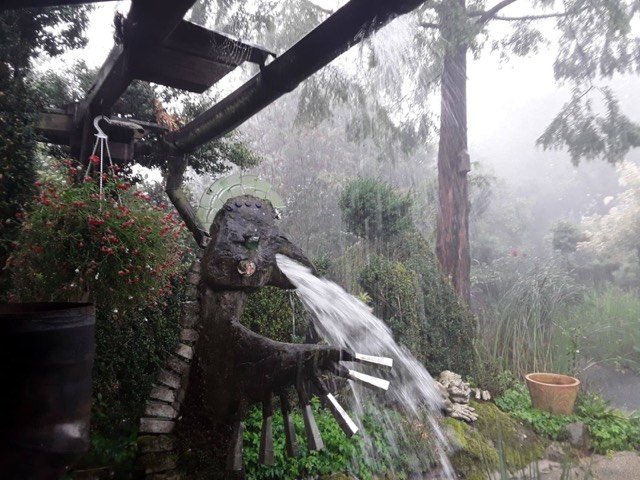
Rain runs down channels on the flying buttresses, along a groove in the gargoyle's back, and out of its mouth, as far from the walls as it will go.
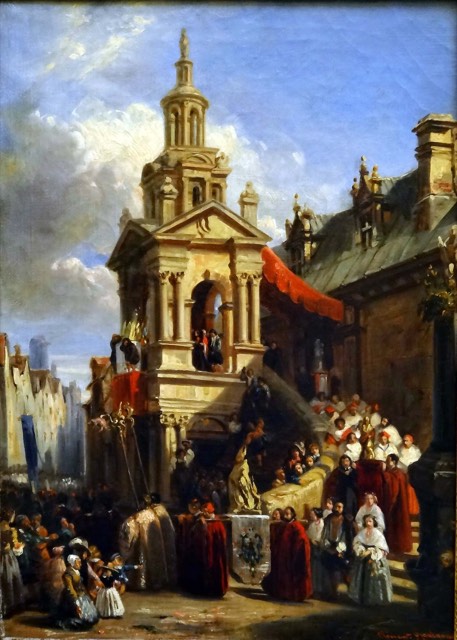
Rouen, in Normandy, tells where the first gargoyle came from. Step through the story.
Romanus was bishop of Rouen in the 630s; the dragon first appears in writing in 1394. From about the 12th century until 1790, the chapter of Rouen freed one condemned prisoner every Ascension Day, the privilège de saint Romain, in memory of the man who went with him.
Wherever people built roofs that shed rain or doors worth guarding, carved creatures moved in. The pins show rain falling there right now. Tap a pin, then tap any drawing.
Tap a pin.
Notre-Dame de Paris, France · about 1240
A drain with a body. Rain runs along a groove in its back and leaves by the mouth, clear of the wall.
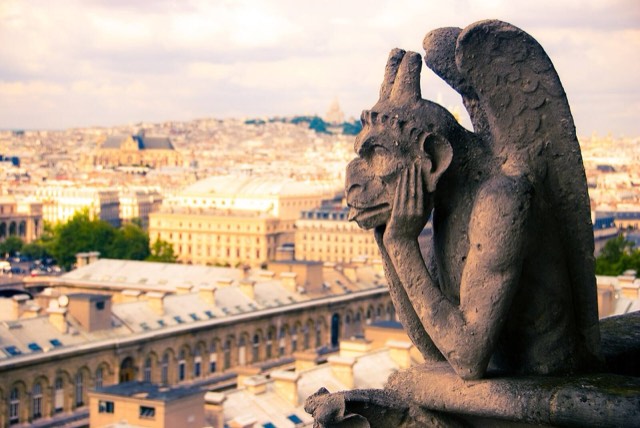
Galerie des Chimères, Notre-Dame · 1850s
A chimera, not a gargoyle: it carries no water. Viollet-le-Duc designed it for the 19th-century restoration.
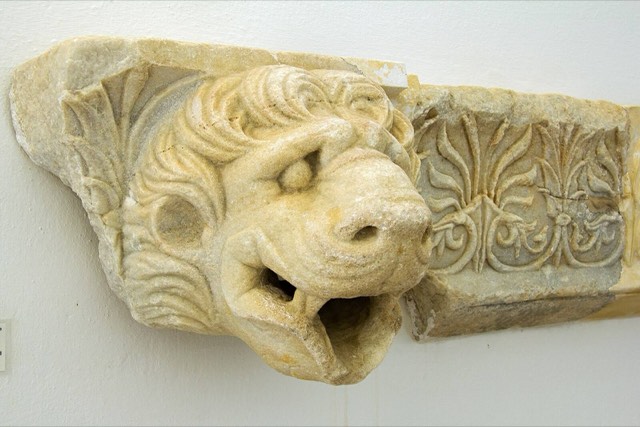
Temple of Zeus, Olympia, Greece · about 470–456 BC
102 lion heads lined the marble roof gutter, the sima; 39 survive. Vitruvius says only the heads over the columns were bored through.
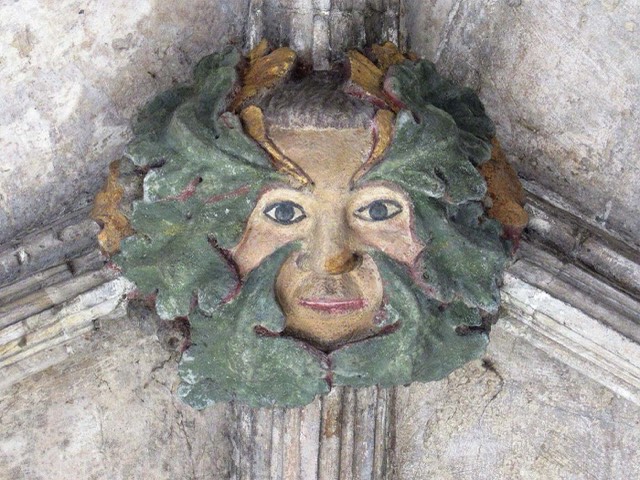
church roofs and capitals across Europe
A face made of leaves, vines growing from its mouth. It reached England from France in the 1100s; the name Green Man dates from 1939.
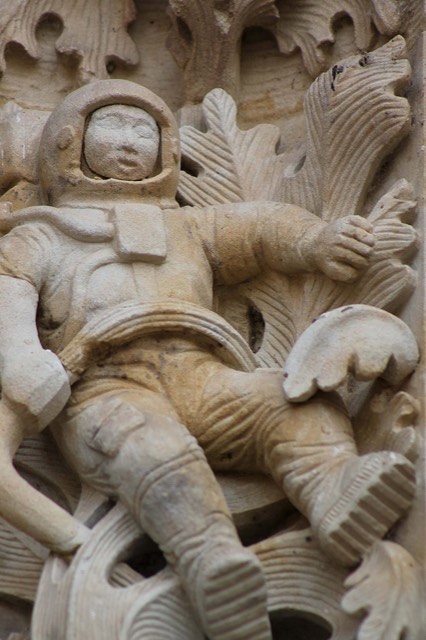
New Cathedral, Salamanca, Spain · 1992
Carved by the stonemason Miguel Romero in 1992, when the north door was restored, among the old foliage.
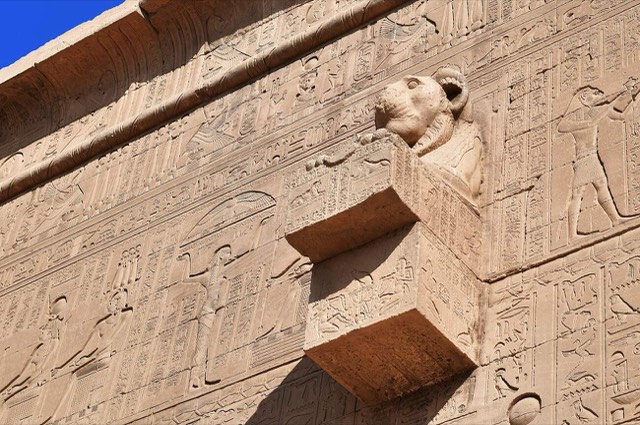
Temple of Hathor, Dendera, Egypt
Rain is rare in Upper Egypt, but the temple roofs at Dendera and Edfu still shed it through lions' mouths.
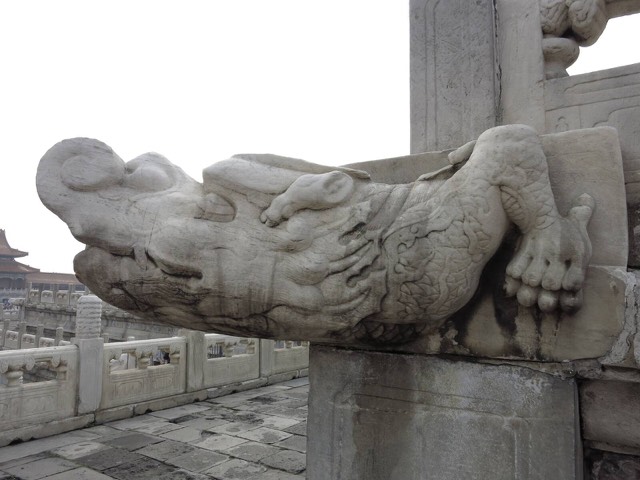
Forbidden City, Beijing · 1400s
A hornless dragon head under every marble baluster post, a hole through its mouth.
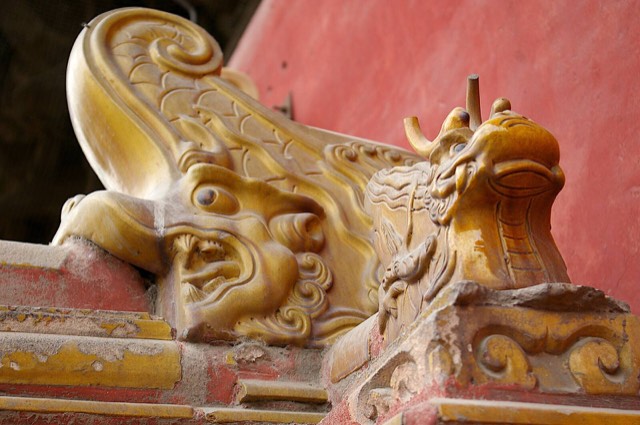
palace and temple roofs, China
It bites the end of the roof ridge, a charm against fire. The one on the Hall of Supreme Harmony stands 3.4 m and weighs about 4.3 tonnes. Legend says the sword in its back pins it there.
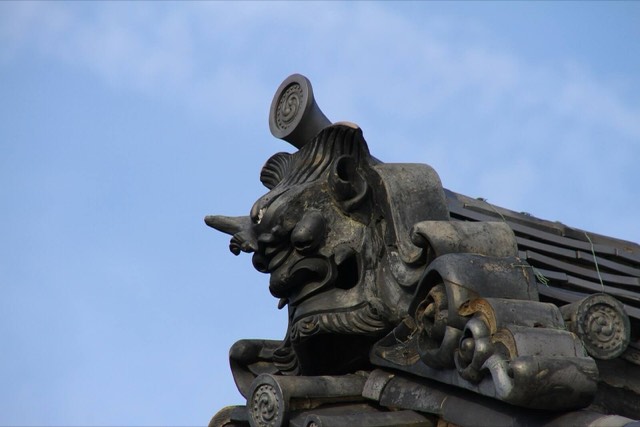
temple and castle roofs, Japan
An ogre's face on the tile at the end of a ridge, to keep misfortune off the roof.
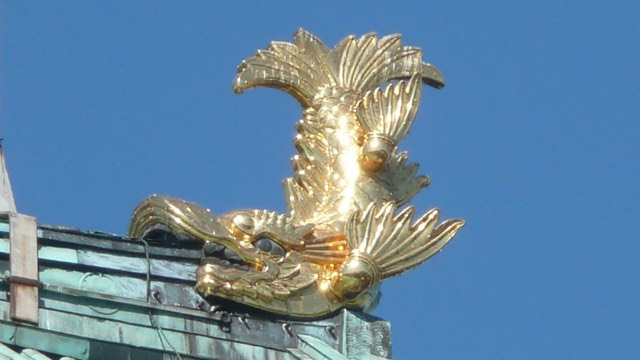
Nagoya Castle, Japan
A tiger's head on a carp's body, tail in the air; said to swallow great quantities of water and control the rain, so it guards against fire.
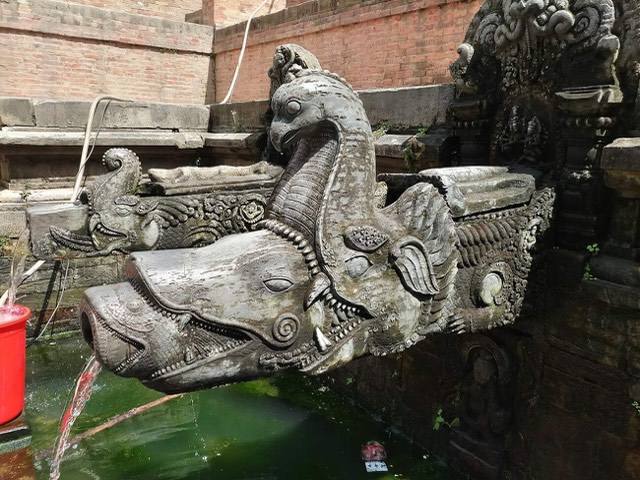
Manga Hiti, Patan, Nepal
A stone spout at the bottom of a sunken court, running with water from the hills.
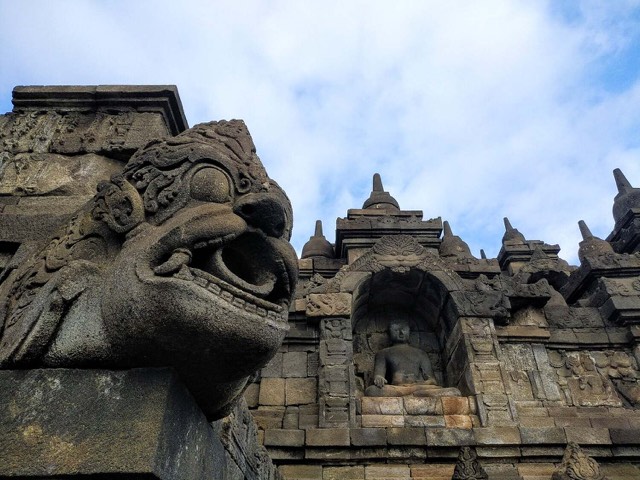
Borobudur, Java, Indonesia · 800s
100 spouts at the corners of the terraces, each a giant or a makara, carry off the tropical rain.
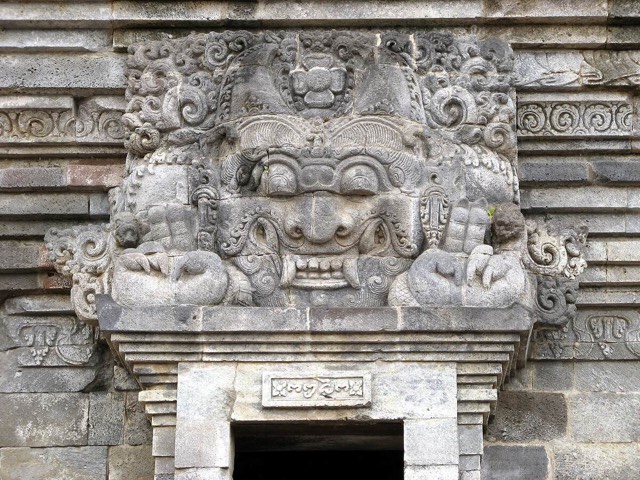
over temple doors, India
The face that ate itself, guarding the door with no body and no lower jaw.
Khmer lintels, Cambodia and Thailand
The same face in Khmer sandstone, holding garlands that pour from its mouth.
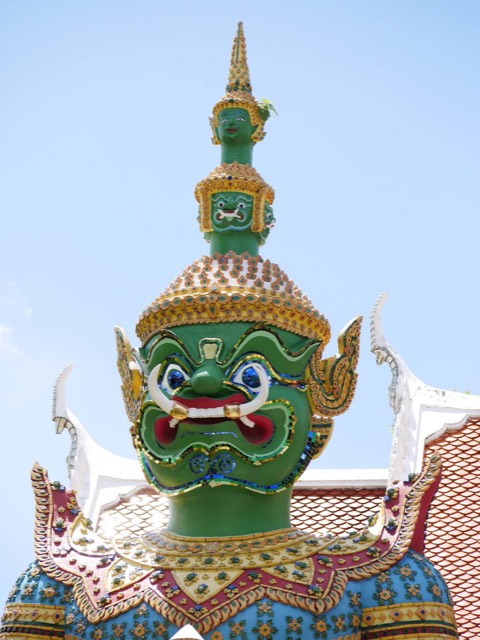
Wat Arun and Wat Phra Kaew, Bangkok
Twelve giants from the Ramakien, each about 5 m tall, guard Wat Phra Kaew's gates. At Wat Arun, green Thotsakan and white Sahatsadecha guard the ordination hall.
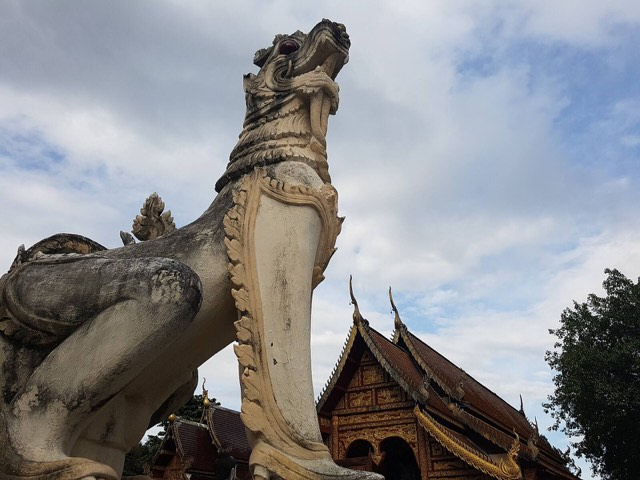
temple gates, Chiang Mai
Lions in pairs at gates and stairways, white and gold, mouths open. The type came to Lanna by way of Burma.
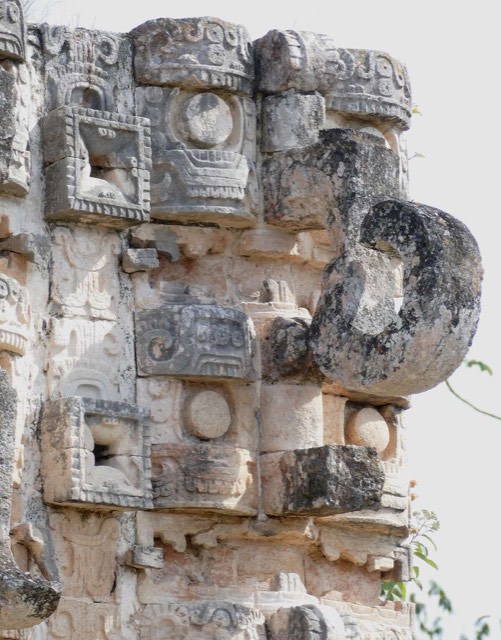
Codz Poop, Kabah, Mexico
The Maya rain god, hundreds of times over on one facade, his long nose curling up. The Puuc hills have no cenotes; rain was the only water.
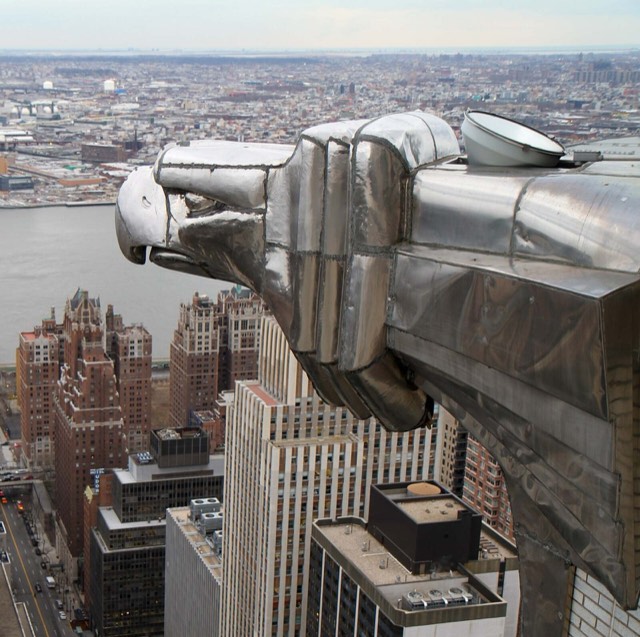
Chrysler Building, New York · 1930
Steel eagle heads at the corners of the 61st floor. People call them gargoyles; they carry no water.
Marble chi heads under the terrace of the Hall of Supreme Harmony.
The three great halls of the Forbidden City stand on a three-tier terrace of white marble, 8.13 metres high. Under the balustrades sit dragon heads with a hole through each mouth: 1,142 of them, by the Palace Museum's count. In a heavy storm all of them spout at once.
Rain on the terraces: the dragons are spitting.
People in Beijing call it 千龙吐水, a thousand dragons spitting water. Each head is a chi, a hornless dragon, one of the dragon's nine sons, said to hold great quantities of water in its belly. The terrace slopes outward a little so the rain finds the mouths. Across town, the Temple of Heaven's three tiers carry 99 spouts each: clouds on the lowest, phoenixes in the middle, dragons on top.
A Hindu story, as Heinrich Zimmer retold it: the demon Rahu came to make a demand of Shiva. Shiva opened his third eye and a lion-headed creature sprang out, starving. Rahu begged for mercy and was spared, which left the creature nothing to eat, so Shiva told it to eat itself. It ate from the tail up until only the face was left. Shiva named it Kirtimukha, face of glory, and set it over the doors of temples.
The same face travelled east with Hindu and Buddhist builders. On Khmer lintels it is Kala, all-devouring time: a great upper jaw, no lower jaw, garlands and vines pouring from its mouth. In Thai it is หน้ากาล, na kan, the one who swallows everything, even itself. On Java the Kala head glares over temple doors with bulging eyes and curved fangs.
Built in 570. People still come to drink, wash and fill their pots.
In the Kathmandu Valley, carved stone spouts called hiti (in Newar) or dhunge dhara (in Nepali, stone faucet) sit at the bottom of stepped pits, fed from underground. Patan's Manga Hiti, built in 570, still runs; its water serves the Krishna Mandir every day. Press and hold to fill a pot.
Press and hold the picture.
Most spouts are a makara: a crocodile's snout, an elephant's trunk, a boar's tusks and ears, a peacock's tail, its body forming the open channel. In a 2019 survey, 224 of the valley's spouts on record still gave water. A European gargoyle throws water away from a building; a hiti brings it to people.
Every gargoyle was a block of stone first. Pick one and chip it out. Sound on for the chisel.
At Gloucester Cathedral the master mason first models the figure full size in clay, and the masons copy it into the stone with a pointing machine, then by eye. A trough is cut along the back so the water leaves by the mouth. Each of Paisley Abbey's twelve new gargoyles took about four weeks; one grotesque at York Minster took fourteen.
In 1992 the Puerta de Ramos of Salamanca's New Cathedral was restored for the next year's Las Edades del Hombre exhibition, and the stonemason Miguel Romero carved a few things of his own time among the old ones: an astronaut, and nearby a smiling dragon with a three-scoop ice cream. Find both.
Tap the carving you think it is.
Chin on its hands above Paris since the 1850s. It carries no water: a chimera, not a gargoyle.
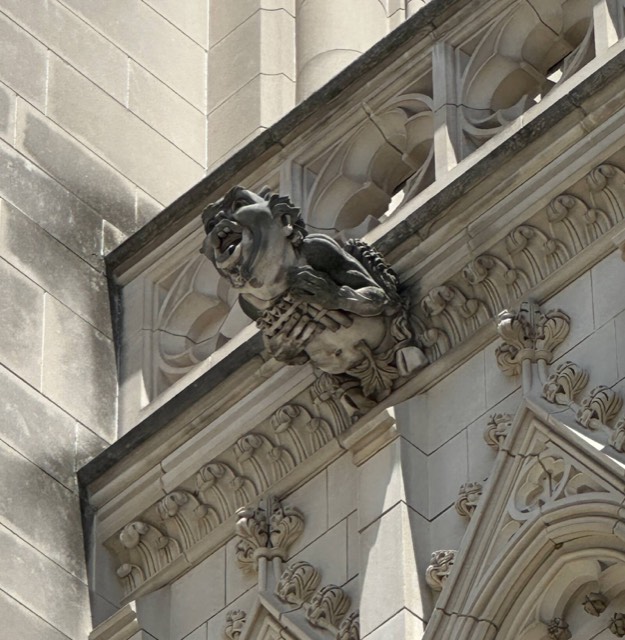 APK · CC BY 4.0Washington, 1984–1986
Washington National Cathedral asked children, through National Geographic World, to design a grotesque; about 1,400 entered from 16 countries. Christopher Rader, 13, drew Darth Vader and was one of three runners-up. Jay Hall Carpenter modelled it in clay and Patrick J. Plunkett carved it high on the northwest tower, where it takes binoculars to find.
The grand prize went to Alison Garner, 12, for a toothy man holding an umbrella. She had read that rainwater drains out of the mouths of gargoyles, so she gave her grotesque an umbrella for protection.
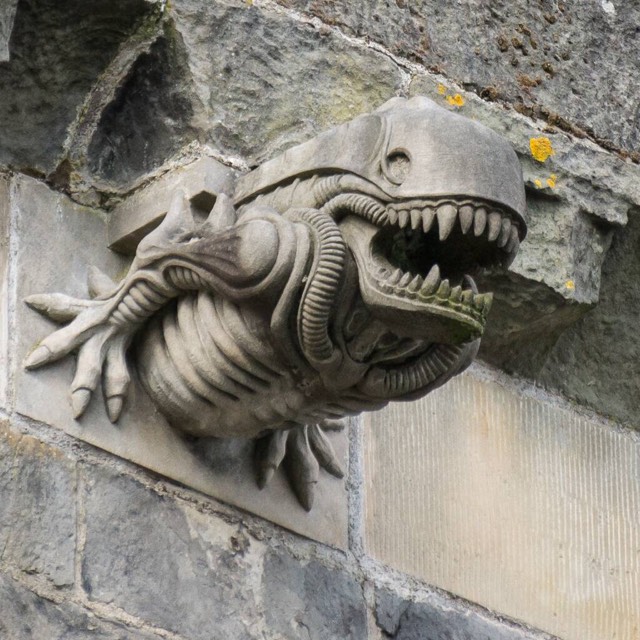 Colin · CC BY-SA 3.0Paisley, 1990s
David Lindsay carved twelve new gargoyles for the abbey's roof, about four weeks each, every one with a channel for water and drawn from 20th-century culture. One looks like the creature from Alien. A photo of it went round the world in 2013.
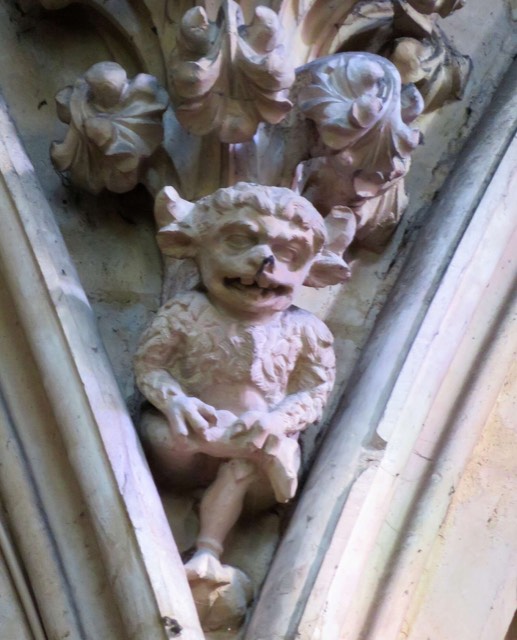 Gordon Hatton · CC BY-SA 2.0Lincoln, 1250–1280
A small grotesque sits high in the Angel Choir of Lincoln Cathedral. Its legend, put into verse in 1897: the devil and the wind came to the minster; the devil went in to chat with the Dean, and the wind has been waiting outside ever since.
Fernando Losada Rodríguez · CC BY-SA 4.0Paris, 1726Archbishop de Noailles had the roof altered and lead gutters fitted, and most of the medieval gargoyles came down. Those there today are mostly from the 19th-century restoration.
Viollet-le-Duc designed the chimeras of the upper gallery himself, and a team of sculptors, Victor Pyanet chief among them, carved them. They are Gothic Revival, not medieval.
Jason Eppink · CC BY 2.0New York, December 1929Margaret Bourke-White photographed the Chrysler Building from its scaffolding and was taken with the steel eagle heads. Its ornaments are Nirosta, an 18-8 stainless steel, the first use of that steel in an American building.
Sasha India · CC BY 2.0Bangkok, 1896King Chulalongkorn of Siam took eight cartloads of sculpture from Borobudur, with the colonial government's consent: two lions, kala heads, a guardian and one waterspout among them. Some are on show in Bangkok.
Brücke-Osteuropa · CC0Nagoya, 1937A survey on 6 January 1937 found 58 of the 110 gold scales gone from the male shachihoko. The originals burned in the air raid of 14 May 1945; the pair now on the keep went up when it was rebuilt in 1959. The male is 2.62 m tall and carries 44.69 kg of gold.
Gloucester Cathedral's six new working gargoyles show a rugby player, a jockey, a suffragette, a miner, a sheep shearer and a cheese roller.
Lead downpipes were already in use on the Tower of London in 1240, to keep spray off its whitewashed walls.
Most languages name it for the water. English and French name it for the throat.
Text and drawings CC BY 4.0, credit NaNoBotCo. Code MIT. Photographs keep the licences listed with them.


