
ตี · โมง · ทุ่ม — strike, gong, drum
Telling Time in Thai
Thailand runs two clocks at once: the 24-hour clock on paper, and in speech an older count of six-hour blocks, named for a gong by day and a drum by night.
บอกเวลาแบบไทย · Gong by day, drum by night
nanobotco.github.io/thai-time
Six-hour clock
Two clocks at once
Written down, Thai time runs on the 24-hour clock: 14.30 น., read sip-si nalika sam-sip nathi. Said out loud it mostly runs on an older count: บ่ายสองโมงครึ่ง, bai song mong khrueng, “afternoon, two gongs, half”.
The spoken count cuts the day into four blocks of six hours and starts again at one in each block. Each block has its own word, and the words are sounds. โมง mong is the boom of a gong, struck through the day. ทุ่ม thum is the thud of a drum, struck through the evening. ตี ti, “strike”, takes the small hours.
So 2 a.m. is ตีสอง, 8 a.m. is แปดโมง, 2 p.m. is บ่ายสองโมง and 8 p.m. is สองทุ่ม. Pick the wrong block and you turn up six hours early, or twelve hours late.
Noon is เที่ยง thiang; midnight is เที่ยงคืน thiang khuen, the noon of the night.
Every hour
| Clock | Said | Reading | Word by word | Also heard |
|---|---|---|---|---|
| 01:00 | ตีหนึ่ง | ti nueng | strike 1 | |
| 02:00 | ตีสอง | ti song | strike 2 | |
| 03:00 | ตีสาม | ti sam | strike 3 | |
| 04:00 | ตีสี่ | ti si | strike 4 | |
| 05:00 | ตีห้า | ti ha | strike 5 | |
| 06:00 | หกโมงเช้า | hok mong chao | 6 gongs, morning | ย่ำรุ่ง |
| 07:00 | เจ็ดโมงเช้า | chet mong chao | 7 gongs, morning | โมงเช้า |
| 08:00 | แปดโมงเช้า | paet mong chao | 8 gongs, morning | สองโมงเช้า |
| 09:00 | เก้าโมงเช้า | kao mong chao | 9 gongs, morning | สามโมงเช้า |
| 10:00 | สิบโมงเช้า | sip mong chao | 10 gongs, morning | สี่โมงเช้า |
| 11:00 | สิบเอ็ดโมง | sip-et mong | 11 gongs | ห้าโมงเช้า |
| 12:00 | เที่ยง | thiang | noon | เที่ยงวัน |
| 13:00 | บ่ายโมง | bai mong | afternoon, 1 gong | |
| 14:00 | บ่ายสองโมง | bai song mong | afternoon, 2 gongs | |
| 15:00 | บ่ายสามโมง | bai sam mong | afternoon, 3 gongs | |
| 16:00 | สี่โมงเย็น | si mong yen | 4 gongs, evening | บ่ายสี่โมง |
| 17:00 | ห้าโมงเย็น | ha mong yen | 5 gongs, evening | บ่ายห้าโมง |
| 18:00 | หกโมงเย็น | hok mong yen | 6 gongs, evening | ย่ำค่ำ |
| 19:00 | หนึ่งทุ่ม | nueng thum | 1 drum | ทุ่มหนึ่ง |
| 20:00 | สองทุ่ม | song thum | 2 drums | |
| 21:00 | สามทุ่ม | sam thum | 3 drums | |
| 22:00 | สี่ทุ่ม | si thum | 4 drums | |
| 23:00 | ห้าทุ่ม | ha thum | 5 drums | |
| 00:00 | เที่ยงคืน | thiang khuen | noon of the night | หกทุ่ม · สองยาม |
Turn the dial
Say any time
Drag the hand or slide the bar. The page writes that time the way people say it, the way the palace listed it in 1900, the way the radio reads it, and the Lanna watch it falls in.
- Also heard
- Palace list, 1900
- Radio and paper
- Written
- Lanna watch
Half past is ครึ่ง khrueng. Other minutes take the number and นาที nathi. Near the hour people count down: อีกสิบนาทีสามทุ่ม, “ten more minutes to three drums”. The 1900 column counts minutes in บาท of six minutes, the old water-clock unit. Hear it plays a gong for โมง, a drum for ทุ่ม, a small bell for ตี and a fast roll for the six o'clocks and noon.
Where the words come from
Gong by day, drum by night
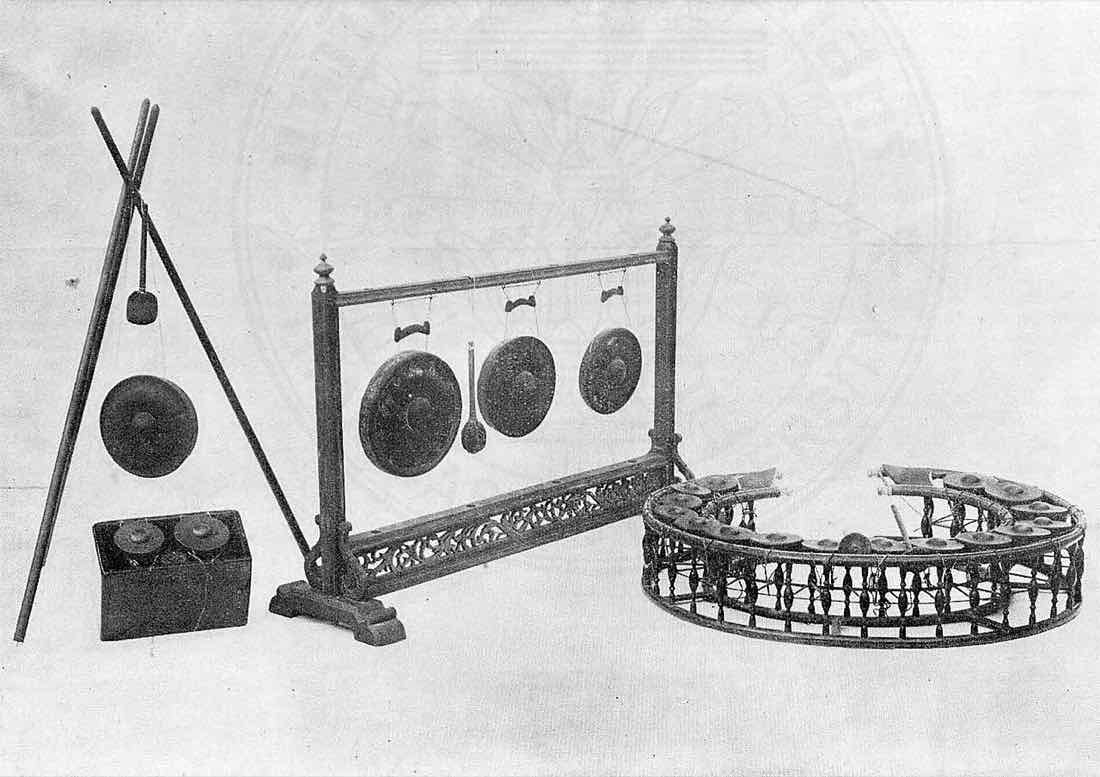
Before clocks, the hours came from a tower. Keepers struck a gong (ฆ้อง khong) through the day and beat a drum (กลอง klong) through the night, once for each hour into the block. People named the hour by what they heard: โมง for the gong, ทุ่ม for the drum.
At 6 a.m., noon and 6 p.m. the keepers beat a long run of strokes, ย่ำ yam: dawn was ย่ำรุ่ง, noon ย่ำเที่ยง, dusk ย่ำค่ำ. In Ayutthaya the big drum at the foot of the drum tower was beaten at sunset to close the city gates.
Your browser makes these sounds from a few sine waves and a burst of noise. They are drawn sounds, not recordings.
Quiz
Try it
Eight questions. The wrong answers are the usual mix-ups: the same number in another block.
· Score 0
Water clock
The coconut that sinks
นาฬิกา nalika, now the word for a clock, first meant a coconut. Siam kept time with a กะลาลอย kala loi: half a coconut shell with a small hole in the bottom, floated in a basin. Water seeps in, the shell rides lower, and when it is full it sinks. One sinking, one hour.
Keepers scored the shell with nine lines into ten parts, each a บาท bat of six minutes. In the palace clock house, each time the shell sank a keeper struck the gong once and pushed a tally stick onto a rail. Twelve sticks made a day or a night; the rail was cleared at dawn and at dusk.
This shell is a half sphere, and it floats, so it rides lower as it fills. Water pushes in through the hole faster the higher the level outside stands above the level inside (Torricelli's law: the speed grows with the square root of that drop). The gap narrows as the bowl widens, so the shell fills more slowly toward the end; the nine lines here sit at equal times under that rule. The shell sinks when its rim reaches the water, before it is full.
King Mongkut (Rama IV) grumbled that the keepers guessed, calling ten บาท to the hour whatever the season, “…คงให้ได้ว่าความแต่ว่าโมงละ ๑๐ บาทอยู่นั้นเอง…”, and that visitors carrying pocket watches would laugh at hours struck short and long.
Royal Gazette
The king's list, 1900
On 23 July 1900 King Chulalongkorn (Rama V) had the hour names printed in the Royal Gazette. People had drifted, it said, and were saying 6 โมงเช้า, 6 โมงเย็น, 3 ทุ่ม, 6 ทุ่ม and 9 ทุ่ม. The list set them right.
In the king's list the drum count runs all night, up to eleven: 1 a.m. is เจ็ดทุ่ม, seven drums. Three points of the night get their own names: ยามหนึ่ง at 9 p.m., สองยาม at midnight, สามยาม at 3 a.m. A ยาม yam is a watch of three hours.
Today people say all five of the forms the list struck out, and ตี has taken the small hours from the drum.
Struck out in 1900 6 โมงเช้า6 โมงเย็น3 ทุ่ม6 ทุ่ม9 ทุ่ม
| Clock | Said today | King's list, 1900 |
|---|---|---|
| 06:00 | หกโมงเช้า | ย่ำรุ่ง yam rung |
| 07:00 | เจ็ดโมงเช้า | โมงเช้า · เช้าโมงหนึ่ง mong chao · chao mong nueng |
| 08:00 | แปดโมงเช้า | สองโมงเช้า song mong chao |
| 09:00 | เก้าโมงเช้า | สามโมงเช้า sam mong chao |
| 10:00 | สิบโมงเช้า | สี่โมงเช้า si mong chao |
| 11:00 | สิบเอ็ดโมง | ห้าโมงเช้า ha mong chao |
| 12:00 | เที่ยง | เที่ยง · ย่ำเที่ยง thiang · yam thiang |
| 13:00 | บ่ายโมง | บ่ายโมง · บ่ายโมงหนึ่ง bai mong · bai mong nueng |
| 14:00 | บ่ายสองโมง | บ่ายสองโมง bai song mong |
| 15:00 | บ่ายสามโมง | บ่ายสามโมง bai sam mong |
| 16:00 | สี่โมงเย็น | บ่ายสี่โมง bai si mong |
| 17:00 | ห้าโมงเย็น | บ่ายห้าโมง bai ha mong |
| 18:00 | หกโมงเย็น | ย่ำค่ำ yam kham |
| 19:00 | หนึ่งทุ่ม | ทุ่มหนึ่ง thum nueng |
| 20:00 | สองทุ่ม | สองทุ่ม song thum |
| 21:00 | สามทุ่ม | ยามหนึ่ง yam nueng |
| 22:00 | สี่ทุ่ม | สี่ทุ่ม si thum |
| 23:00 | ห้าทุ่ม | ห้าทุ่ม ha thum |
| 00:00 | เที่ยงคืน | สองยาม song yam |
| 01:00 | ตีหนึ่ง | เจ็ดทุ่ม chet thum |
| 02:00 | ตีสอง | แปดทุ่ม paet thum |
| 03:00 | ตีสาม | สามยาม sam yam |
| 04:00 | ตีสี่ | สิบทุ่ม sip thum |
| 05:00 | ตีห้า | สิบเอ็ดทุ่ม · ตีสิบเอ็ด sip-et thum · ti sip-et |
Royal Gazette volume 17, page 206, dated 29 July, Rattanakosin year 119: 1900. English Wikipedia gives 1901.
The north
Lanna time: watches, not hours
The old Lanna count has no 60-minute hour. Inscriptions cut the day into sixteen watches, ยาม yam, of an hour and a half: eight by day and eight by night, from 6 a.m. A watch takes its name from the instrument that signalled it, then the part of the day. ตูด tut is a buffalo horn blown; กลอง klong the drum; แตร trae a horn or trumpet.
ยามกลองงาย, the morning-meal drum, runs from 7.30 to 9 a.m. The four watches found most in Lanna inscriptions all fall between dawn and early afternoon: ยามตูดเช้า, ยามกลองงาย, ยามแตรใกล้เที่ยง and ยามตูดซ้าย. Kannika Wimonkasem, who listed them, reads that as the hours chosen for ceremonies.
Day
- 06:00–07:30ยามตูดเช้าyam tut chao
- 07:30–09:00ยามกลองงายyam klong ngai
- 09:00–10:30ยามแตรใกล้เที่ยงyam trae klai thiang
- 10:30–12:00ยามเที่ยงyam thiang
- 12:00–13:30ยามตูดซ้ายyam tut sai
- 13:30–15:00ยามกลองค่ำyam klong kham
- 15:00–16:30ยามแตรใกล้ค่ำyam trae klai kham
- 16:30–18:00ยามค่ำ · พาดลั่นyam kham · phat lan
Night
- 18:00–19:30ยามตูดดึกyam tut duek
- 19:30–21:00ยามกลองดึกyam klong duek
- 21:00–22:30ยามแตรดึกyam trae duek
- 22:30–00:00ยามดึกyam duek
- 00:00–01:30ยามตูดรุ่งyam tut rung
- 01:30–03:00ยามกลองรุ่งyam klong rung
- 03:00–04:30ยามแตรใกล้รุ่งyam trae klai rung
- 04:30–06:00ยามรุ่งyam rung
Names and hours from Kannika Wimonkasem, Damrong Journal, 2002. Inscriptions from Isan and Laos use some other names.
Still in the calendar
Lanna calendars still time the big moments by watch. The 2022 Lanna calendar compiled by Saknarin Chaongio at Rajamangala University of Technology Lanna puts Songkran in ยามแตรสู่เที่ยง, the horn watch toward noon, at 9.52.12 a.m. on 14 April, and the turn of the era year in ยามกลองแลง, the late-day drum, at 1.49.48 p.m. on 16 April. Both clock times fall inside the watches in the table above. แลง laeng is the northern word for late afternoon.
Five hundred years earlier, in 1502, an inscription at Wat Doi Kham in Lamphun dates its horoscope ยามแตรจักใกล้เที่ยง, “the horn watch, near noon”.
Sixty named days
Lanna also names each day from a cycle of sixty, the วันไท wan thai, “Tai day”. Ten first names and twelve last names turn together, one step a day, like two gears: กาบยี, ดับเหม้า, รวายสี, เมืองใส้ … The gears line up again after 60 days.
Both gears step at once, and 10 and 12 are both even, so a first name only ever meets every other last name: 60 of the 120 possible pairs occur. The years turn on the same two gears; the era year 1388, which began in April 2026, is ปีรวายสะง้า, a horse year.
Era year –
Counted from the 2022 Lanna calendar, where 1 January 2022 is กาบยี and 14, 15 and 16 April are เมืองเร้า, เปิกเส็ด and กัดใค้. The page counts by the civil date; the era year turns in mid-April.
Months two ahead
Lanna numbers its lunar months two ahead of central Thailand. Yi Peng, ยี่เป็ง, is the full moon of the second month in the north and of the twelfth in Bangkok. Tai Lue and Tai Khuen towns, Mae Sai, Chiang Khong, Chiang Kham and northern Nan among them, count เดือนโหรา duean hora, one month ahead of Bangkok and one behind the rest of Lanna.
Sun time
Noon by the sun
Thai clocks run on the 105th meridian east, the line through Ubon Ratchathani. Until 1 April 1920 Siam kept Bangkok's own sun time, 6 hours 42 minutes 4 seconds ahead of Greenwich; that night the clocks jumped 17 minutes 56 seconds.
Chiang Mai sits six degrees west of the line, so its sun peaks about 24 minutes after clock noon, more or less with the season. Pick a town.
In the northern forests people read the hour off the sun by hand: arm out, fingers spread, count hand-spans (คืบ khuep) up from the horizon. One span, one โมง; six spans, noon.
Sun from the NOAA solar equations; sunrise and sunset for the sun's top edge, allowing for air bending the light.
Daily round
A day by the clock
- 04:00ตีสี่Many temples wake; monks chant the morning service.
- 06:00หกโมงเช้าMonks walk the alms round, บิณฑบาต binthabat, in the first light.
- 08:00แปดโมงเช้าThe national anthem plays on radio, TV and loudspeakers; the flag goes up and people stand still where they are.
- 11:00สิบเอ็ดโมงเพล phen: the monks' last meal of the day, finished before noon.
- 12:00เที่ยงLunch for everyone else: ข้าวเที่ยง khao thiang.
- —บ่ายควายOld sun-time phrases: บ่ายควาย, “buffalo afternoon”, and ควายเข้าคอก, “buffalo into the pen”, for late in the day.
- 18:00หกโมงเย็นThe anthem again; the flag comes down.
- 00:00เที่ยงคืนThe noon of the night. In the 1900 list, สองยาม, the end of the second watch.
Pictures


.jpg)
History
From drum tower to radio
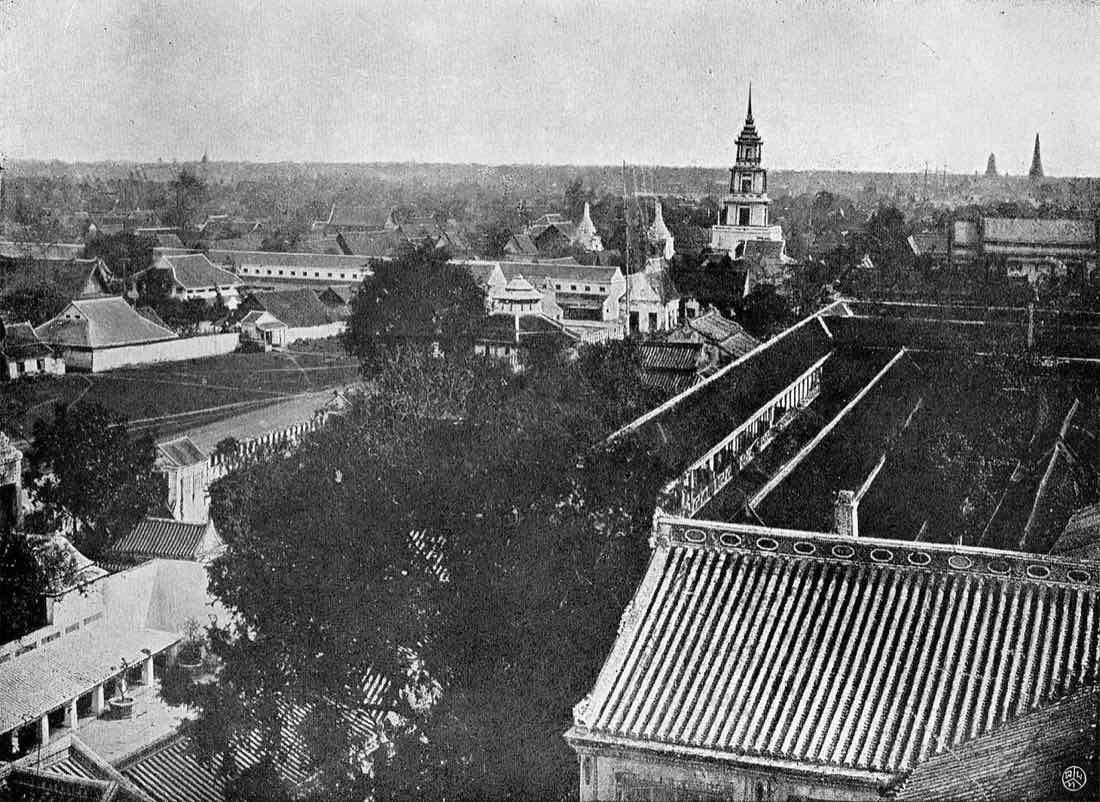
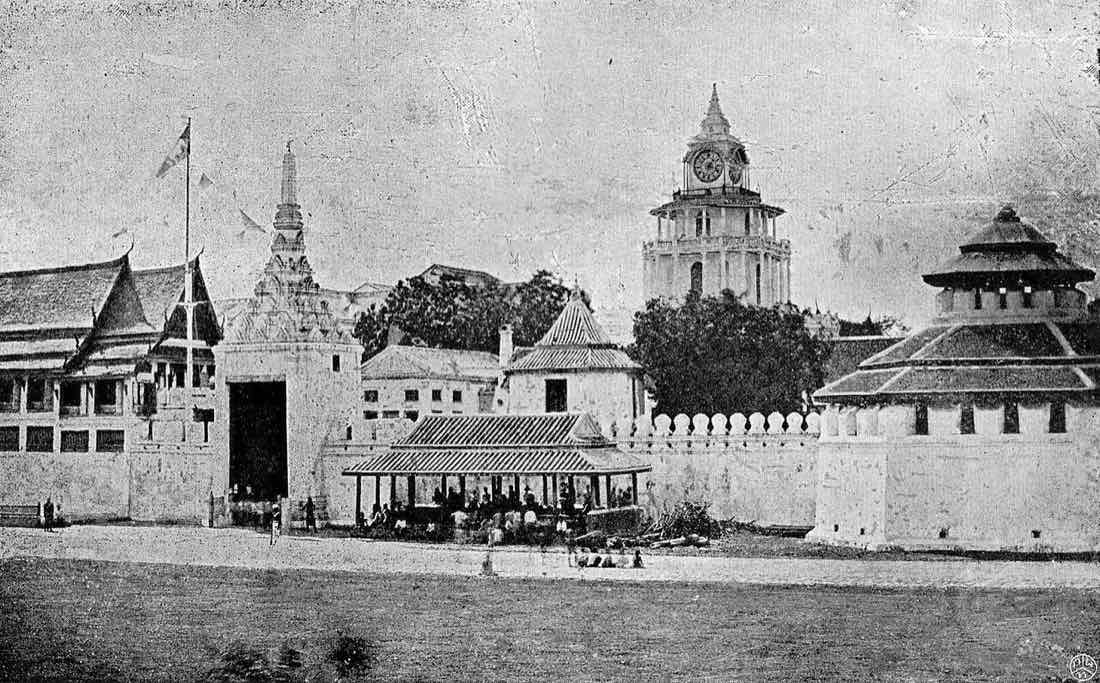
- AyutthayaA drum tower ten wa high, four storeys, held three drums: ย่ำพระสุรศรี at the foot, beaten at sunset to close the gates; อัคคีพินาศ in the middle for fire; พิฆาตไพรินทร์ at the top for an enemy at the walls.
- Rama ITrials by diving were timed with a sinking coconut. The king worried over a shell that sank before either diver came up, and had a gong signal used instead.
- Rama IISmall watches arrived as Portuguese gifts. With no shirt pockets, people tucked them into the fold of the waist-cloth, the พก phok: so a pocket watch is นาฬิกาพก.
- Rama IVKing Mongkut set up a clock office in the palace, compared its pendulum clocks against the sundial at noon, and had the hour names announced in the Royal Gazette.
- 1889The solar calendar becomes the government calendar, the year starting on 1 April.
- 1900Rama V's announcement ประกาศใช้ทุ่มโมงยาม lists the hour names and strikes out five common mistakes.
- Noon gunThe navy fired a gun at noon so the city could set its clocks; later the power station blinked the lights at สองทุ่ม instead.
- 1920On 1 April Siam moves from Bangkok's sun time to the 105th meridian, UTC+7.
- TodayThe Royal Thai Navy's Hydrographic Department keeps Thailand's standard time; radio and TV read it at 08:00 and 18:00 with the anthem.
Words
To strike. The hours from 1 to 5 a.m.: ตีหนึ่ง … ตีห้า.
The boom of a gong. The daytime hours.
The thud of a drum. The hours from 7 to 11 p.m.
A long run of strokes, at 6 a.m., noon and 6 p.m. in the old names. Said with a falling tone; another word from ยาม.
A watch: three hours of the night in central Thai, an hour and a half in Lanna.
Noon. เที่ยงคืน, thiang khuen, is midnight.
Morning, afternoon, evening.
Dusk, late night, dawn.
Half. บ่ายสองโมงครึ่ง is 14:30.
A clock, and “o'clock” on the 24-hour clock. Once a coconut-shell water clock.
Written short for นาฬิกา: 14.30 น.
Hour (as a length of time), minute.
Six minutes: a tenth of an hour on the coconut clock.
A hand-span, thumb to little finger.
The monks' late-morning meal, eaten before noon.
Sources
Hour names from the Royal Gazette of 1900 and the Thai and English Wikipedia articles; Lanna watches from Kannika Wimonkasem; coconut clock, drum tower and noon gun from Phisansri Kratai-thong in Silpa Wattanatham.
- Royal Gazette vol. 17, p. 206, 29 July R.S. 119 (1900): ประกาศใช้ทุ่มโมงยาม
- Kannika Wimonkasem, ศักราช ศก ปี วัน เดือน ฤกษ์ และยามในจารึกล้านนา, Damrong Journal 1(1), 2002
- Phisansri Kratai-thong, หอสูงกับการบอกเวลา, Silpa Wattanatham, October 2015 (online excerpt)
- Silpa Wattanatham, คำเรียกเวลา โมง-ทุ่ม มาจากไหน ใครกำหนด?
- Saknarin Chaongio, ปฏิทินล้านนา 2565 (Lanna calendar 2022), Rajamangala University of Technology Lanna
- Wikipedia: Thai six-hour clock
- วิกิพีเดีย: นาฬิกาหกชั่วโมง
- Wikipedia: Time in Thailand
- Hydrographic Department, Royal Thai Navy (standard time)
- NOAA solar calculation details