Sampot hol
สมปตโฮล · សំពត់ហូល
The weft-ikat silk wrap worn for weddings and Buddhist ceremonies. It is woven in an uneven 1/2 twill on three shafts, so one colour rules the face and another the back. More than 200 hol patterns have names.
เส้นยืน เส้นพุ่ง · អំបោះបញ្ឈរ អំបោះទទឹង
Silk, weaving and the arithmetic inside cloth. The loom is weaving NaN's Khmer silk shawl, one weft thread at a time, from a plan drawn in code.
Loom
Warp threads run the length of the loom, stretched tight. The weft crosses them, over some and under others. Which ones rise is up to the shafts: frames that each lift a set of warps when the weaver steps on a treadle.
A weaving draft writes this down as three grids. Top: which shaft each warp is threaded through. Top right: which shafts each treadle lifts. Right: which treadle each pick uses. The cloth is their product: the warp shows wherever the treadle lifts that warp's shaft. Tap any square to change it.
cloth[pick][warp] = tie-up[shaft(warp)][treadle(pick)]
Math
In 1804 Joseph Marie Jacquard hung a chain of punched cards on a loom: one card per pick, one hole for each warp to lift. Charles Babbage borrowed the cards for his Analytical Engine, and in 1843 Ada Lovelace wrote that the engine
“weaves algebraical patterns just as the Jacquard loom weaves flowers and leaves.”
Weavers in Thailand, Laos and Cambodia store patterns too. For supplementary-weft cloth a weaver picks the pattern out once with a stick, then saves each row as a string heddle hung above the loom. Lift them in order and the pattern repeats; hand them to another weaver and it travels.
A satin ties each warp down once every n threads, stepping k places each row, so the ties never touch and the long floats shine. It works when k shares no factor with n and is not 1 or n−1. Try 4 and 6: no step works.
A border repeats one motif along a line. Counting slides, flips and half-turns, there are exactly seven ways to do it. John Conway named them for footprints: hop, step, sidle, jump and their spinning kin. Draw a motif in the square and all seven follow.
Ikat
Ikat, from the Malay and Indonesian word for tie, dyes the pattern before weaving. Bundles of thread are bound tight where colour must stay out, dipped, untied, bound again and dipped again. In Cambodia the tying is chong kiet, “tying strings”, and the weft-ikat silk is hol; in Thailand it is mudmee, “tie the bundle”. Woven, each dyed thread lands a hair off its neighbour, and the edges feather.
Weavers often tie a folded bundle once and get both halves of a mirrored pattern.
Shawl
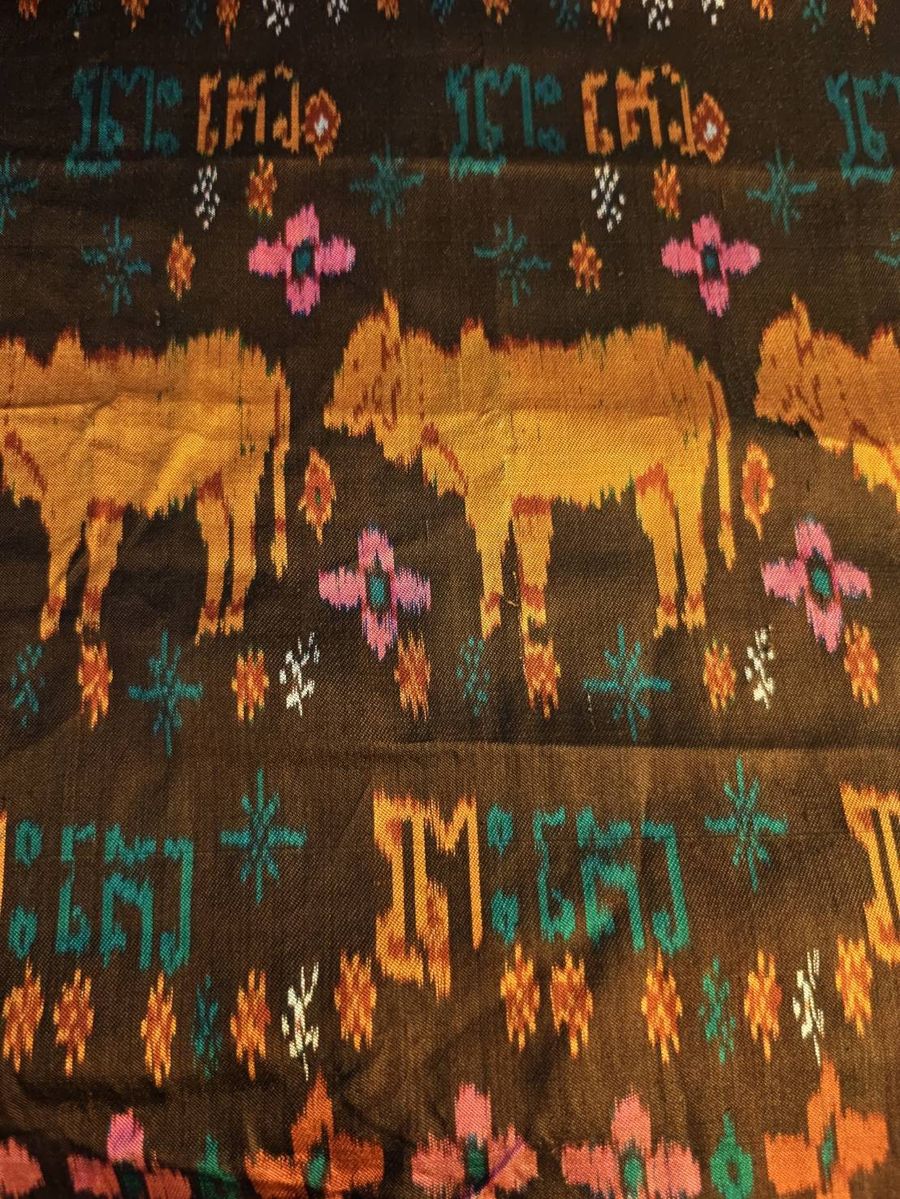
A Khmer silk hol, ikat through and through: every colour was tied and dyed into the weft before weaving. The silk has a shantung texture, the nubbly hand of thread with thick and thin places. On it: gold humped cattle, pink and teal flowers, and rows of woven Khmer letters; the gold word reads គោ, kou, “cow”. The redrawing is a plan of 72 × 104 squares. Pull drift to zero for the plan as it was tied; push it up for the tie-dye blur. Slubs adds the thick-and-thin thread.
Cambodia
สมปตโฮล · សំពត់ហូល
The weft-ikat silk wrap worn for weddings and Buddhist ceremonies. It is woven in an uneven 1/2 twill on three shafts, so one colour rules the face and another the back. More than 200 hol patterns have names.
ปิดาน · ពិដាន
Pictorial hol hung above altars and offerings: temples, Buddhas, nagas, elephants, lions, rows of figures. The name is the Khmer word for ceiling.
ไหมทอง · សូត្រមាស
Cambodia's native silkworms spin yellow cocoons. In 1996 Kikuo Morimoto, a kimono dyer from Kyoto, founded the Institute for Khmer Traditional Textiles, gathered older weavers who still held the craft, and planted mulberry and dye trees. It works from Siem Reap.
หมู่บ้านทอผ้า · ភូមិត្បាញ
Takeo province, south of Phnom Penh, is known for its silk. Koh Dach, an island in the Mekong just upstream of the city, keeps looms under the houses.
Thailand
มัดหมี่ · ម៉ាត់មី
Isan's weft ikat, in silk and in cotton, from fine silk for ceremonies to the everyday cotton pha sin, the tube skirt. Patterns are tied in bundles, and many have names: naga, hook, tree.
ขิด · ខិត
Continuous supplementary weft: an extra thread runs selvedge to selvedge over the ground weave, lifted by pattern sticks into diamonds, hooks and nagas. The triangular mon khit pillows of Isan are the best-known pieces.
จก · ចក
Discontinuous supplementary weft, picked in by fingertip or a small pick, one patch of colour at a time. The teen jok, the worked hem of a Tai Yuan tube skirt, is the pride of Mae Chaem in Chiang Mai province.
แพรวา · ផ្រែវ៉ា
The Phu Tai weavers of Kalasin make this shoulder cloth of dense supplementary-weft patterns on a red ground. Thais call it the queen of silks.
ตรานกยูง · ត្រាក្ងោក
Four peacock marks grade Thai silk. Gold: native silk, handmade start to finish, natural dyes. Silver: handmade with some modern steps. Blue: pure silk, made any way. Green: silk blends.
ฟื้นฟู · ការស្តារ
After the Second World War the American Jim Thompson built Thai silk into an export known abroad; he vanished in Malaysia's Cameron Highlands in 1967. In 1976 Queen Sirikit founded the SUPPORT Foundation, which trains village weavers and buys their cloth.
Silkworm
Bombyx mori has lived with people for thousands of years and no longer lives wild. The caterpillar eats only mulberry leaves and grows about ten thousand times heavier in under a month. Then it spins for two or three days, swinging its head in figure eights, and lays down one unbroken thread, often around 900 m. Its moth cannot fly.
Thai and Khmer native silkworms are small breeds that spin gold cocoons and hatch several generations a year. Reeled by hand, their thread comes out thick and uneven.
Chinese legend credits Leizu, wife of the Yellow Emperor, with finding silk when a cocoon fell into her tea and unravelled.
Silk Road
Silk went west by caravan from Chang'an through the oasis towns, and by sea past the ports of Southeast Asia. Oc Eo, a Funan port in today's Mekong Delta, has given up Roman coins and Indian beads. The German geographer Ferdinand von Richthofen named the Silk Road in 1877. Around 552, monks carried silkworm eggs to Constantinople hidden in hollow canes, and Byzantium began making its own silk.
Gold: the caravan road. Pale blue: the sea road. Pink: Chiang Mai.
Draw
Each pattern is one formula over the grid of crossings, woven with the same drift as the ikat. Diamond measures distance the way a taxi drives a street grid. Naga folds the rows into zigzags. Pascal's triangle, kept only where it is odd, draws Sierpiński's triangle. Or type a name.
Sources
Map: Natural Earth. Photo of the shawl: NaN. Every cloth on this page is drawn in the browser by docs/weave.js.