a sauceTeriyaki sauce
also: teriyaki · tare
Teri (照り) is the shine the sugar gives; yaki (焼き) is grilling or broiling. The sauce is named for what it looks like after the heat.
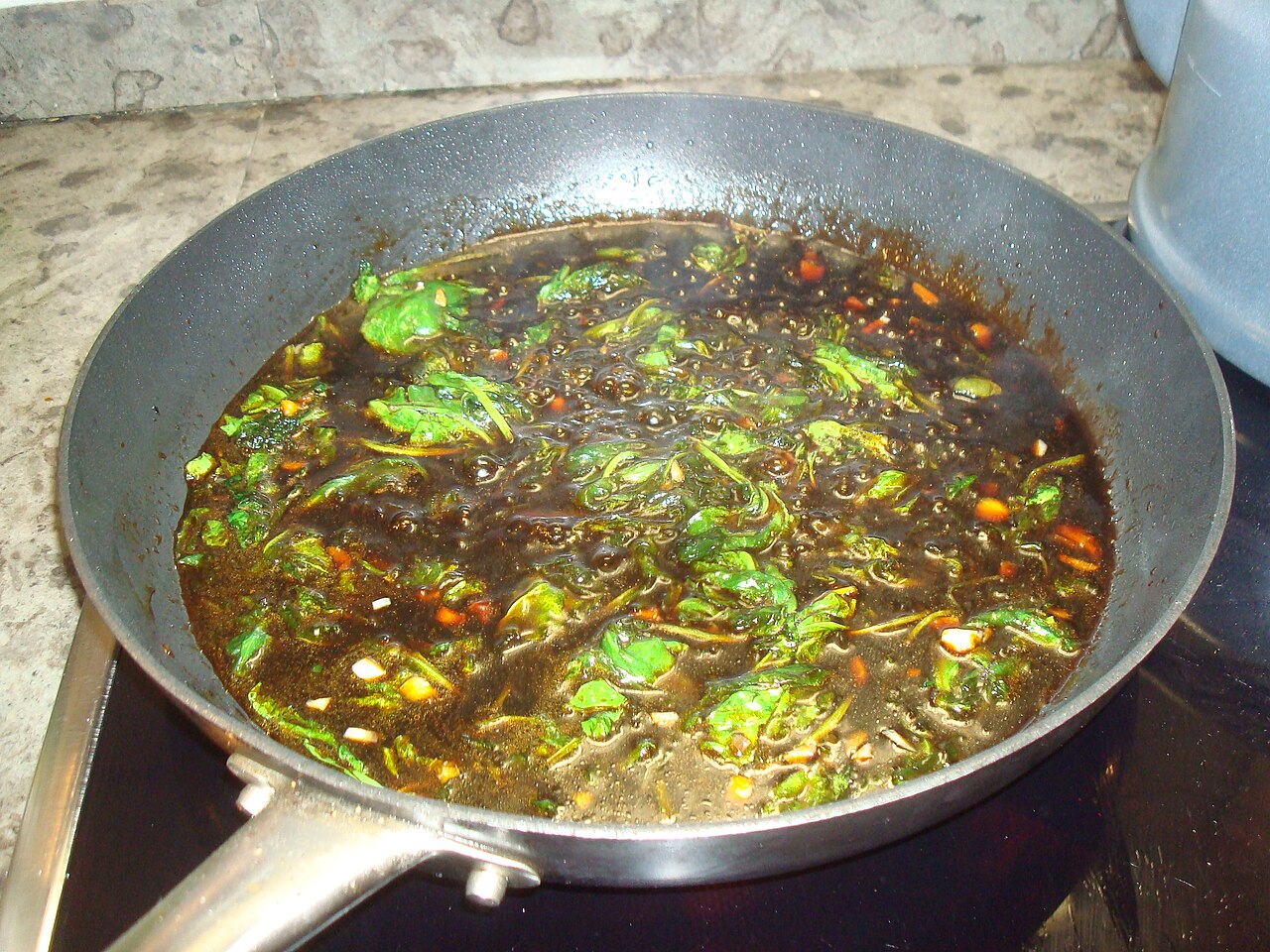
Soy sauce, mirin or sake, and sugar, boiled down to a glaze. The Japanese name for it is tare (タレ). Traditionally the meat is dipped in it or brushed with it while cooking; ginger goes in sometimes, spring onion over the top. In North America the word covers any dish made with a teriyaki-like sauce, including versions using substitutes for sake or mirin, or adding sesame or garlic — both uncommon in Japanese cooking. It goes on chicken wings and is used as a dipping sauce.
The story Cited · wp-teriyaki
Teriyaki emerged as a cooking technique in Japan during the Edo period; it is believed to have developed during the 1600s. Fish carry it there — yellowtail, marlin, skipjack tuna, salmon, trout, mackerel — while the West puts it on chicken, pork, lamb and beef.
Japanese immigrants brought it to Hawaii, where it changed with local ingredients and became a fixture of the plate lunch. Seattle grew a teriyaki culture of its own in the 1990s; by 2010 more than eighty-three restaurants in the city had teriyaki in the name, and some outlets call it the city's signature cuisine. The first standalone teriyaki restaurant, Toshi's Teriyaki, opened in Lower Queen Anne in 1976, selling low-cost chicken and beef skewers; by 1996 it had grown to seventeen locations.
The American sauce is generally sweet, though it can be made spicy. Pineapple juice is sometimes used — it sweetens and its bromelain enzymes tenderise the meat. Grilling first and pouring the sauce on afterwards, or using sweet sauce as a marinade, are both non-traditional methods.
Inference — the teriyaki wing came off the plate lunch and the skewer counter, not off a Buffalo menu, and arrived on wing boards already familiar to everyone.
How it is done Cited · wp-teriyaki
Blend soy sauce, sake or mirin and sugar over heat, boil and reduce to the thickness you want. Brush it on the wings while they grill or broil, in coats, letting each set before the next. For fried wings, toss them in the reduced sauce off the heat. Cornstarch, potato starch or kuzu root starch thickens a thin one. Sugar is why it goes on late: it darkens fast over direct heat.
Today Harvested · fdc-kikkoman-teriyaki
Bottled by every large soy-sauce maker and on wing boards nationally. As of 16 September 2026 the USDA label panel for Kikkoman Teriyaki Marinade & Sauce reads 610 mg sodium and 2 g sugar in a 1-tablespoon serving — the highest sodium per tablespoon of any sauce measured for this set, ahead of Frank's RedHot at 570. Soy sauce is first; no chile appears on the label and no Scoville number is published.
The particulars
| base | soy-sweet |
|---|---|
| heat | none |
| region | The United States, Hawaii, The Pacific Northwest |
| confidence | high · updated 2026-09-16 |
On the label
| what was read | bottle · Kikkoman Sales USA, Inc. |
|---|---|
| pepper or chile | — |
| vinegar | #5 on the label |
| butter or oil | — |
| tomato | — |
| sugar | #3 on the label |
| soy sauce | #1 on the label |
| mustard | — |
| sodium per tablespoon | 610 mg (the FDA counts 2,300 mg as a day) |
| sugar per tablespoon | 2 g (a tablespoon of table sugar is about 12.6 g) |
| Scoville | nobody publishes one for this bottle |
| the label, in order | naturally brewed soy sauce (water, wheat, soybeans, salt), wine, high fructose corn syrup, water, vinegar, salt, spices, onion powder, succinic acid, garlic powder, sodium benzoate |
Read from this page, 2026-09-16. Kikkoman Teriyaki Marinade & Sauce. Label serving is 1 Tbsp (15 mL), so the per-tablespoon figures are the label's own. The USDA transcription runs 'WINE HIGH FRUCTOSE CORN SYRUP' with no comma; read here as two ingredients, wine at 2 and high fructose corn syrup at 3 — the ranks after that follow from the reading and would shift by one if the transcription is wrong. No mirin on the label: the corn syrup does the sweetening the mirin does in a Japanese tare. No chile, no heat word, no Scoville number. Every bottle we have read is on the sauce page.
Recipes you can use
Old cookbooks are printed whole, spelling and all. Where a recipe is still somebody's copyright, you get the ingredient list and a link to the rest.
Teriyaki Sauce
- ¼ cup (2 parts) soy sauce
- ¼ cup (2 parts) mirin
- 2 tablespoons (1 part) brown sugar
- 1 tsp fresh, peeled, finely-chopped ginger
- 1 tsp fresh, peeled, finely-chopped garlic
- A litte bit of sake (optional)
Wikibooks Cookbook, CC BY-SA 4.0, copied in full with the source named, including the misspelling of 'little' in the sake line. Two parts soy, two parts mirin, one part brown sugar is the ratio; the garlic in it is the Western addition. Wikibooks files its variations under a separate heading; only the recipe itself is copied here.
Not to be confused with
- Soy garlic sauce — Garlic and mirin. Teriyaki's sweetness comes from mirin or sugar; soy garlic leads with garlic and apple juice concentrate.
Who it runs with
Where we got it
- Teriyaki · link
- Buffalo wing · link
- Kikkoman Teriyaki Marinade & Sauce — branded food label (FDC ID 2085929) · link
- Cookbook:Teriyaki Sauce · link
Where it came from: Cited a source we name · Harvested pulled from an open dataset · Tradition what the tradition says, hedged · Inference this project's reasoning · Field somebody stood there. This record as JSON.