mathematical modelling, with picturesBlack holes, drawn from the equations
Nobody has ever seen a black hole. Every picture of one is a calculation: light traced backwards from each dot of the picture, through an equation a page long, to where it came from. This site draws them that way, in front of you, and tells the story from a country rector in 1783 to the last flash ten to the hundred years from now.
Draw one yourselfHe who fights with monsters should be careful lest he thereby become a monster. And if thou gaze long into an abyss, the abyss will also gaze into thee.
Wer mit Ungeheuern kämpft, mag zusehn, dass er nicht dabei zum Ungeheuer wird. Und wenn du lange in einen Abgrund blickst, blickt der Abgrund auch in dich hinein.
Draw
How drawing with math worksin easy words, then in front of you
A picture is a grid of dots. For each dot, run the light backwards and see where it lands. The whole method, and a ray tracer running on your graphics card.
The modelmetrics, horizons, orbits, hair
Schwarzschild, Kerr, the photon sphere, the last stable orbit, why a settled black hole has three numbers and no more.
Orbitsthrow something in
Rosettes, zoom-whirls and plunges. Newton on one button, Einstein on the other.
The shadowBardeen's outline, by spin
Spin it up and watch one side flatten. Put in a mass and a distance and get the size on the sky in microarcseconds.
Wavesa chirp you can hear
Two masses spiral in. The pitch rises, the pair merge, the remnant rings. Played through your speakers at its own frequencies.
Numbersput in a mass
Horizon, temperature, lifetime, entropy, the stretch across your body, and what the horizon is the size of.
Who discovered black holes?
Nobody, and about nine people. The idea is from 1783; the equation from 1916; proof that they form from 1939 and 1965; the name from 1964 and 1967; the first one weighed in 1972, heard in 2015, photographed in 2019.
The past, with credit where it is duePast1783 → 2019
Michell and Laplace first; Schwarzschild in a trench; Chandrasekhar at nineteen; Oppenheimer in 1939; Luminet's dots in 1979.
Presentwhat is known, as of 2026
Two photographed, about three hundred heard, one seen alone by its lensing, a thirty-three-solar-mass one in our neighbourhood, and the ones the JWST found too early.
Future2027 → 10¹⁰⁰
LISA, the Einstein Telescope, the photon ring from orbit; then the age when black holes are all that is left, and how it ends.
Legendsthe ones who got there first
Rahu, who eats the sun and has an orbit; the Emu drawn from the dark; Charybdis; the spaces between the worlds; the abyss.
What kind of black hole are you?nine questions
Schwarzschild, Kerr, primordial, supermassive, merging, evaporating — with the numbers for whichever you turn out to be.
Galleryevery picture, with its credit line
Everything on the site, downloadable, CC BY 4.0. Attribution requested: a name and a link.
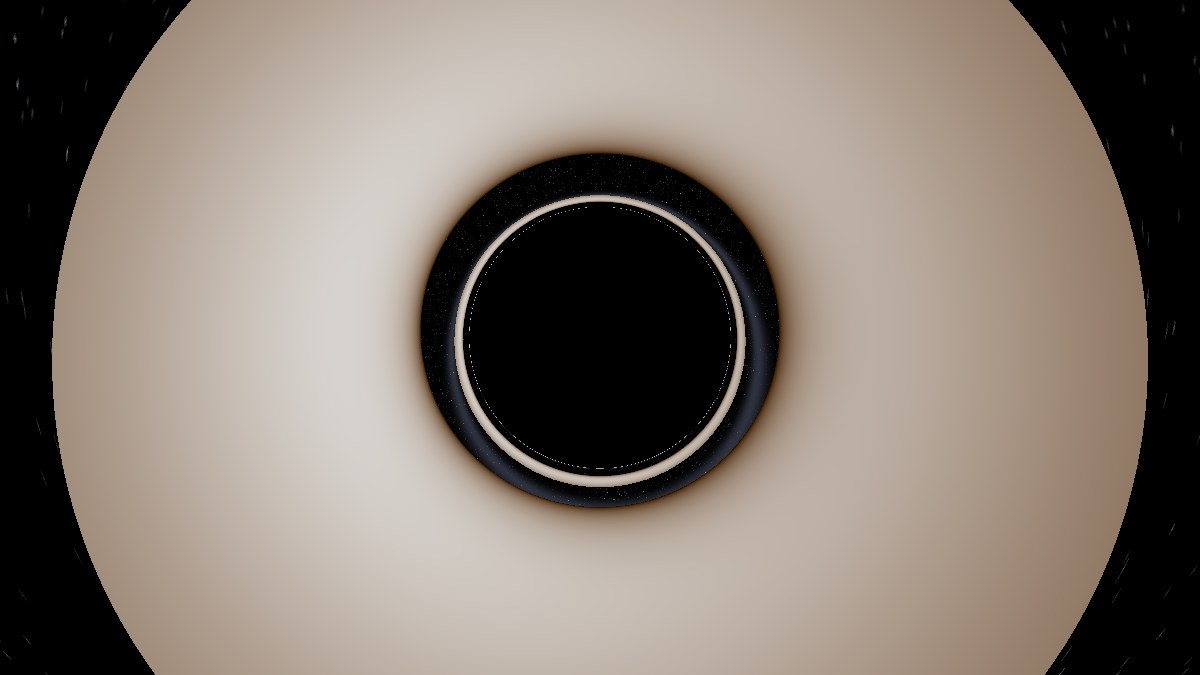
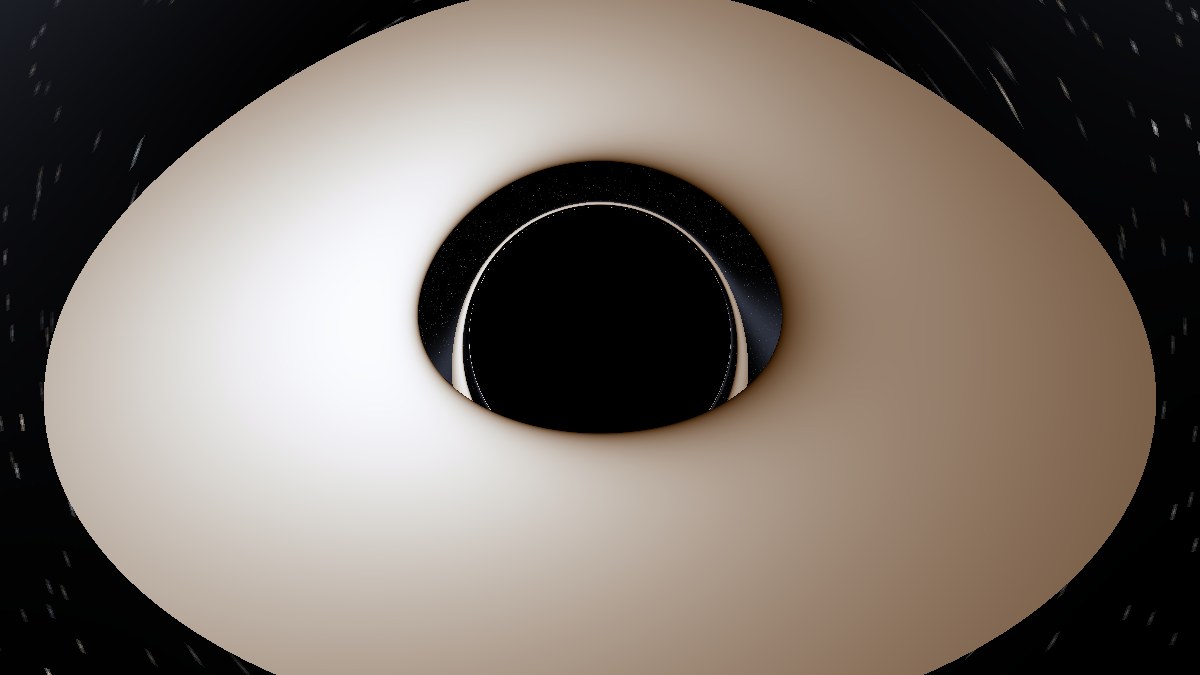
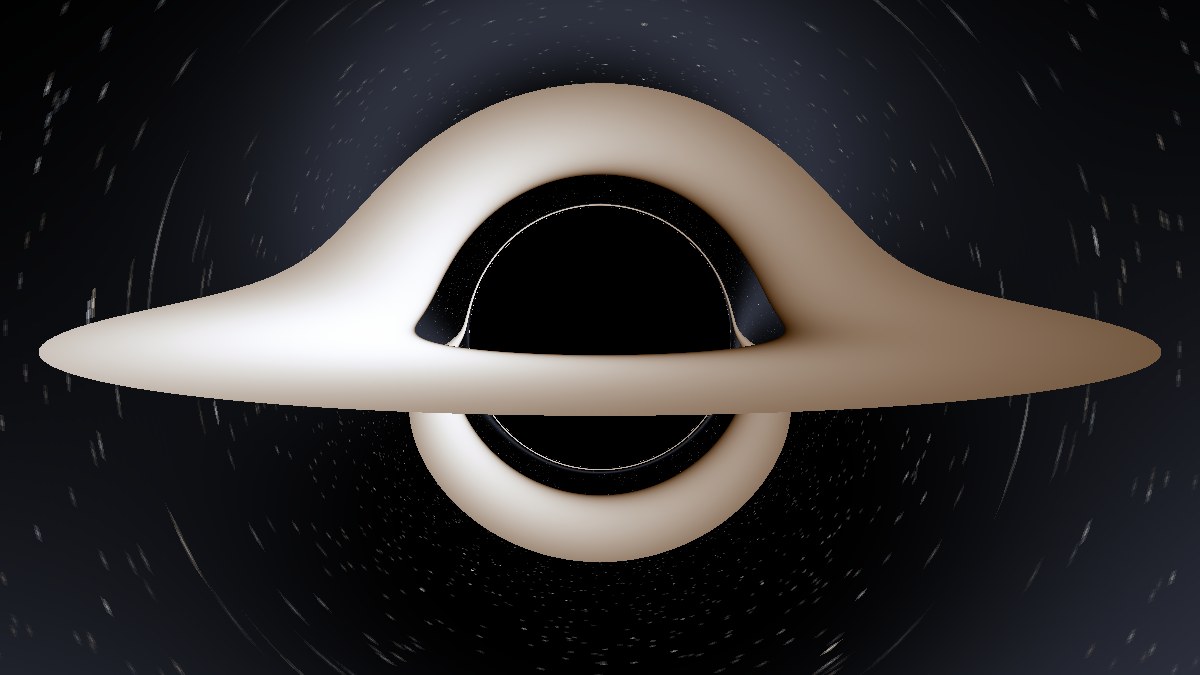
Three angles, one disk
The same disk of hot gas, same black hole, seen from three places. From above it is a ring; from the side the far half rises over the top, because light from behind the hole is bent up and over to reach you.