Eight ways to multiplyExceptional
Magic
Numbers you can multiply and divide come in four sizes: one, two, four, eight. That is the whole list, and it has been the whole list since 1898. Every time the size doubles you give up a law you were counting on. Follow the last one far enough and you arrive at the biggest exceptional object in mathematics — 248 dimensions, 240 directions, and a three-way symmetry that some physicists think is the reason there are three generations of matter.
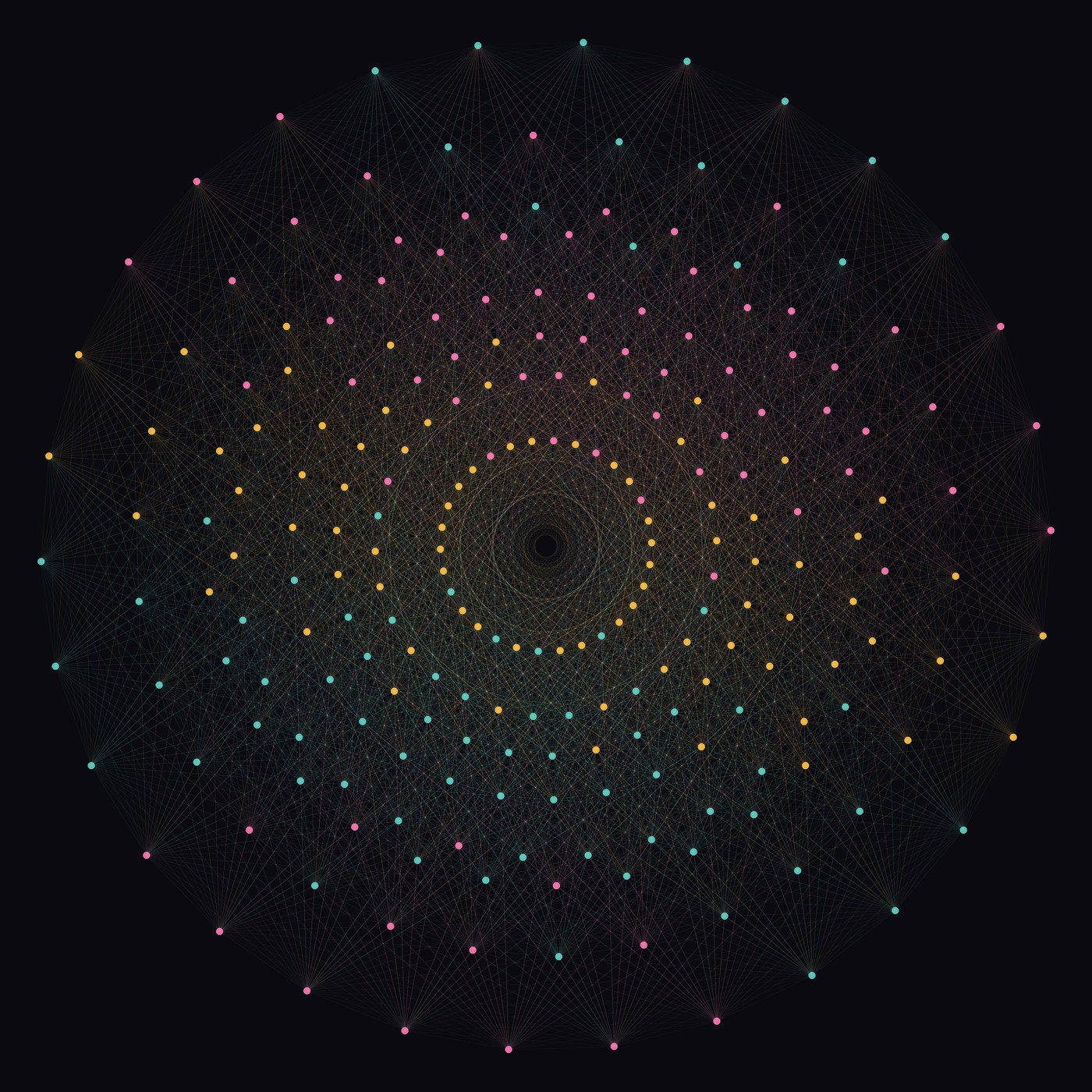
E8's 240 roots, flattened onto the one plane where the whole thing turns like a wheel — 30 clicks to the full turn, 6,720 lines joining every pair of roots sixty degrees apart. The three colours are the three pieces triality cuts it into: 84 that stand still, 78 that turn one way, 78 that turn the other. Drawn here from the coordinates, not traced.
The paper this reads
A. Garrett Lisi, Division Algebras, Triality, and Exceptional Magic, arXiv:2609.12112v1 [math-ph], 10 September 2026. HTML · PDF · CC BY-NC-ND 4.0.
That licence allows no derivatives, so nothing here is a copy of it. The mathematics is nobody's property: every table, picture and number on this site is computed in this repository from the definitions, and the paper is named wherever it is the reason a thing is here. Read it; it is better than this page.
The short version
A division algebra is a number system where you can undo a multiplication — every nonzero thing has a reciprocal. There are four, of dimension 1, 2, 4 and 8: the reals, the complex numbers, the quaternions, the octonions.
Each one is built by doubling the one before it, and each doubling takes something away. Going to the quaternions, multiplication stops caring about order. Going to the octonions, it stops caring about grouping. Go one more rung and it stops being a division algebra at all — two things that are not zero multiply to zero. Sixteen is where the wheels come off, and the 2,000 random products measured on the numbers page show exactly where each law quits.
In eight dimensions something rare happens. Vectors have eight components. Spinors — the things that describe matter, and that turn only halfway when you turn the world all the way — also have eight. Two kinds of them, in fact. So there are three different eight-dimensional objects sitting in the same room, and a symmetry called triality shuffles all three like a three-legged stool. That symmetry is the octonion product wearing a different hat.
Stack two of these algebras and you get the magic square: a seven-by-seven chart whose boxes are Lie algebras, filled by one arithmetic rule, with every exceptional algebra in it. Octonions times octonions is E8.
Where to start
Numbers
1, 2, 4, 8 — and the price of each doubling
Four algebras, the ladder that builds them, and a multiplier you can break associativity with.
Wheel
Seven posts, seven wires
The octonion table is a seven-point plane. Click two units and watch the line light up.
Triality
The same thing, three ways
One cyclic form, three arguments, and a symmetry that shuffles them. Checked on 4,000 random triples.
Square
Forty-nine boxes, one formula
The Freudenthal–Tits magic square, dimensions computed rather than quoted.
E8
240 roots, 248 dimensions
Every exceptional root system, turned live in your browser, cut three ways and two ways.
Physics
What it is all supposed to be for
One generation in e6, three in e8 — the proposal, and the objections to it, side by side.
How to read this site
The mathematics on these pages is old, settled and not in dispute: division algebras, triality, the magic square, E8's root system. Where a page turns to particle physics it says so out loud, names whose proposal it is, and lists the objections in the same breath J. Distler 2010.
Nothing is asserted here that this repository does not compute. Every number in the text is
read out of build/facts.json at build time, and
139 checks run before the site will publish —
0 failing as of 2026-09-23.