a person · NCAdam Scott
also: Rev. Adam Scott · Elder Adam Scott
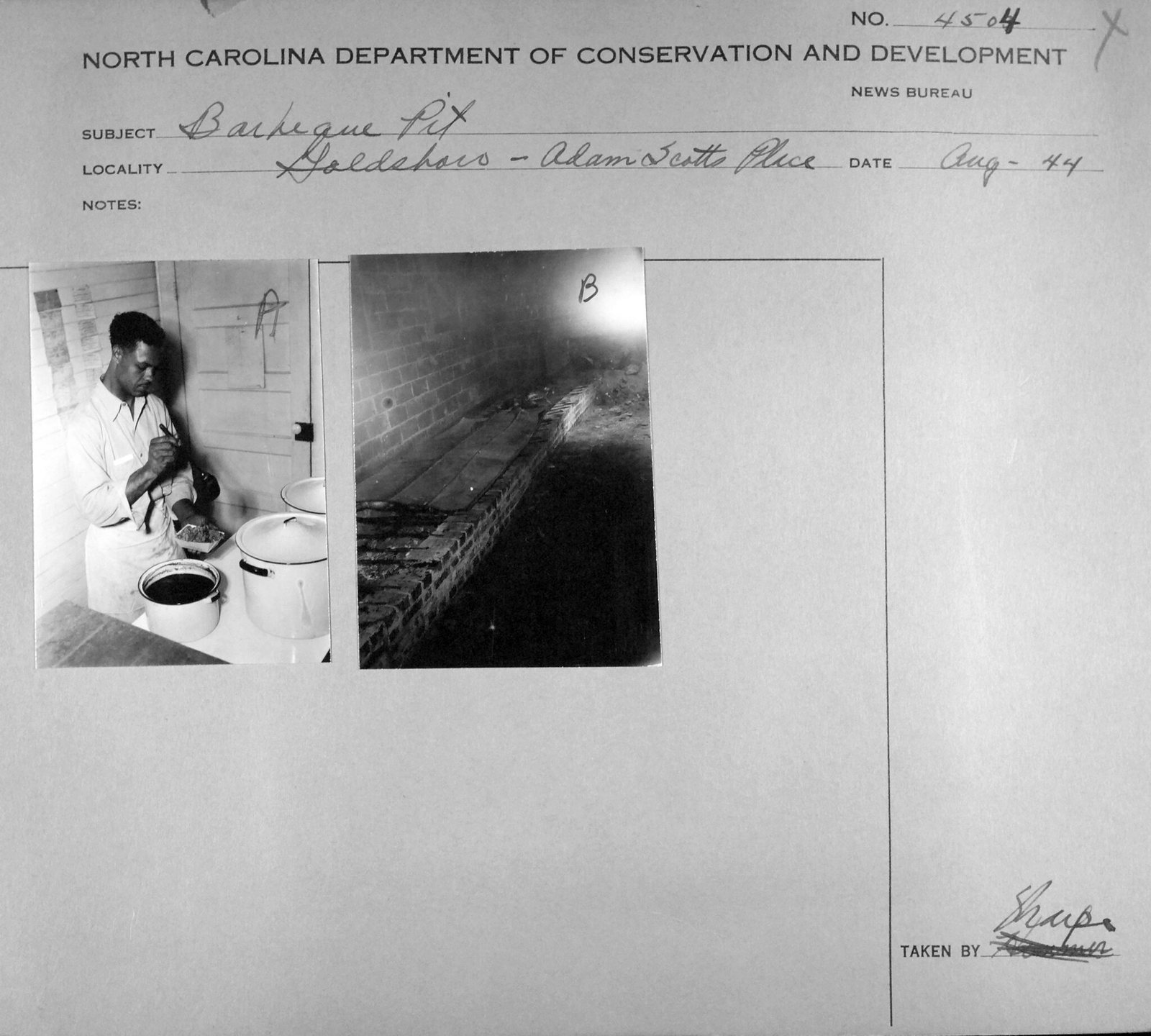
The Rev. Adam Scott (1890–1983) was a Black cook and Holiness minister in Goldsboro who by his company's date went into the barbecue business in 1917, cooking whole hogs in his back yard and selling chopped pork with a vinegar sauce through the back door; between 1931 and 1933 the house on Brazil Street became a restaurant. He said the sauce came to him in a dream; his son A. Martel Scott patented it in 1946, and the family still bottles it. David Cecelski's account has him catering a barbecue for President Franklin Roosevelt at the White House in 1933.
The story Cited · web-cecelski-adam-scott
Adam Scott was born in Goldsboro in 1890, the son of Joseph Scott, who was born in Oberlin, Ohio, and the grandson of Charles and Mary Scott, who had likely been enslaved in Johnston County. His first cooking job was at the Elberon Hotel in Atlantic City in 1911. Back home he catered barbecues from about the mid-1910s — 1917 is the company's founding date — and between 1931 and 1933 opened a restaurant at his home on Brazil Street: two hogs a week at first, cooked Friday night and sold Saturday through the back door, then four to seven hogs a day, with an enclosed porch for a dining room. His first customers were mostly white; he ran a separate cafe for Black customers elsewhere in town. The sauce, sugar-free and fat-free, took him three years to settle, and he said the precise ingredients were revealed to him in a dream. Tradition holds — in 1933 he catered barbecue in the White House Rose Garden for President Franklin Roosevelt; Cecelski tells it as fact, without a document behind it, and this record has seen none. He was a minister of the United Holy Church of America, by 1938 pastor of three churches and its general treasurer, and he closed on Sundays. In the 1940s he moved to Winston-Salem to cook for R.J. Reynolds and other private clients; his son Alvin Martel Scott, born 1913, took the Goldsboro business, patented Scott's Famous Barbecue Sauce in 1946, and by 1950 there were three Scott's around town, one run by Adam on the Raleigh road. He died in 1983 at ninety-three and is buried in Elmwood Cemetery under the word 'Elder'. The American Royal made him a legacy inductee of its Barbecue Hall of Fame in 2022.
Today Cited · web-ncarts-goldsboro
Dead: 1983, at ninety-three, in Goldsboro. The restaurants closed after 2001; the sauce is made by his descendants and sold in eastern North Carolina groceries and online, and the American Royal's Barbecue Hall of Fame lists him as a 2022 legacy inductee.
Facts
| role | cook, founder, sauce-maker |
|---|---|
| state | NC |
| styles | Eastern North Carolina barbecue |
| region | Eastern North Carolina, North Carolina |
| links | Remembering a Barbecue Legend: The Rev. Adam Scott — David Cecelski (2025) · Scott's Cafe — The Green Book in North Carolina (NC AAHC) · Scott's Barbecue Sauce — Our History |
| confidence | medium · needs verification · updated 2026-09-15 |
Its kin
Who points back
Sources
- Remembering a Barbecue Legend: The Rev. Adam Scott of Goldsboro, N.C. — David Cecelski (21 Nov 2025) · link
- Scott's Cafe — The Green Book in North Carolina (essay by Brandie K. Ragghianti, 2022) · link
- Our History · link
- Let's Eat: Goldsboro — African American Music Trails · link
- BBQ Hall of Fame Inductees Announced — Robert F. Moss (25 May 2022) · link
- Black Smoke: African Americans and the United States of Barbecue — Adrian Miller, 2021 · link
- Flickr Commons · link
- State Archives of North Carolina on Flickr Commons · link
- Department of Conservation and Development, Travel Information Division Photograph Collection · link
Where it came from: Cited a source we name · Harvested pulled from an open dataset · Tradition what the tradition says, hedged · Inference this project's reasoning · Field somebody stood there. This record as JSON.