the pitdirect heat
also: coals under the meat · open-pit · pit-cooked · cooking on coals
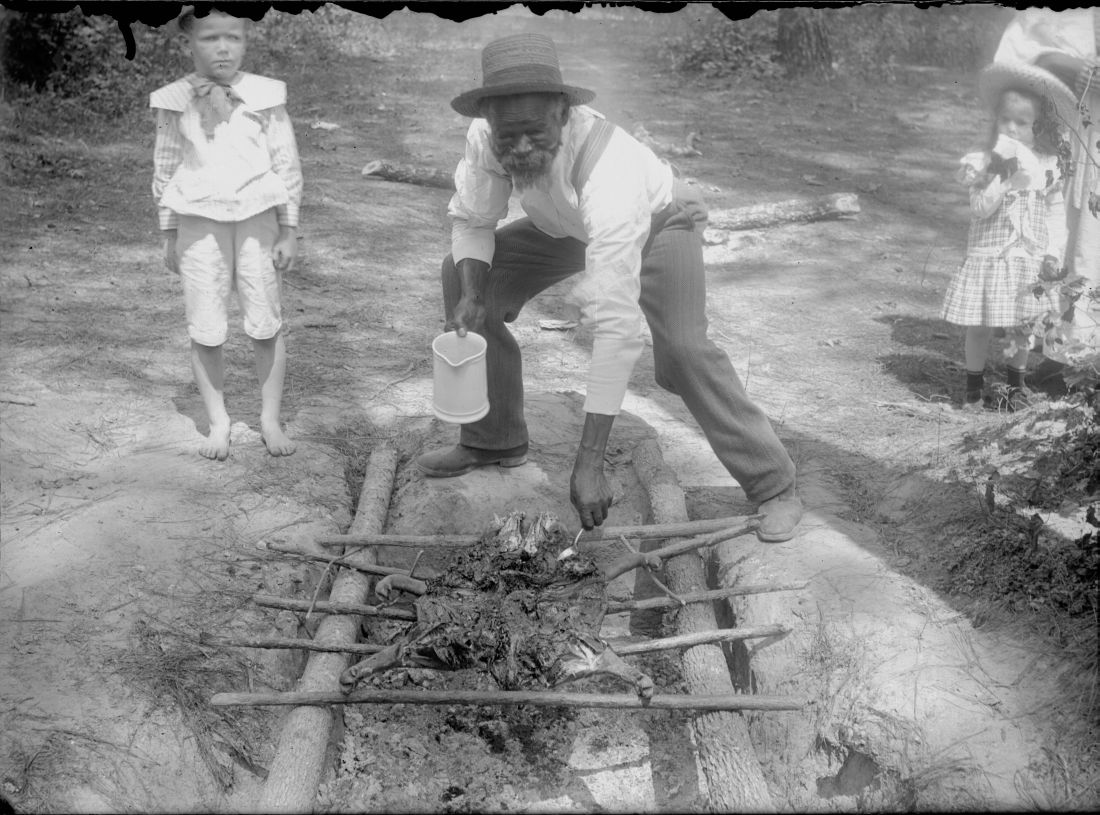
The Carolina way of putting fire to meat: a bed of hardwood coals directly beneath the hog or the shoulders, with no flame and no separate firebox. The coals are made elsewhere — in a burn barrel or a fireplace — and shoveled in, so the meat sits over glowing charcoal and its own dripping fat rather than in a stream of smoke. The contrast is the offset smoker of Central Texas: a cylinder with a smaller firebox attached at one end, whose burning post-oak fire sends heat and smoke sideways through the chamber past the meat — indirect heat. The whole-hog article, the Mallard Creek church and the Barbecue Center all describe the coals going under the meat.
The story Cited · wp-barbecue
The word carries the method. The Wikipedia article on barbecue draws its line between the indirect barbecues of the United States — meat roasted or smoked over wood or charcoal at low temperature for hours — and the direct grilling of most of the world, done over hot coals for minutes; in a typical American home barbecue the coals are dispersed to the sides. The Carolina pit sits across that line: the coals are directly under the meat, as on a grill, but far enough below and slow enough that the cook is barbecuing, not grilling. True 'Cue quotes a federal meat-labeling rule that defines barbecued meat as 'cooked by the direct action of dry heat resulting from the burning of hard wood'. Texas divides the same way: Central Texas cooks with indirect heat from a pecan, post-oak or mesquite fire, and West Texas over direct mesquite heat 'in a method very similar to grilling'. Inference — in geometry the Carolina pit is closer to the West Texas cowboy fire than to the Austin smoker, and the reason both Carolina styles burn their wood to coals first is that flame under a fat hog is a fire. Ed Mitchell in Wilson cooks 'hot and fast' with a bank of coals surrounding the hog, starting at 500 degrees and letting it fall to 250; Rodney Scott shovels coals under a hog lying belly-down for eight to twelve hours; the Barbecue Center in Lexington 'fires the pits' by distributing coals evenly beneath the shoulders.
How it is done Tradition
Coals go in under the meat in a thin, even bed and are renewed from the burn barrel through the cook; the meat is never over flame. Tradition holds — the bed goes heavier under the hams and shoulders of a whole hog and thinner under the loin. Fat drips onto the coals and vaporizes — Inference — the source of much of what the Carolinas call wood flavor — and a flare-up from that fat is the whole-hog cook's constant danger. The pit is closed with a lid or a door to hold the heat, and a hog is flipped once near the end.
Today Cited · web-ourstate-historic-barbecue-trail
Every pit on the North Carolina Historic Barbecue Trail and every True 'Cue certificate cooks this way by definition — on grates over pits with wood or charcoal. Tradition holds — the offset smoker has arrived too: Lewis Barbecue in Charleston cooks Central Texas brisket in offset smokers, and is described here the same way as a wood pit.
Facts
| kind | method |
|---|---|
| region | The Carolinas, The American South |
| links | Barbecue — Wikipedia (direct and indirect) · Smoker (cooking) — Wikipedia (offset smoker) · Barbecue in Texas — Wikipedia |
| confidence | medium · needs verification · updated 2026-09-15 |
Not to be confused with
- hickory and oak — Direct heat is where the fuel sits; hickory and oak are the fuel. A Texas firebox burns the same woods beside the meat instead of beneath it.
Its kin
Who points back
Sources
- Barbecue — Wikipedia · link
- Smoker (cooking) — Wikipedia · link
- Barbecue in Texas — Wikipedia · link
- Whole hog barbecue — Wikipedia · link
- History of the Annual Barbecue · link
- Lexington, North Carolina Barbecue is All About the Pork (Randy Mink) · link
- Ed Mitchell (pitmaster) — Wikipedia · link
- When His Pit Burned Down, A Southern BBQ Master Took Hogs On Tour (Debbie Elliott, February 4, 2014) · link
- Wood — The Campaign for Real Barbecue · link
- Running on Full: The North Carolina Historic Barbecue Trail (Bryan Mims, January 29, 2016) · link
- The Campaign for Real Barbecue (John Shelton Reed, January 23, 2018) · link
- Flickr Commons · link
- State Archives of North Carolina on Flickr Commons · link
- Albert Barden Collection, State Archives of North Carolina — Albert Barden · link
Where it came from: Cited a source we name · Harvested pulled from an open dataset · Tradition what the tradition says, hedged · Inference this project's reasoning · Field somebody stood there. This record as JSON.