Shor, and the billQuantum
In 1994 Peter Shor showed that a quantum computer could split any number in a number of steps that grows like a small power of its length — not the L(1/3) curve, not anything near it [42]. The quantum part of the algorithm does one thing: it finds how often a sequence repeats. Here is that one thing, then every claim to have done it on hardware, then the bill.
The period
Pick a number a with no factor in common with N and write down a, a², a³, … each reduced mod N. The sequence has to repeat, because there are only N remainders. Call the spacing r, the period. Then, half the time or better, ar/2 is a square root of 1 mod N that is not ±1, and
For N = 15 and a = 7: the sequence runs 1, 7, 4, 13, 1, 7, 4, 13, … with period 4; 72 mod 15 = 4, and gcd(3, 15) = 3, gcd(5, 15) = 5. That is the arithmetic the 2001 IBM experiment did [43]. For 21 with a = 2 the period is 6 and the factors are 7 and 3 [44].
Finding r classically means walking the sequence, which for a 2048-bit N is a walk as long as trial division. A quantum register holds all the values ax at once, and the quantum Fourier transform turns that into a set of readings that peak at multiples of Q/r — the frequency of the beat. Read one, do a little arithmetic with continued fractions, and you have r. That is the whole quantum step.
Watch the period
Top: the sequence. Bottom: what the quantum computer reads — the Fourier transform of the beat, computed here on 128 points the slow way. Some choices of a fail (odd period, or the trivial root); Shor's algorithm picks another a and goes again.
Every claim, beside what was done
The largest number split by Shor's algorithm on real hardware, as of 2026-09-23, is 21, in 2012 — and that run, like every hardware run of Shor so far, was 'compiled' with knowledge of the answer, which Smolin, Smith and Vargo showed lets two qubits 'factor' any number you like [47]. Everything larger in the press was one of: an adiabatic minimisation with no known scaling advantage, a classical method with a small quantum step bolted on, a number chosen to be easy, or a toy curve key.
| date | who | what was said | what was done | verdict |
|---|---|---|---|---|
| 2001-12 | Vandersypen and others, IBM Almaden and Stanford | 15 = 3 × 5 by Shor's algorithm | Seven nuclear spins in a molecule ran a circuit compiled with the answer known. The first hardware Shor. | Real, tiny, compiled. [43] |
| 2012-03 | Xu and others, USTC | 143 factored on four qubits | An adiabatic minimisation, not Shor; the problem was reduced to a few unknown bits first. In 2014 Dattani and Bryans showed the same run had also 'factored' 56,153, because the trick only depends on how the factors' bits differ. | No route to big numbers. [45][46] |
| 2012-10 | Martín-López and others, Bristol | 21 = 3 × 7 by Shor's algorithm | Photons and a recycled qubit; compiled. Still the largest Shor factorisation on hardware in 2026. | Real, tiny, compiled. [44] |
| 2016-03 | Monz and others, Innsbruck | A scalable Shor's algorithm on five trapped ions — 15 | The first run of the full Kitaev-style period finding without shortcuts in the quantum part, on 15. | Real, tiny, cleaner. [48] |
| 2019-03 | Amico, Saleem and Kumph, IBM | 35 on IBM Q hardware | The attempt failed: noise swamped the answer. An honest negative result. | Did not work. [49] |
| 2021-03 | Claus Peter Schnorr | 'This destroys the RSA cryptosystem' (a classical lattice method) | No challenge number was factored; the sentence was dropped in a revision; later work found the method fails past about 80 bits. | Nothing was destroyed. [53][103] |
| 2022-12 | Yan and 23 others | 372 qubits could challenge RSA-2048 | Schnorr's method with a small quantum optimiser in the loop; the hardware run split a 48-bit number on ten qubits. The classical part is the part that does not scale. | Aaronson: 'cargo cult quantum factoring'. [54][55] |
| 2024-05 | Wang Chao and others, Shanghai University | RSA broken on a D-Wave annealer (the October 2024 headlines) | A 22-bit number, 2,269,753, on a quantum annealer. Annealing has no known advantage at scale. | 22 bits against 2048. [77] |
| 2024-12 | Wang Chao and others | 'A first successful factorization of RSA-2048 integer by D-Wave' | On integers whose two primes differ in two low bits — every one of which Fermat's 1643 method splits in milliseconds. Not an RSA key. | The number was chosen to be easy. [78] |
| 2025-04 | Wang Chao's group, reported by the SCMP | A 90-bit RSA number on a D-Wave machine | No paper located as of September 2026. | Unconfirmed. [82] |
| 2025-07 | Steve Tippeconnic | A 5-bit elliptic-curve key broken on IBM's 133-qubit machine | A 15-qubit circuit over a 32-element group; the answer, k = 7, is found by classical post-processing of the readouts. | A toy key, run for real. [85] |
| 2026-04 | Giancarlo Lelli; the Q-Day Prize | A 15-bit curve key recovered on IBM Heron processors — one bitcoin awarded | About 98,000 gates on cloud hardware. Bitcoin developers reproduced the recovery from random bits, since 32,767 candidates can simply be checked; the hardware output was 'statistically indistinguishable from coin flips'. | Project Eleven's CEO: 'not Q-Day'. [95][96] |
The bill
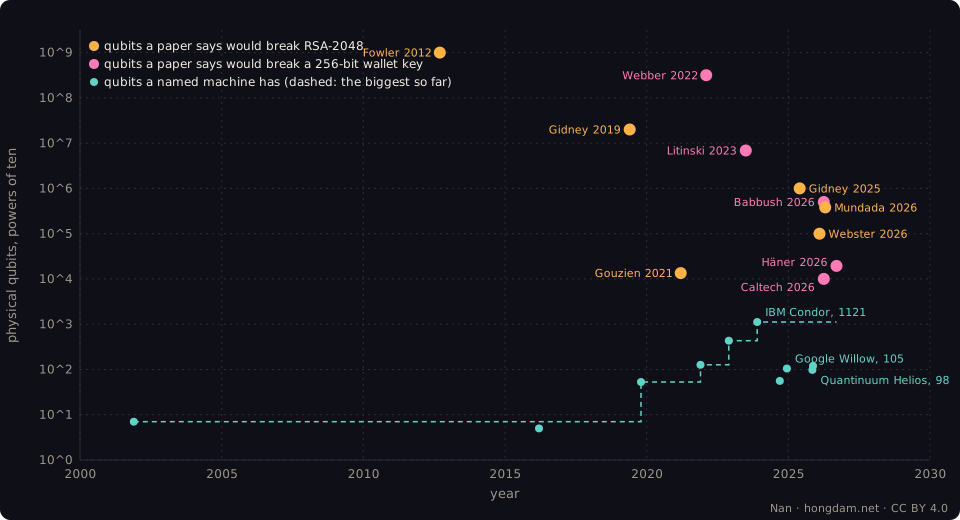
Since nobody can run Shor at scale, the field publishes estimates: how many physical qubits, at what error rate, for how long. The estimates have fallen a thousandfold in fourteen years, all on paper. Each one assumes a physical error rate of about one in a thousand and a code that turns many noisy qubits into one reliable one; the newest ones assume codes and wiring that do not exist yet at scale.
| date | who | target | physical qubits | logical | time | note |
|---|---|---|---|---|---|---|
| 2012-09 | Fowler, Mariantoni, Martinis, Cleland | RSA-2048 | 1,000,000,000 | — | about a day | the surface-code review's headline: a billion physical qubits for a 2000-bit number [50] |
| 2017-06 | Roetteler, Naehrig, Svore, Lauter | 256-bit curve key | — | 2,330 | 1.26 × 10^11 Toffoli gates | the first precise count for a 256-bit curve key: about 2,330 logical qubits [59] |
| 2019-05 | Gidney and Ekerå | RSA-2048 | 20,000,000 | — | 8 hours | twenty million noisy qubits, 0.1% error, 1 µs cycle [51] |
| 2021-03 | Gouzien and Sangouard | RSA-2048 | 13,436 | — | 177 days | plus a quantum memory of 28 million modes that does not exist; time traded for space [52] |
| 2022-01 | Webber, Elfving, Weidt, Hensinger | 256-bit curve key | 317,000,000 | — | 1 hour (13 million qubits for a day; 1.9 billion for 10 minutes) | the paper that first priced a Bitcoin key against the ten-minute block [60] |
| 2023-06 | Litinski | 256-bit curve key | 6,900,000 | — | about 10 minutes per key | 50 million Toffoli gates in a photonic 'active volume' model [61] |
| 2024-02 | Chevignard, Fouque, Schrottenloher | RSA-2048 | — | 1,730 | about 40 runs of 2^36 Toffoli gates | a third of the logical qubits at the price of a thousand times more gates [76] |
| 2025-05 | Gidney | RSA-2048 | 1,000,000 | — | under a week | fewer than a million noisy qubits; same 0.1% error assumption as 2019 [58] |
| 2026-02 | Webster and others, Iceberg Quantum | RSA-2048 | 100,000 | — | not the headline | fewer than 100,000 on qLDPC codes with long-range wiring; about 22,000 at 0.01% error [88] |
| 2026-03 | Babbush, Zalcman, Gidney, Broughton, Khattar, Neven, Bergamaschi, Drake, Boneh | 256-bit curve key | 500,000 | 1,450 | 18–23 minutes; about 9–12 from a primed state | fewer than half a million superconducting qubits; fast enough for the ten-minute block on a fast-clock machine [91] |
| 2026-03 | Caltech and Oratomic | 256-bit curve key | 10,000 | — | about 10 days per key | ten to twenty-six thousand neutral atoms; slow clock, so days not minutes [93] |
| 2026-04 | Mundada and others, Q-CTRL | RSA-2048 | 381,000 | — | 9.2 days | idle logical qubits parked in slower memory tiers [94] |
| 2026-09 | Häner and others, IonQ | 256-bit curve key | 19,397 | 1,457 | 25.7 days, 63% success | a trapped-ion blueprint; IonQ's largest machine is 256 qubits [100] |
The machines
| year | machine | physical qubits | logical | |
|---|---|---|---|---|
| 2002 | IBM Almaden NMR | 7 | — | [43] |
| 2016 | Innsbruck ion trap | 5 | — | [48] |
| 2020 | Google Sycamore | 53 | — | [62] |
| 2022 | IBM Eagle | 127 | — | [87] |
| 2023 | IBM Osprey | 433 | — | [87] |
| 2024 | IBM Condor | 1,121 | — | [87] |
| 2025 | Quantinuum H2 (with Microsoft) | 56 | 12 | [79] |
| 2025 | Google Willow | 105 | 1 | [62] |
| 2026 | Quantinuum Helios | 98 | 48 | [86] |
| 2026 | IBM Nighthawk | 120 | — | [87] |
Physical qubits are the noisy ones a chip has. Logical qubits are the reliable ones built from them by error correction, and the exchange rate has been about a thousand to one for the surface code. Google's Willow (December 2024) was the first chip clearly past the point where adding physical qubits makes the logical one better instead of worse [62]; Quantinuum's Helios (November 2025) holds 48 logical qubits, the most anywhere [86]. The papers want more than a thousand logical qubits running billions of operations. IBM's roadmap puts 200 logical qubits in 2029 [84].
The wallet page has the 2026 estimates for a curve key specifically, and the ten-minute question.