1991 to this monthRecords
Every general-purpose factoring record since the RSA challenge list was published, the curve they sit on, and a ruler for how far a 2048-bit key is from the biggest number anyone has split.
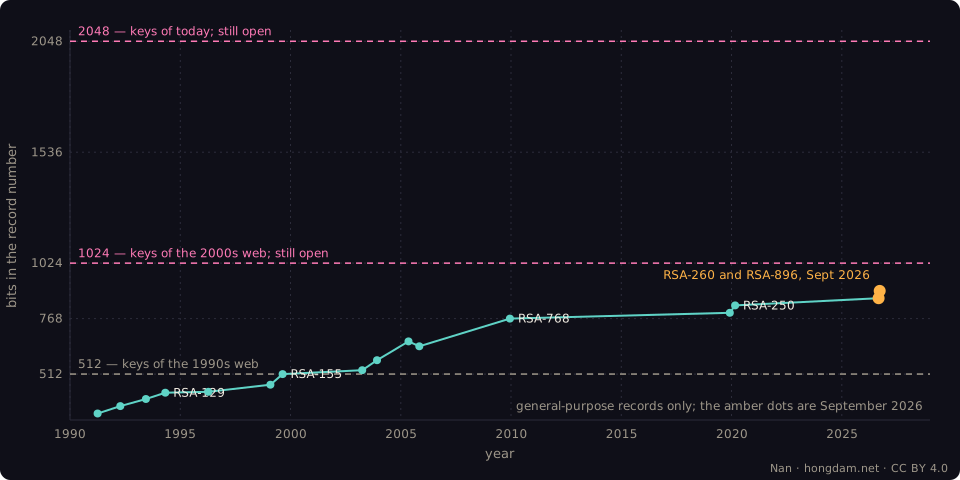
| number | digits | bits | date | who | method | effort |
|---|---|---|---|---|---|---|
| RSA-100 | 100 | 330 | 1991-04-01 | Arjen Lenstra | MPQS | a few days on a MasPar [29] |
| RSA-110 | 110 | 364 | 1992-04-14 | Arjen Lenstra and Mark Manasse | MPQS | about a month [29] |
| RSA-120 | 120 | 397 | 1993-06-09 | Denny, Dodson, Lenstra, Manasse | MPQS | about 830 MIPS-years [29] |
| RSA-129 | 129 | 426 | 1994-04-26 | Atkins, Graff, Lenstra, Leyland and about 600 volunteers | MPQS | about 5,000 MIPS-years over eight months [23] |
| RSA-130 | 130 | 430 | 1996-04-10 | Lenstra and others | GNFS | about 1,000 MIPS-years — the first RSA number by the number field sieve [29] |
| RSA-140 | 140 | 463 | 1999-02-02 | te Riele and others (CWI) | GNFS | about 2,000 MIPS-years [29] |
| RSA-155 | 155 | 512 | 1999-08-22 | Cavallar and seventeen others | GNFS | about 8,000 MIPS-years, seven months [24] |
| RSA-160 | 160 | 530 | 2003-04-01 | Franke, Kleinjung and others (Bonn) | GNFS | a few months on a cluster [29] |
| RSA-576 | 174 | 576 | 2003-12-03 | Franke, Kleinjung and others | GNFS | months on a cluster [29] |
| RSA-640 | 193 | 640 | 2005-11-02 | Bahr, Boehm, Franke, Kleinjung | GNFS | about 30 years of a 2.2 GHz Opteron [29] |
| RSA-200 | 200 | 663 | 2005-05-09 | Bahr, Boehm, Franke, Kleinjung | GNFS | about 55 years of a 2.2 GHz Opteron [29] |
| RSA-768 | 232 | 768 | 2009-12-12 | Kleinjung and twelve others | GNFS | about 2,000 years of a 2.2 GHz Opteron core [25] |
| RSA-240 | 240 | 795 | 2019-12-02 | Boudot, Gaudry, Guillevic, Heninger, Thomé, Zimmermann | GNFS (CADO-NFS) | about 900 core-years of a 2.1 GHz Xeon Gold 6130 [26] |
| RSA-250 | 250 | 829 | 2020-02-28 | Boudot, Gaudry, Guillevic, Heninger, Thomé, Zimmermann | GNFS (CADO-NFS) | about 2,700 core-years of a 2.1 GHz Xeon Gold 6130 [27][26] |
| RSA-260 | 260 | 862 | 2026-09-03 | Eric Lu (Cognition) | GNFS (CADO-NFS on GPUs) | 4,923 GPU-days on B200-class GPUs, about 16 days elapsed, about $400k at list prices [99] |
| RSA-896 | 270 | 896 | 2026-09-19 | Stephen Weis (Anthropic) | GNFS (CADO-NFS on GPUs) | about 30 GPU-years on up to 2,048 idle GPUs over ten days [101] |
| still open | ||||||
| RSA-270 | 270 | 895 | 270 digits, still open in the challenge list — RSA-896 (also 270 digits) was the one that fell [29] | |||
| RSA-1024 | 309 | 1024 | the key size most of the web used until about 2013; still open [29] | |||
| RSA-2048 | 617 | 2048 | the key size most of the web uses now; still open [29] | |||
| special form — a different, easier sieve; not comparable | ||||||
| 2^1061 − 1 | 320 | 1061 | 2012-08-04 | NFS@Home | SNFS | the special number field sieve works on numbers of a special form; the record for those is bigger, and says nothing about RSA keys [102] |
| Seventeen Mersenne numbers 2^n − 1, 1007 ≤ n ≤ 1199 | 361 | 1199 | 2014-08 | Kleinjung, Bos, Lenstra | SNFS, shared sieving | the 'Mersenne factorization factory' — one sieving pass amortised across many numbers [102] |
The two 2026 rows are not on the RSA challenge list's own cadence: RSA-260 was the next unsolved challenge number; RSA-896 was a 270-digit challenge number picked because it was a round number of bits. Effort units change with the era — MIPS-years, Opteron-years, Xeon core-years, GPU-years — and are not convertible without a footnote; the sources give each team's own figure.
The curve
The number field sieve's running time has a known shape [22]:
Anchor it on RSA-250 — 2,700 core-years for 829 bits [27] — and read off the rest:
| bits | digits | times RSA-250 | core-years, scaled | in words |
|---|---|---|---|---|
| 512 | 155 | 2.67e-05 | 0.0721 | about 26 days of one core |
| 768 | 232 | 0.164 | 442 | about 442 core-years — a big cluster for a year |
| 829 | 250 | 1 | 2.7e+03 | about 2,700 core-years — a big cluster for a year |
| 1024 | 309 | 200 | 5.4e+05 | about 540,014 core-years — every core in a large data centre for years |
| 1536 | 463 | 1.99e+07 | 5.38e+10 | 5.4e+10 core-years — more computing than has been done on Earth |
| 2048 | 617 | 2.33e+11 | 6.29e+14 | 6.3e+14 core-years — more computing than has been done on Earth |
| 3072 | 925 | 8.82e+17 | 2.38e+21 | 2.4e+21 core-years — more computing than has been done on Earth |
| 4096 | 1234 | 1.96e+23 | 5.29e+26 | 5.3e+26 core-years — more computing than has been done on Earth |
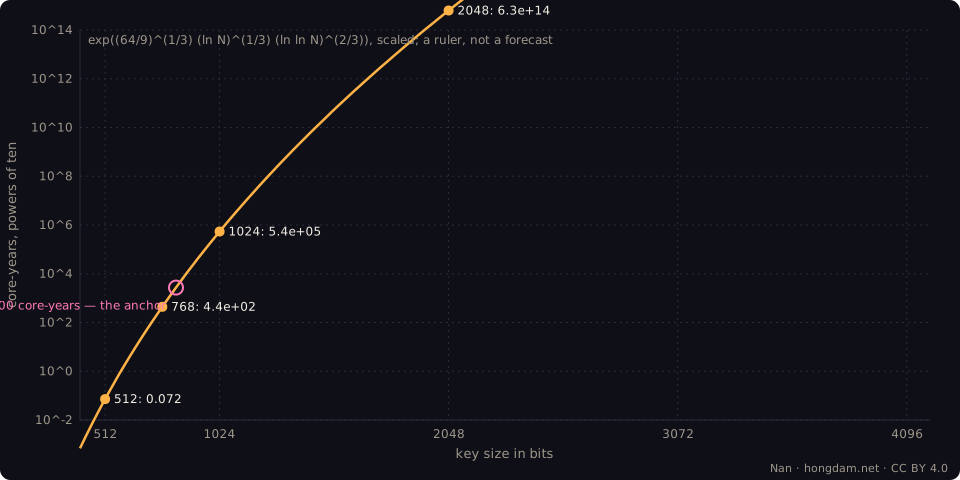
The ruler
What the 2026 records changed
Two things, and neither is the mathematics. Eric Lu's RSA-260 run in early September and Stephen Weis's RSA-896 run two weeks later both ported CADO-NFS to data-centre GPUs, with AI coding agents doing much of the port [99][101]. Weis's ran as a low-priority job on idle machines: about thirty GPU-years in ten days, at no marginal cost to anyone. His own conclusion: the running time of the sieve did not improve, deployed 2048-bit keys are not affected — and a 1024-bit key is now within reach of anyone with a large GPU fleet and a slow month. Old keys do not retire themselves; in 2015 a 512-bit key cost $75 of cloud time to break and hundreds were still in use [32].