a donutFrench cruller
also: cruller · kruller
The light one. Ridged, hollow, gone in three bites.
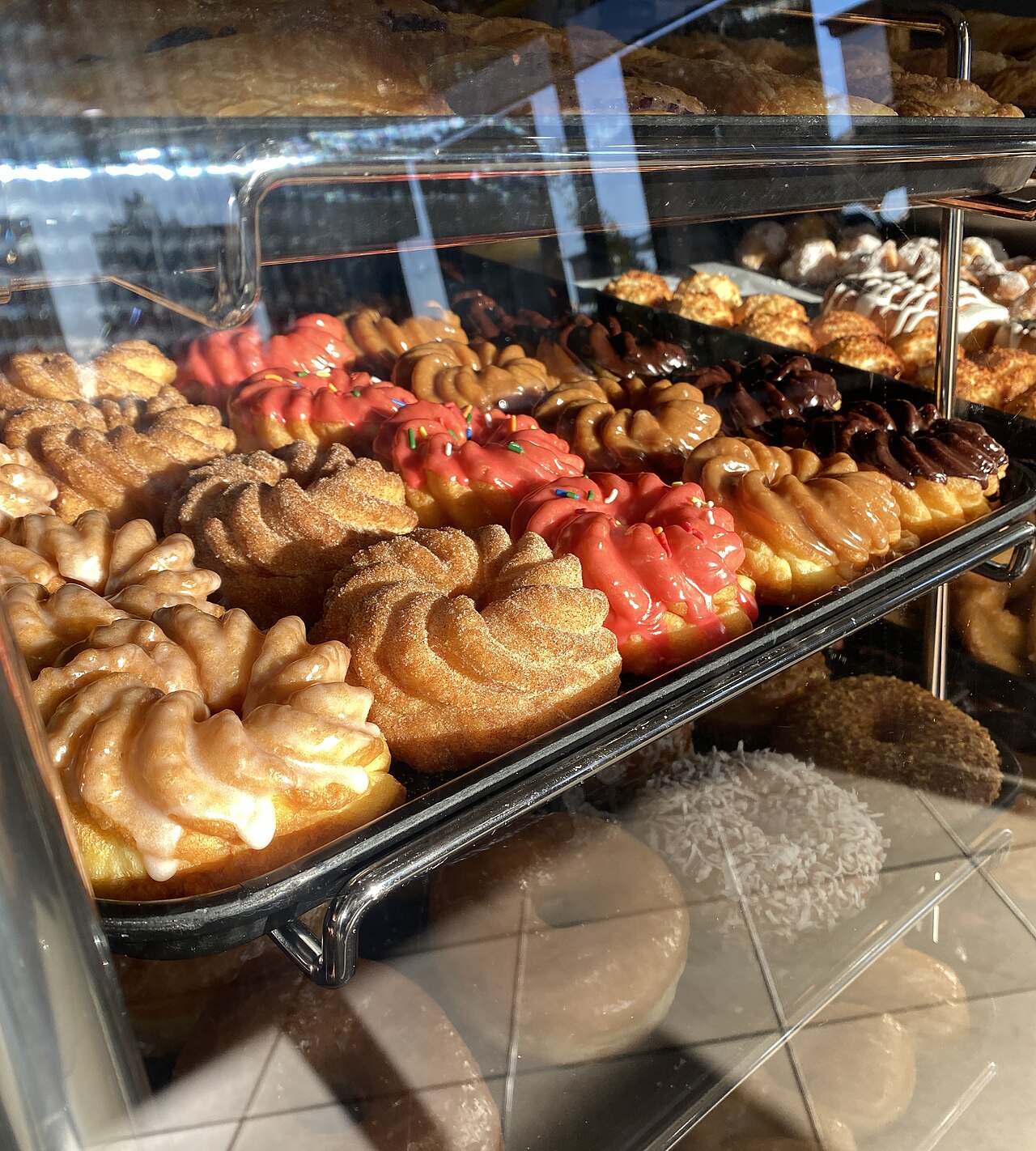
A ring extruded from choux paste — flour cooked into butter and water, then beaten with eggs — piped through a star tip so it fries up ridged and hollow, and glazed thin. No yeast, no baking powder: steam lifts it.
The story Cited · wp-cruller
Cruller is Dutch, from kruller, from krullen, to curl, and it arrives in America in the late eighteenth and early nineteenth centuries with Pennsylvania Dutch settlers. In Europe the shape is a twist or a plaited rectangle pulled through itself; in North America the word covers both a small loaf- or stick-shaped cake doughnut and the French cruller, the choux ring. Milwaukee's cruller is the loaf kind: a glazed cake bar with a crunchy shell.
The word travels further than the pastry. Youtiao, the Chinese fried stick, gets called a Chinese cruller in English; so does mahua, the twisted one.
How it is done Cited · wp-cruller
Cook the paste, beat in the eggs, pipe rings onto squares of paper, and slide them paper and all into the fat so they keep their shape. The paper lifts off once they set. Glaze while warm.
Today Inference
Few independent shops make them, because the paste is a different process from everything else on the bench, and the ones that do say so on the sign.
The particulars
| dough | choux |
|---|---|
| finish | glazed |
| region | The United States |
| confidence | high · updated 2026-09-16 |
On the label
| what was read | usda |
|---|---|
| pepper or chile | ? |
| vinegar | ? |
| butter or oil | ? |
| tomato | ? |
| sugar | ? |
| soy donut | ? |
| mustard | ? |
| Scoville | nobody publishes one for this donut |
Read from this page, 2026-09-17. USDA SR Legacy 172756, "Doughnuts, french crullers, glazed", published per 100 g and scaled here to the portion USDA itself lists as "cruller (3" dia)" — 41 g. No ingredient list is published for these generic rows, so the ingredient ranks are null. A shop's own donut is not this donut; this is the closest published measurement of the kind. Every donut measured is on the donut page.
Who it runs with
Who talks about it
Where we got it
Where it came from: Cited a source we name · Harvested pulled from an open dataset · Tradition what the tradition says, hedged · Inference this project's reasoning · Field somebody stood there. This record as JSON.