a sauceJerk marinade
also: jerk seasoning · jerk spice · Jamaican jerk spice
One word covers three things: the rub, the wet marinade made from it, and the way of cooking. A jerk stand sells all three at once.
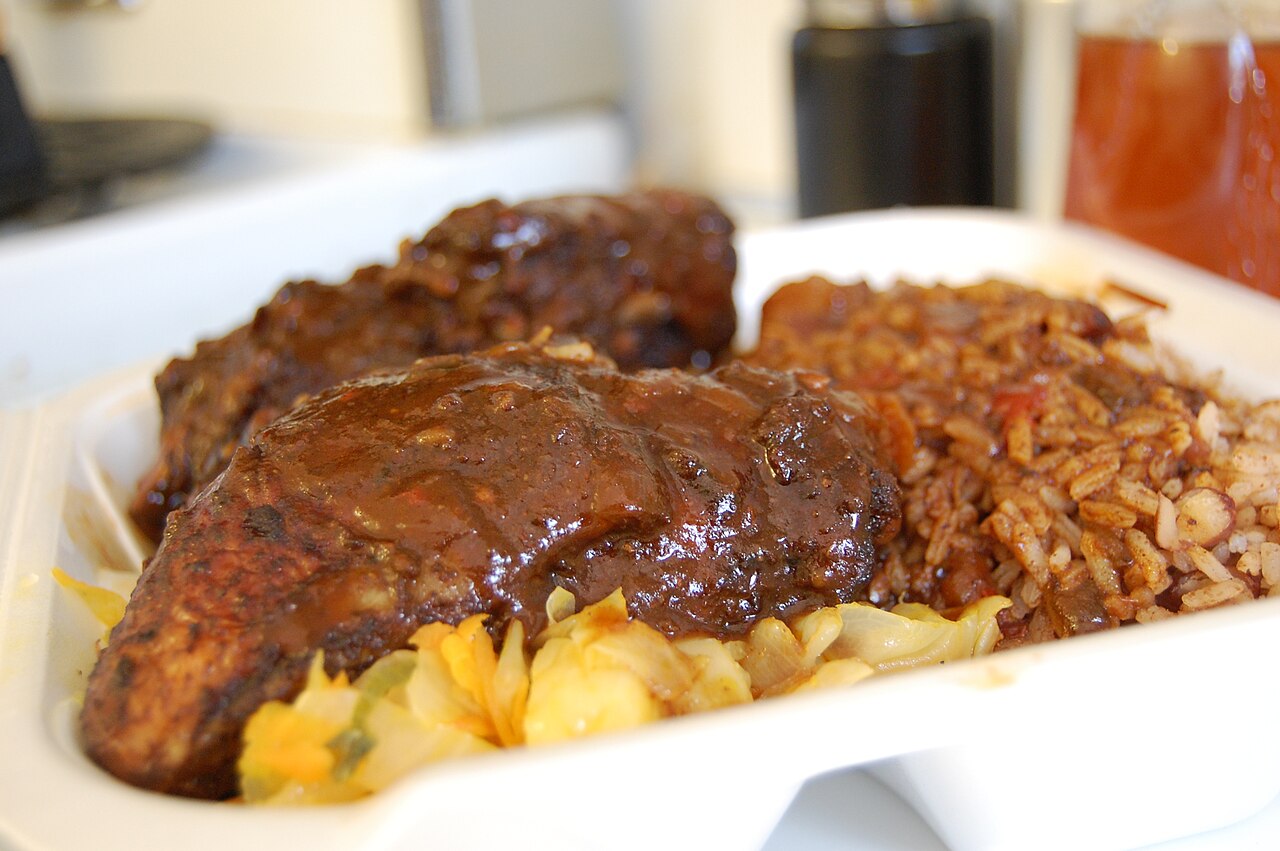
A wet marinade, or a dry rub, built on allspice and Scotch bonnet peppers — both native to Jamaica and grown there by the Taíno. Scallion, thyme, garlic, ginger, cloves, cinnamon, nutmeg, brown sugar, soy sauce, vinegar and salt turn up in it. The heat is the Scotch bonnet's. The word 'jerk' names the rub, the marinade and mop sauce made from it, and the cooking technique, all three.
The story Cited · wp-jerk-cooking
Jerking came from Jamaica's indigenous people, the Arawak and Taíno, and was taken up by the descendants of 17th-century Jamaican Maroons who lived among them. In 1516 the Spanish historian Gonzalo Fernández de Oviedo y Valdés recorded how the Taíno prepared and preserved meat and fish on a barbacoa, seasoning with native hot peppers — Scotch bonnet and cayenne — and pimento. Meats were sometimes wrapped in papaya leaves to tenderise before jerking. Local game went on it: coney, iguana, wild hog, agouti, wild birds, waterfowl, turtle, and a range of seafood.
Spanish colonists adopted Taíno methods to survive and introduced pig, cattle and chicken in the 1500s, curing them over a barbacoa with pimento wood and berries. When the Spanish were invaded in 1655 they freed the enslaved Africans, who fled into the countryside and became some of the first Jamaican Maroons; they intermingled with the remaining Taíno and learned jerking. By the end of the 18th century most groups had switched to imported pork, while the Maroons kept hunting wild hogs and jerking them.
The word comes from charqui, a Spanish term of Quechua origin for dried meat, which became 'jerky' in English.
Method followed portability. Around the 1960s Caribbean entrepreneurs began cutting oil barrels lengthwise, drilling ventilation holes and hinging lids to hold the smoke; the barrel drum is now standard across the island. Jerk stands sell the meat with hard dough bread, bammy, fried dumplings and festival.
Jerk travelled with the Caribbean diaspora — Britain, Canada, the United States, coastal Panama, Costa Rica, Honduras, Nicaragua, San Andrés. In September 2015 the Jamaican government registered Jamaica Jerk as a geographical indication, making Jamaica the first English-speaking Caribbean country to do so.
How it is done Tradition
Marinate, then cook over smoke. Blend the wet version and work it under the skin; leave the wings in it for hours. Cook over pimento wood, in a halved oil drum with the lid down, or in a wood-burning oven; a home kitchen uses a grill and finishes in the fryer. Reserve some marinade unheated as a mop sauce and brush it on at the end. The Scotch bonnet's heat sits behind the allspice, which is the flavour people name first.
Today Harvested · fdc-spur-tree-jerk-seasoning
Sold bottled in every Caribbean grocery in the United States and in most supermarkets. As of 16 September 2026 the USDA label panel for Spur Tree Jamaican Jerk Seasoning reads 700 mg sodium and 1 g sugar in a 1-tablespoon serving, with scallion first and Scotch bonnet pepper second. No maker in this set publishes a Scoville number for it.
The particulars
| base | other |
|---|---|
| heat | hot |
| region | Caribbean America, The United States |
| confidence | high · updated 2026-09-16 |
On the label
| what was read | bottle · Georgia Peach Products, Inc. (Spur Tree Jamaican) |
|---|---|
| pepper or chile | #2 on the label |
| vinegar | #4 on the label |
| butter or oil | — |
| tomato | — |
| sugar | #9 on the label |
| soy sauce | — |
| mustard | — |
| sodium per tablespoon | 700 mg (the FDA counts 2,300 mg as a day) |
| sugar per tablespoon | 1 g (a tablespoon of table sugar is about 12.6 g) |
| Scoville | nobody publishes one for this bottle |
| the label, in order | scallion, Scotch bonnet pepper, sea salt, cane vinegar, onion, garlic, pimento, thyme, cane sugar, caramel color, dextrose, yeast extract, sodium benzoate (preservative) |
Read from this page, 2026-09-16. Spur Tree Jamaican Jerk Seasoning, 35 oz. Label serving is 1 tbsp (18 g), so the per-tablespoon figures are the label's own. A wet seasoning, which is why it measures by the tablespoon where dry jerk rubs measure by the quarter-teaspoon — Grace Jerk Seasoning, FDC 2567137, is a dry powder at 140 mg sodium per ¼ tsp. 'Pimento' at rank 7 is allspice, the Jamaican name for it. No heat word and no Scoville number on the jar. Every bottle we have read is on the sauce page.
Recipes you can use
Old cookbooks are printed whole, spelling and all. Where a recipe is still somebody's copyright, you get the ingredient list and a link to the rest.
Jamaican jerk seasoning, as described
- allspice
- Scotch bonnet peppers
- cloves
- cinnamon
- scallions
- nutmeg
- thyme
- garlic
- brown sugar
- ginger
- soy sauce
- vinegar
- salt
Ingredients only — a list of ingredients states a fact, and there is no free-licence instruction text to copy. Order is the source's, not a label's, so no ranks are read off it. Allspice and Scotch bonnet are the two the source calls principal; the rest it lists as things that may be included.
Who it runs with
Who talks about it
Where we got it
Where it came from: Cited a source we name · Harvested pulled from an open dataset · Tradition what the tradition says, hedged · Inference this project's reasoning · Field somebody stood there. This record as JSON.