a styleKorean fried chicken wings
also: KFC (Korean fried chicken) · yangnyeom wings · soy garlic wings · chikin
Order half and half — yangnyeom ban, huraideu ban — and the box comes divided down the middle.
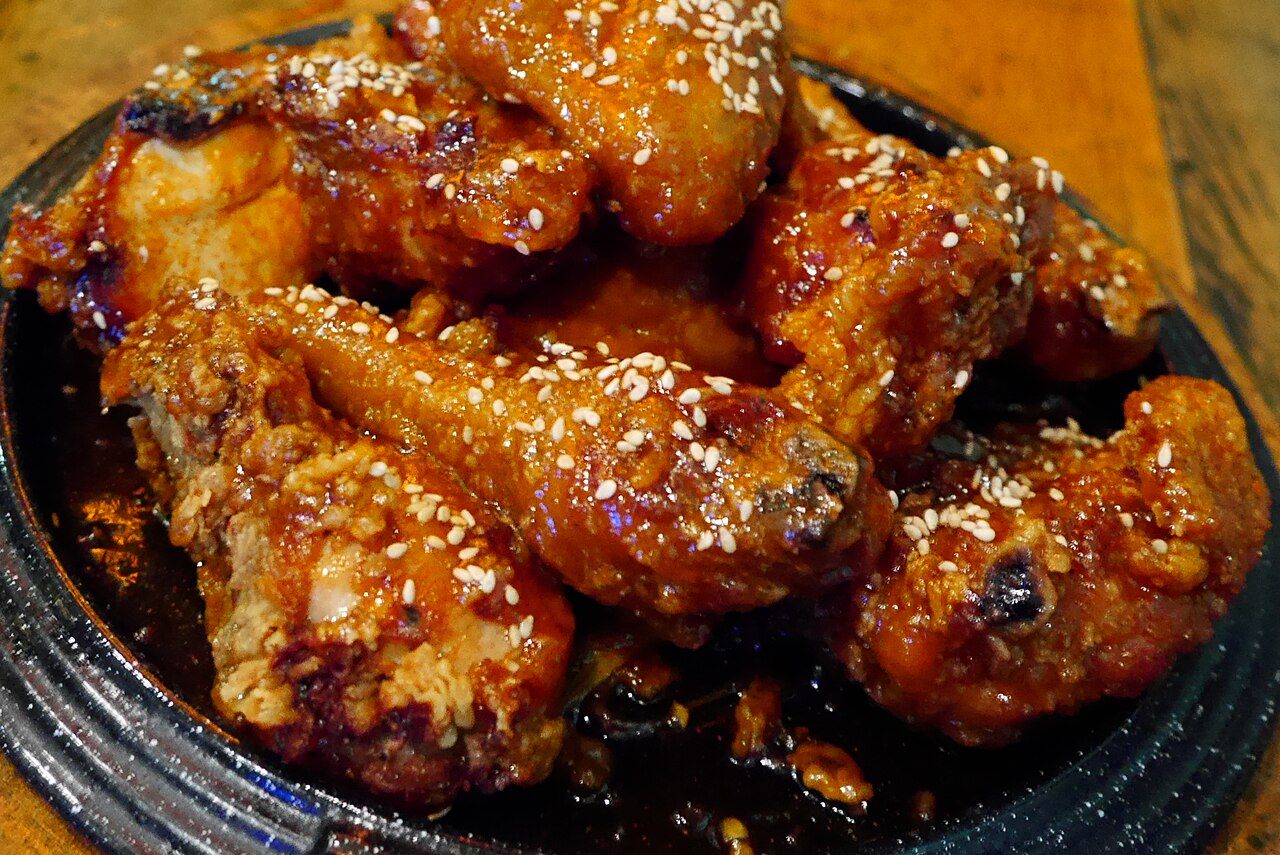
Chicken fried twice so the crust comes out thin and brittle — Julia Moskin of The New York Times called it "thin, crackly and almost transparent" — then hand-painted with sauce by brush rather than shaken in a bowl, so the coating stays a thin film and the crust keeps its snap. Two sauces carry the style: yangnyeom, sweet and spicy on a gochujang base, and ganjang, soy and sugar and a great deal of garlic. Wings and drums arrive whole or jointed depending on the house. Pickled radish comes in a tub alongside, and beer with it; the pairing has its own word, chimaek, from chicken and maekju.
The story Cited · wp-bonchon-chicken
Frying chicken is old in Korea — a fifteenth-century method survives, and an early Joseon dish called pogye was cooked in oil with soy sauce, sesame oil, flour-and-water and vinegar poured in turn. The modern chain runs from the late 1960s, when Myeongdong Yeongyang Center in Seoul sold whole chicken roasted over an electric oven. U.S. military presence after the Korean War introduced deep-fried chicken; cooking oil did not become widely available until the 1970s. Lims Chicken, the first modern franchise, opened in 1977 in the basement of the Shinsegae department store on Chungmu-ro, founded by Yu Seok-ho, and was taken up as a pairing for draft beer.
Yangnyeom has a date and a reason. Yun Jonggye, running a fried chicken restaurant in Daegu in 1982, noticed customers struggling with the hard crisp shell — scraped palates among the complaints — and marinated the chicken sweet and spicy to soften it. Kentucky Fried Chicken opened in South Korea in 1984. The Asian financial crisis of the late 1990s pushed laid-off workers into opening chicken shops, and the count kept climbing: over 20,000 restaurants by 2013, 36,000 by 2017, 40,000 as of 2026, with 1,800 more run abroad by Korean brands in 60 countries — double the figure of ten years earlier. Almost a third of the chicken eaten in South Korea is fried.
The American side arrived through those brands. Bonchon, founded by Jinduk Seo in Busan in 2002, opened its first U.S. location in Fort Lee, New Jersey, built the business on a double-fry method and two centrally manufactured sauces — soy garlic and spicy — and closed its South Korean retail operations by the end of 2016 to franchise abroad. It now runs about 500 restaurants in more than ten countries, with more than 150 in the U.S. generating over 60 percent of worldwide revenue, and moved its global headquarters to Dallas in 2021. Mexicana, Kyochon, Genesis BBQ, Pelicana and Nene followed the same route out.
Inference — the style met the American wing market halfway. A cuisine that sells whole birds and boneless sunsal in Korea sells wings and drums in the United States, because that is the cut an American bar menu is built around.
How it is done Cited · wp-korean-fried-chicken
Cut or leave whole, season before frying — spices, sugar and salt go on both before and after — and fry once at a lower heat to cook it through, rest it, then fry again hot to drive off moisture and set a thin shell. Smaller or medium birds, which give more tender meat. Brush the sauce on in a thin even layer rather than tossing, or leave it plain as huraideu. Yangnyeom for sweet-and-spicy, ganjang for soy-garlic, banban for half of each. Serve with pickled radish cubes and beer or a carbonated drink.
Today Cited · wp-korean-fried-chicken
Korean chains run across 21 U.S. states and Bonchon was one of the few restaurant groups still adding stores through the COVID-19 pandemic. Its owner VIG Partners put the brand up for auction in March 2026; the process drew over 100 potential buyers from the United States and Asia. The National Chicken Council's Super Bowl LX note, dated 28 January 2026, listed Korean barbecue among the global flavours moving into American wing menus.
Put it head to head →Where it sits for heat →
The particulars
| cut | whole wing |
|---|---|
| base | soy-sweet |
| cooked | double-fried |
| heat | medium |
| region | Korean America, New York City, Southern California, The United States |
| confidence | high · updated 2026-09-16 |
Not to be confused with
- Buffalo wings — Bite and listen. A double-fried wing snaps and the sauce is a thin painted film; a Buffalo wing is soft-skinned under a loose sauce that runs on the plate.
- Teriyaki sauce — Soy and sugar in both. Ganjang chicken is heavy on garlic and goes on a shatter-crisp crust; teriyaki is a glaze with mirin behind it and no garlic requirement.
Who it runs with
Where we got it
- Korean fried chicken · link
- Bonchon Chicken · link
- Gochujang · link
- Americans to Eat 1.48 Billion Chicken Wings for Super Bowl LX · link
- Wing Country — this project's own reasoning
Where it came from: Cited a source we name · Harvested pulled from an open dataset · Tradition what the tradition says, hedged · Inference this project's reasoning · Field somebody stood there. This record as JSON.