Carolina Barbecue

pig artThe FSA photographs of Carolina eating

also: Marion Post Wolcott in the Carolinas · FSA/OWI Carolina photographs · the 1939 Farm Security Administration series
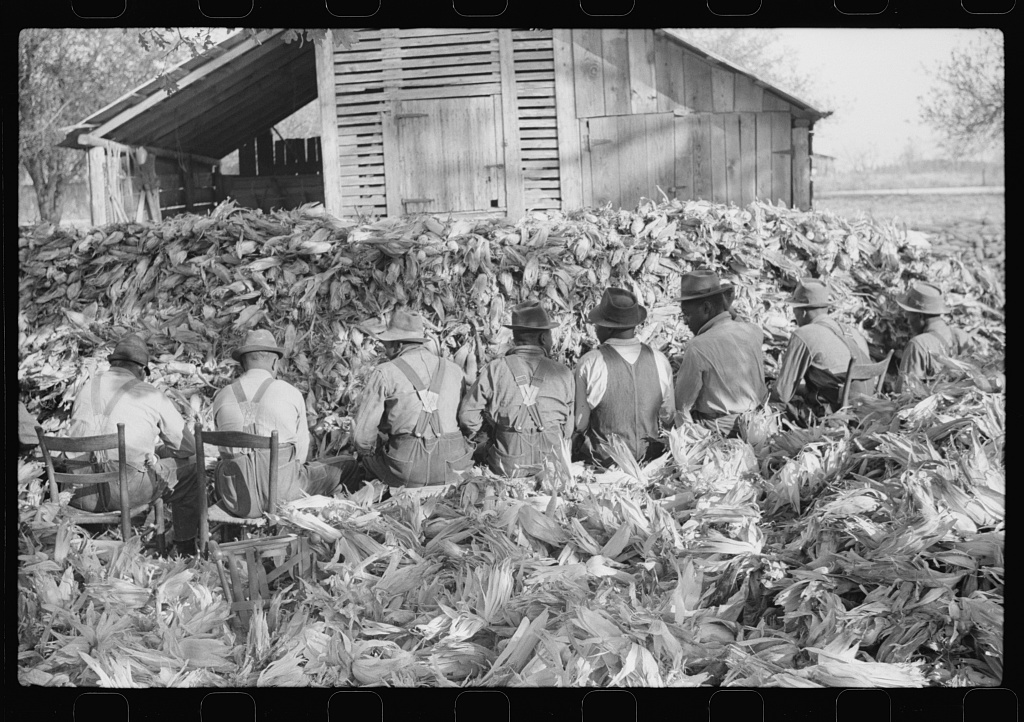
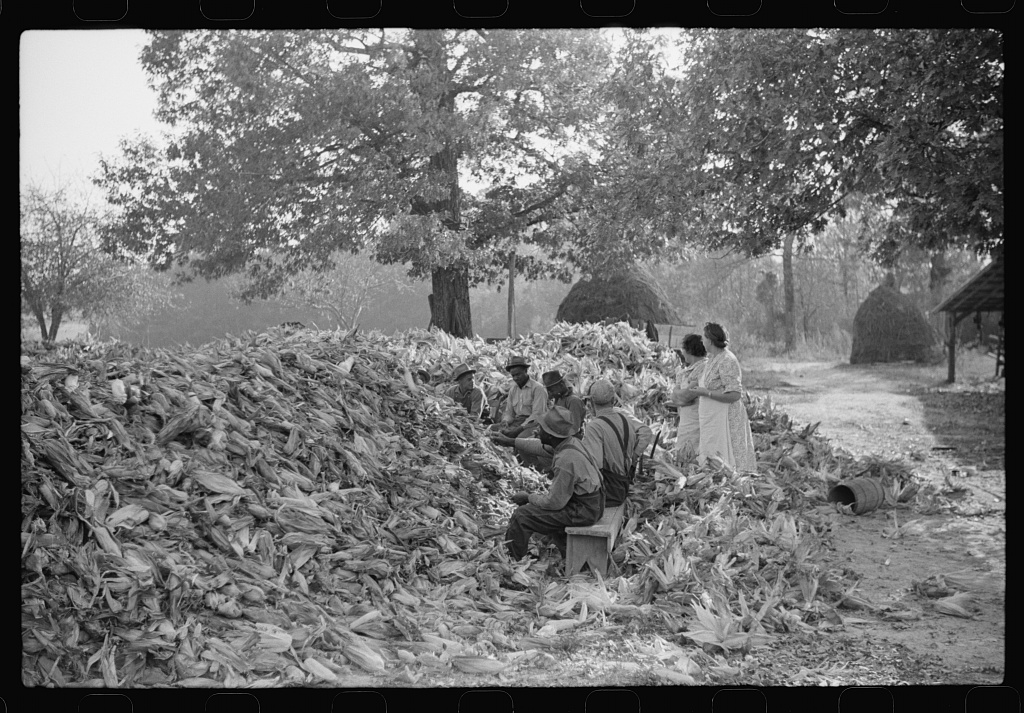
Men in hats and overalls sit on kitchen chairs in a chest-high drift of corn shucks, working through the pile, with a wooden corn crib behind them. Corn shucking at Uncle Henry Garrett's place, Tally Ho near Stem, Granville County, North Carolina, November 1939.
Men in hats and overalls sit on kitchen chairs in a chest-high drift of corn shucks, working through the pile, with a wooden corn crib behind them. Corn shucking at Uncle Henry Garrett's place, Tally Ho near Stem, Granville County, North Carolina, November 1939. — Marion Post Wolcott, Public domain

The Farm Security Administration — a New Deal agency for rural poverty — kept photographers on the road from 1935, and their negatives went to the Library of Congress as federal work, free of copyright. Marion Post Wolcott worked North and South Carolina in 1939. What survives of Carolina eating is the occasion rather than the pit: a corn shucking at Tally Ho, near Stem in Granville County, North Carolina, with the tables that followed it; ministers and deacons at an outdoor picnic near Yanceyville; and a Fourth of July on St. Helena Island, South Carolina, shot on Kodachrome, which was new.

Tally Ho, Granville County, November 1939

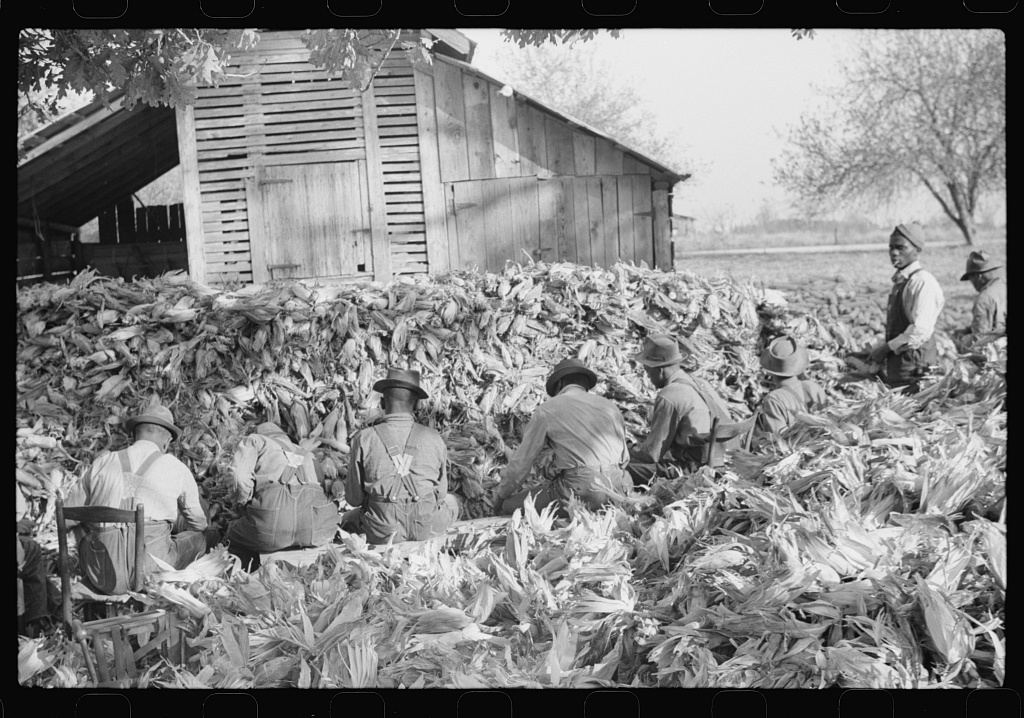
A corn shucking was a work party: neighbours came, shucked a farmer's crop, and were fed. Wolcott photographed one at Uncle Henry Garrett's place near Stem. The men sit on kitchen chairs in a chest-high drift of shucks with the crib behind them, hats on, working through the pile.

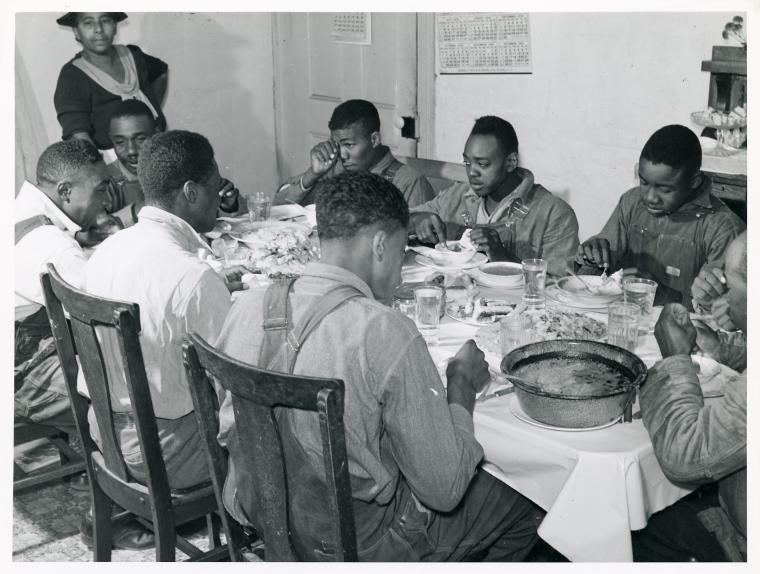
The agency's own caption sheet says who ate when, and the project reproduces its wording because the arrangement is the fact: 'White women don't go to Negro shucking to help with the cooking but white men are fed by Negro women just the same as at other shucking week previous at Mr. Fred Wilkins' home.' A second frame is captioned 'The Negro tenants and neighbors eating dinner after the white men have finished.' It shows a long white-clothed table, ten or twelve men at it, glasses and plates and a big enamel basin at the near end. Two sittings, in that order, at a meal the second sitting had cooked.

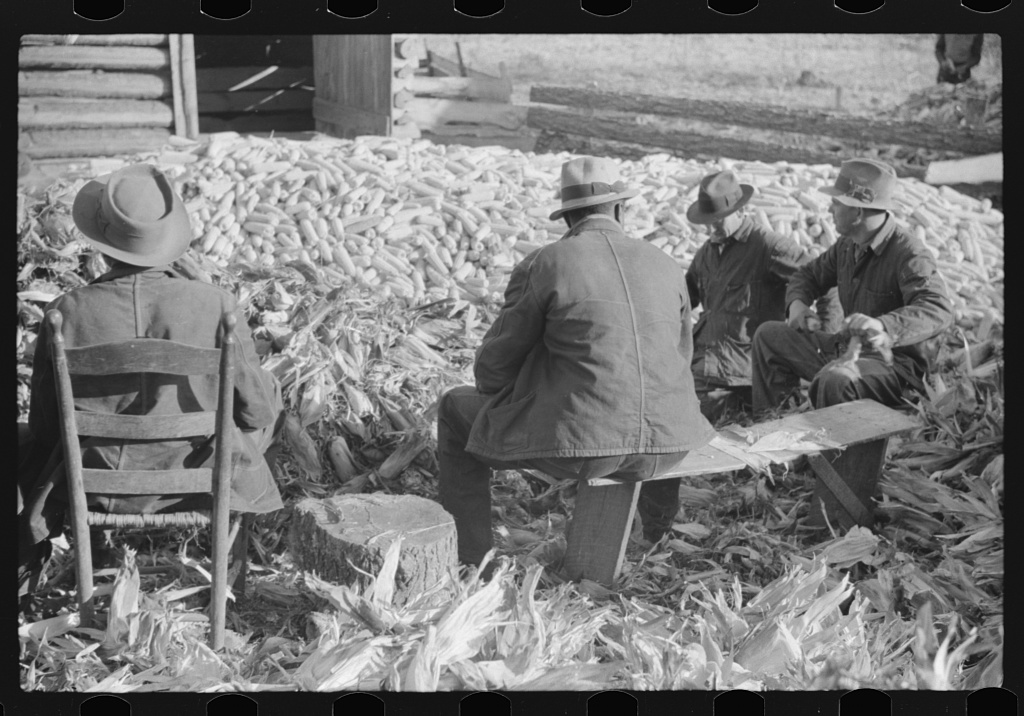
Men in hats and overalls sit on kitchen chairs in a chest-high drift of corn shucks, working through the pile, with a wooden corn crib behind them. Corn shucking at Uncle Henry Garrett's place, Tally Ho near Stem, Granville County, North Carolina, November 1939.
Men in hats and overalls sit on kitchen chairs in a chest-high drift of corn shucks, working through the pile, with a wooden corn crib behind them. Corn shucking at Uncle Henry Garrett's place, Tally Ho near Stem, Granville County, North Carolina, November 1939. — Marion Post Wolcott, Public domain
A second frame of the same corn shucking near Stem, Granville County, North Carolina, November 1939.
A second frame of the same corn shucking near Stem, Granville County, North Carolina, November 1939. — Marion Post Wolcott, Public domain
An unlabelled frame from the same corn shucking at Tally Ho near Stem, Granville County, North Carolina, November 1939.
An unlabelled frame from the same corn shucking at Tally Ho near Stem, Granville County, North Carolina, November 1939. — Marion Post Wolcott, Public domain
A second unlabelled frame from the same corn shucking near Stem, Granville County, North Carolina, November 1939.
A second unlabelled frame from the same corn shucking near Stem, Granville County, North Carolina, November 1939. — Marion Post Wolcott, Public domain
A long table under a white cloth in a farmhouse room, ten or twelve men eating, glasses and plates down its length and a large enamel basin at the near end; a woman stands at the back. The agency caption reads: the Negro tenants and neighbors eating dinner after the white men have finished, at the Wilkins place, Tallyho, Stem, Granville County, November 1939.
A long table under a white cloth in a farmhouse room, ten or twelve men eating, glasses and plates down its length and a large enamel basin at the near end; a woman stands at the back. The agency caption reads: the Negro tenants and neighbors eating dinner after the white men have finished, at the Wilkins place, Tallyho, Stem, Granville County, November 1939. — Marion Post Wolcott, Public domain

St. Helena Island, July 1939

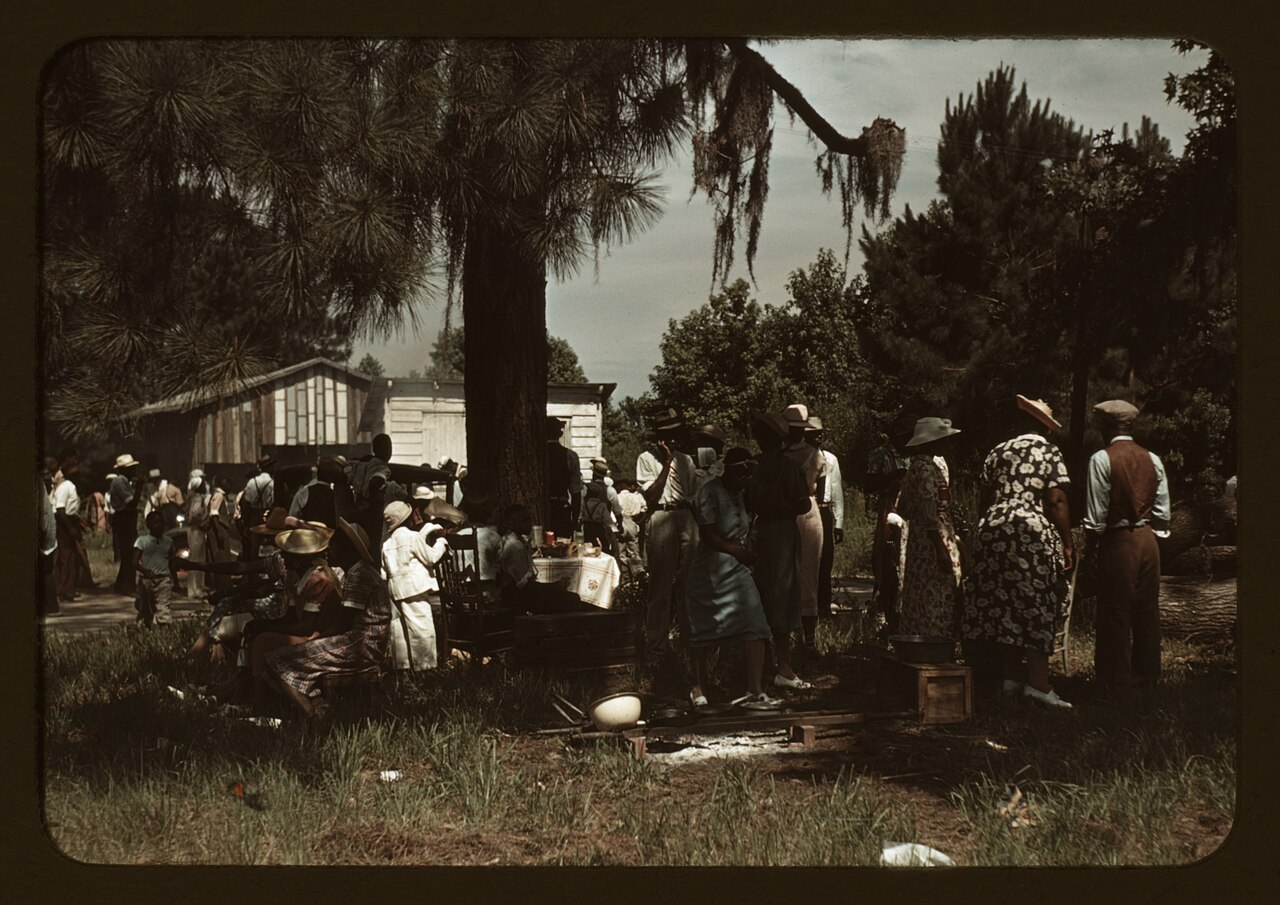
The FSA shot most of its work in black and white and a small part on Kodachrome, a colour film then a few years old. Wolcott's St. Helena Island Fourth of July is in that colour set, which is why these frames look nothing like the rest of the period.

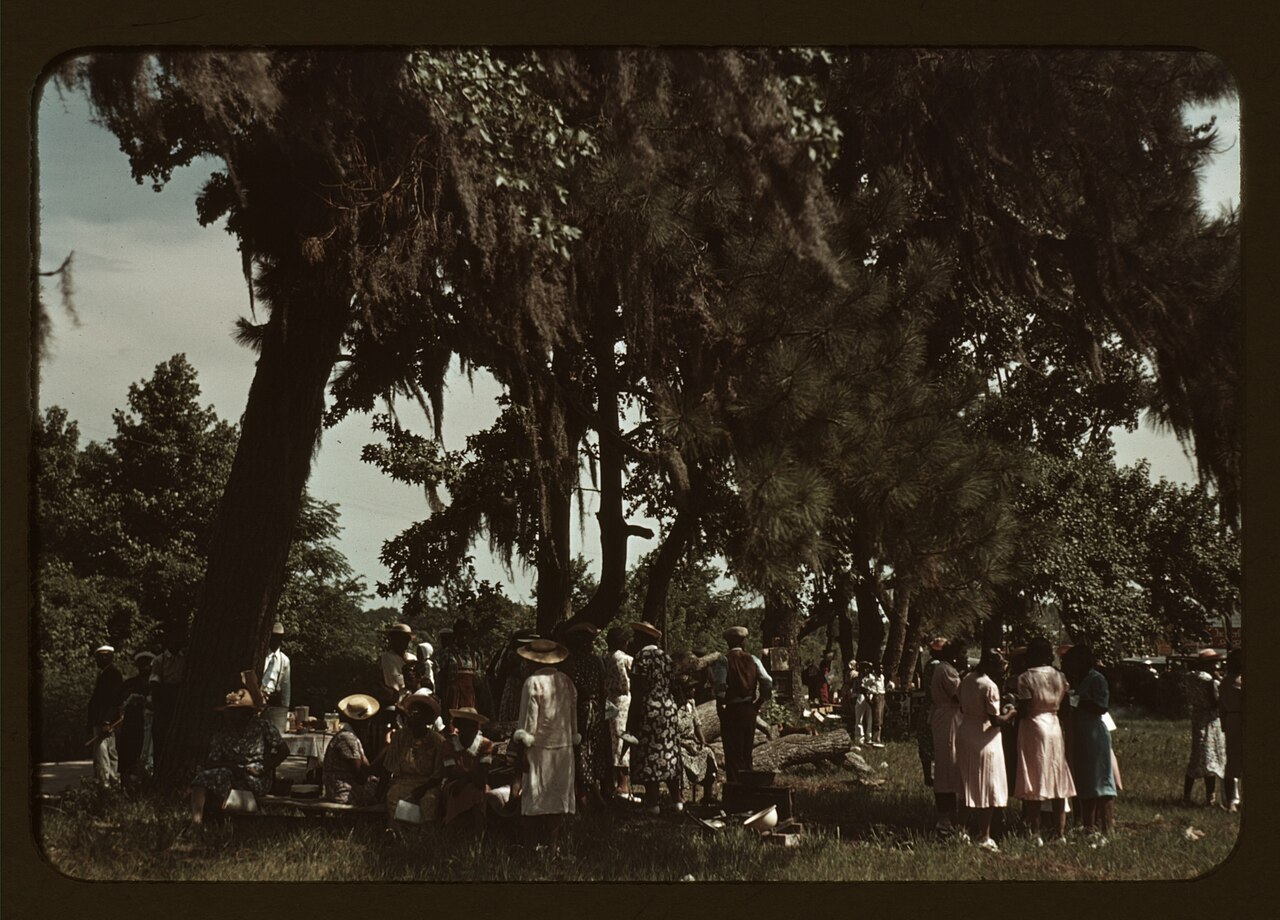
Under pines hung with Spanish moss, a crowd stands around a cloth-covered table and a scatter of washtubs, pots and crates; one frame takes in a Texaco filling station behind the flag. The catalogue calls it a Fourth of July celebration and a Fourth of July picnic. It does not call it a barbecue.
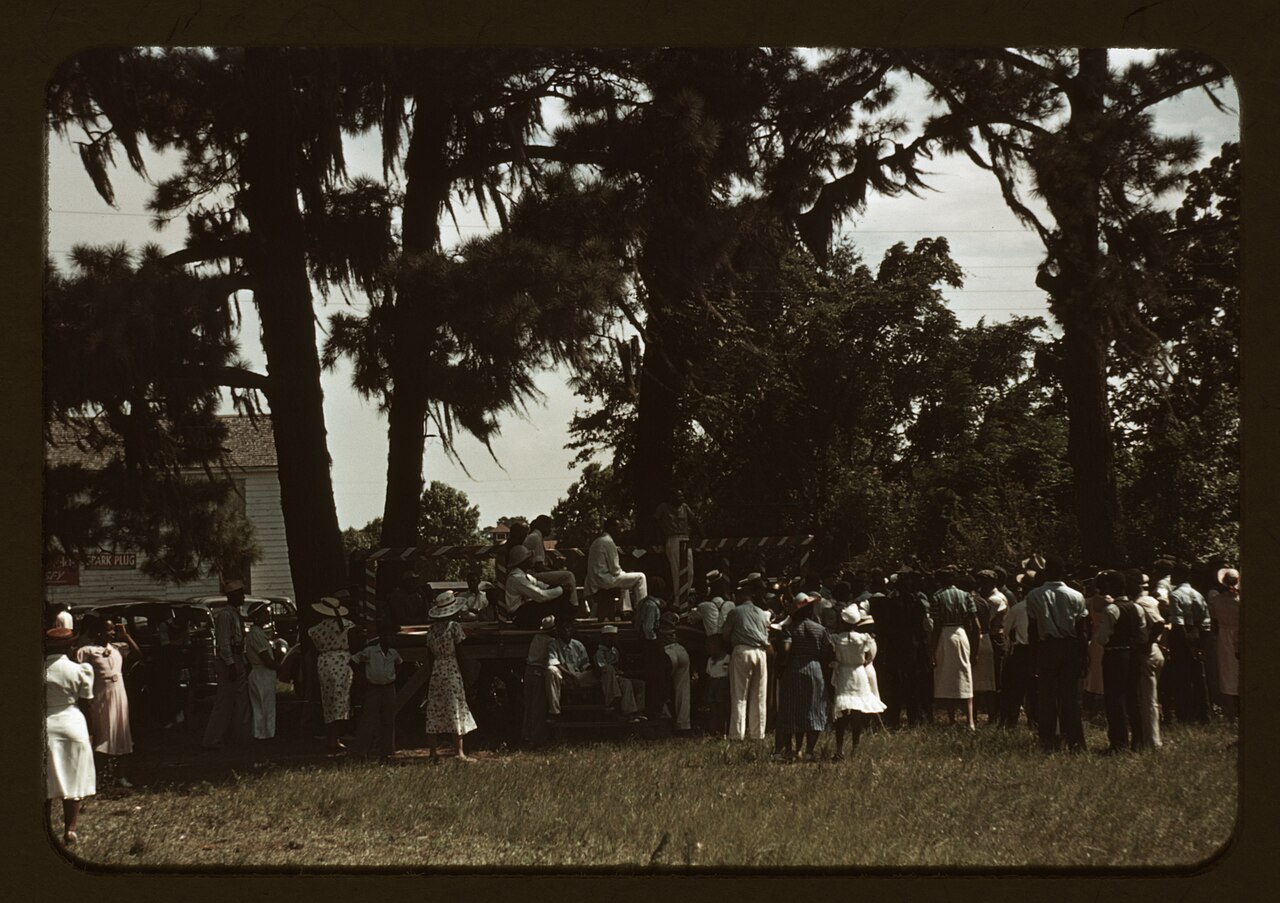
Colour transparency, 1939: a crowd under pines hung with Spanish moss at a Fourth of July celebration on St. Helena Island, South Carolina, with washtubs and cooking pots on the ground.
Colour transparency, 1939: a crowd under pines hung with Spanish moss at a Fourth of July celebration on St. Helena Island, South Carolina, with washtubs and cooking pots on the ground. — Wolcott, Marion Post, 1910-1990, photographer, Public domain
Colour transparency, 1939: people standing and talking at the Fourth of July celebration on St. Helena Island, South Carolina.
Colour transparency, 1939: people standing and talking at the Fourth of July celebration on St. Helena Island, South Carolina. — Wolcott, Marion Post, 1910-1990, photographer, Public domain
Colour transparency, 1939: a cloth-covered table under the pines at the Fourth of July picnic on St. Helena Island, South Carolina, with tubs, crates and a pot set out around it.
Colour transparency, 1939: a cloth-covered table under the pines at the Fourth of July picnic on St. Helena Island, South Carolina, with tubs, crates and a pot set out around it. — Wolcott, Marion Post, 1910-1990, photographer, Public domain

What is not in the file

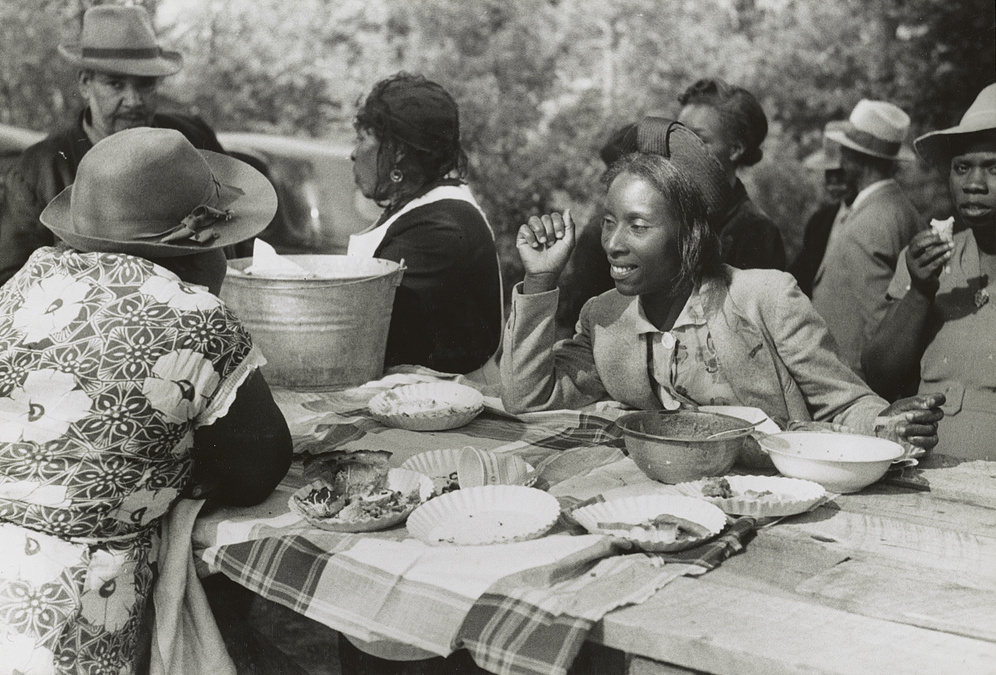
No photograph in the Carolina part of this collection that reached Wikimedia Commons is captioned as a barbecue, and none shows a hog on a pit. The agency's photographers caught Carolina barbecue only in its surroundings: the work party, the church meeting, the holiday crowd, the table afterwards. Two frames from near Yanceyville in Caswell County are captioned as an outdoor picnic held during the noon intermission of an all-day meeting of ministers and deacons — the church dinner, mid-century, in a field.

Inference — that is a fact about the photographers' brief rather than about the food. The FSA sent people to document rural poverty and federal relief, so a camera went where a committee met or a crop came in. An all-night pit in a shed behind a store was nobody's assignment. The pictures that do exist of a Carolina hog on a pit come later, from restaurants and from towns, and are mostly still in copyright.

A caution on the captions: the descriptions carried with these files are the agency's, written in 1939, and they use the racial vocabulary of that year. They are quoted rather than rewritten so that what the file says and what the file shows can be read against each other.
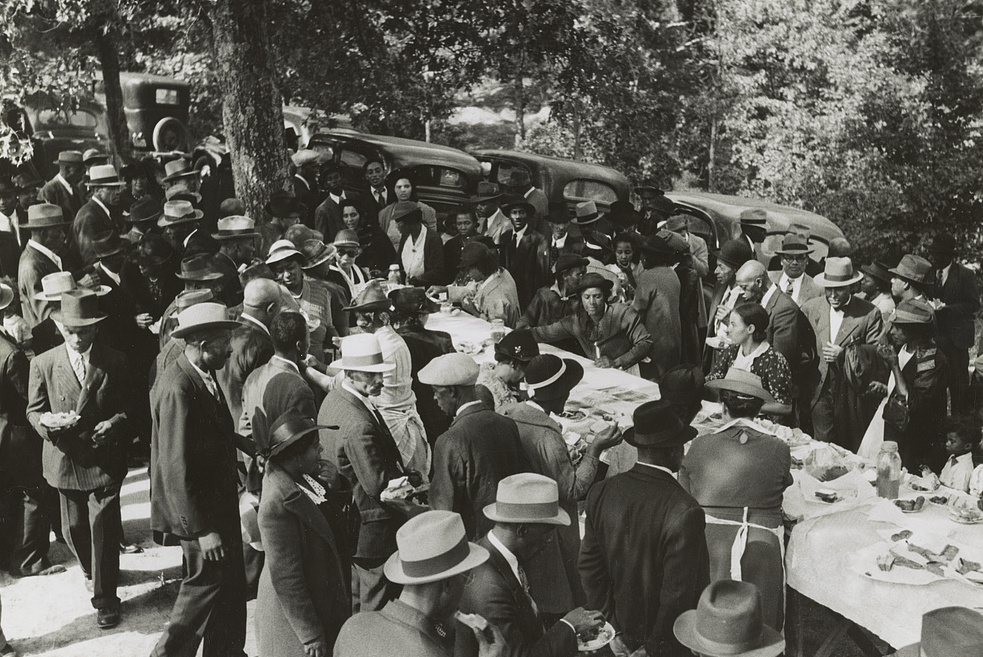
An outdoor picnic held during the noon intermission of an all-day meeting of ministers and deacons at a church near Yanceyville, Caswell County, North Carolina, 1940.
An outdoor picnic held during the noon intermission of an all-day meeting of ministers and deacons at a church near Yanceyville, Caswell County, North Carolina, 1940. — Marion Post Wolcott, Public domain
A second frame of the same church picnic near Yanceyville, Caswell County, North Carolina, 1940.
A second frame of the same church picnic near Yanceyville, Caswell County, North Carolina, 1940. — Marion Post Wolcott, Public domain

Facts

kindphotograph
stateboth
regionThe Carolinas, North Carolina, South Carolina, The Lowcountry
linksFarm Security Administration photographs by Marion Post Wolcott — Wikimedia Commons
confidencemedium · needs verification · updated 2026-09-16

Its kin

the pithog killingthe other November work party a Carolina farm held, and the one Wolcott did not photograph here.eventsfundraiser barbecuethe church dinner the Yanceyville picnic is an early frame of.eventspig pickin'the gathering these photographs stand next to: a crowd, a yard, food set out on boards.peopleAdrian Millerwhose Black Smoke follows the cooks the FSA caption sheet records as feeding two sittings.stylesPee Dee whole-hog barbecuethe style whose region reaches down to St. Helena Island; the Fourth of July frames are the Lowcountry's oldest colour pictures here.stylesEastern North Carolina barbecueGranville County lies at its western edge, where the whole hog and the Piedmont shoulder meet.artroadside barbecue signsthe other government-owned picture collection this project draws on, from fifty years later.and of this page it says: the other federal picture collection this project draws on, from fifty years before Margolies.

Who points back

art · says of this pagebarbecue postcardsthe same decade, photographed by a government rather than a printer, and with nothing to sell.

Pictures

Sources

Where it came from: Cited a source we name · Harvested pulled from an open dataset · Tradition what the tradition says, hedged · Inference this project's reasoning · Field somebody stood there. This record as JSON.

Pass it on