a signRooster weathervanes
also: weathercock · cockerel vane
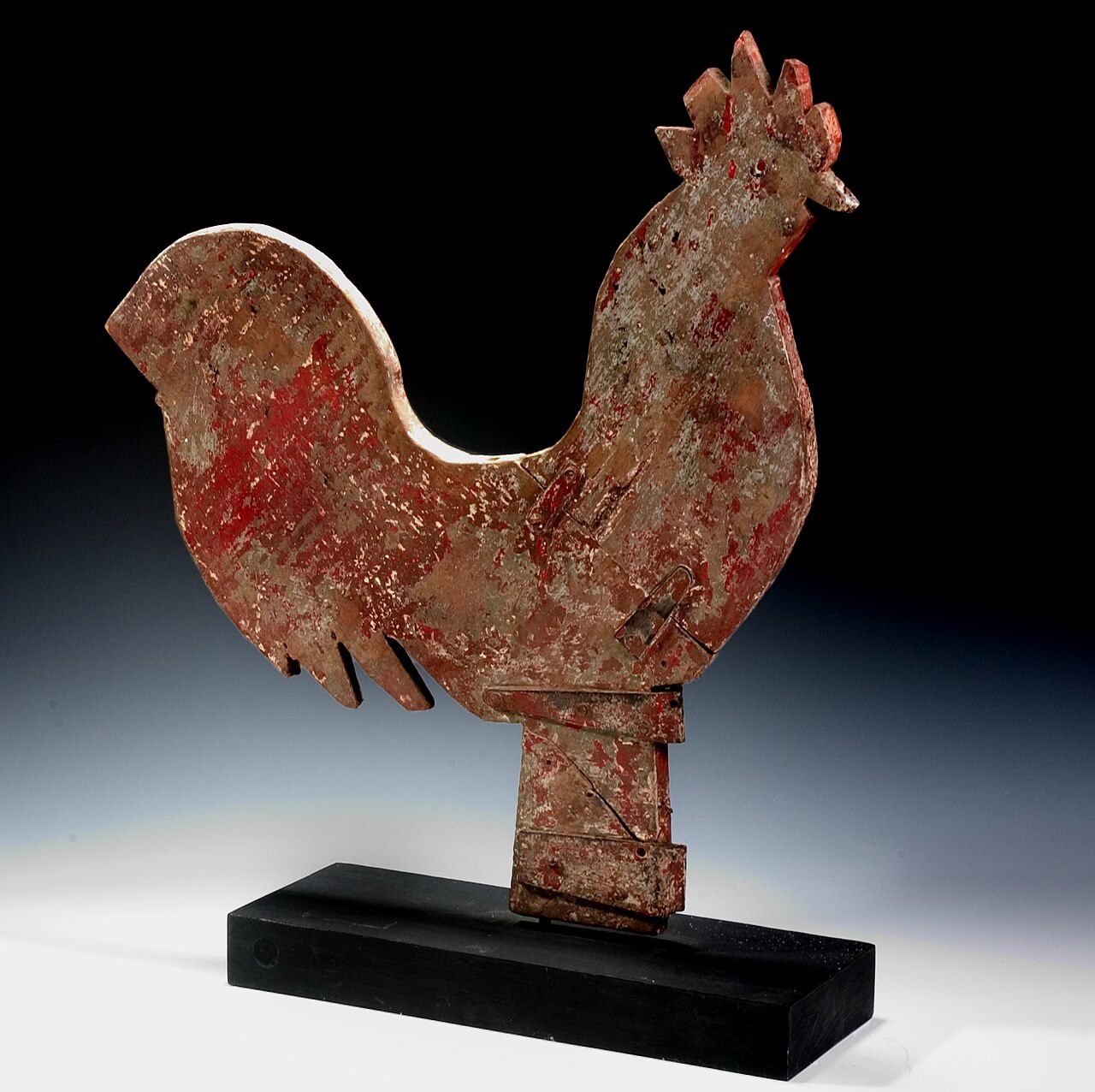
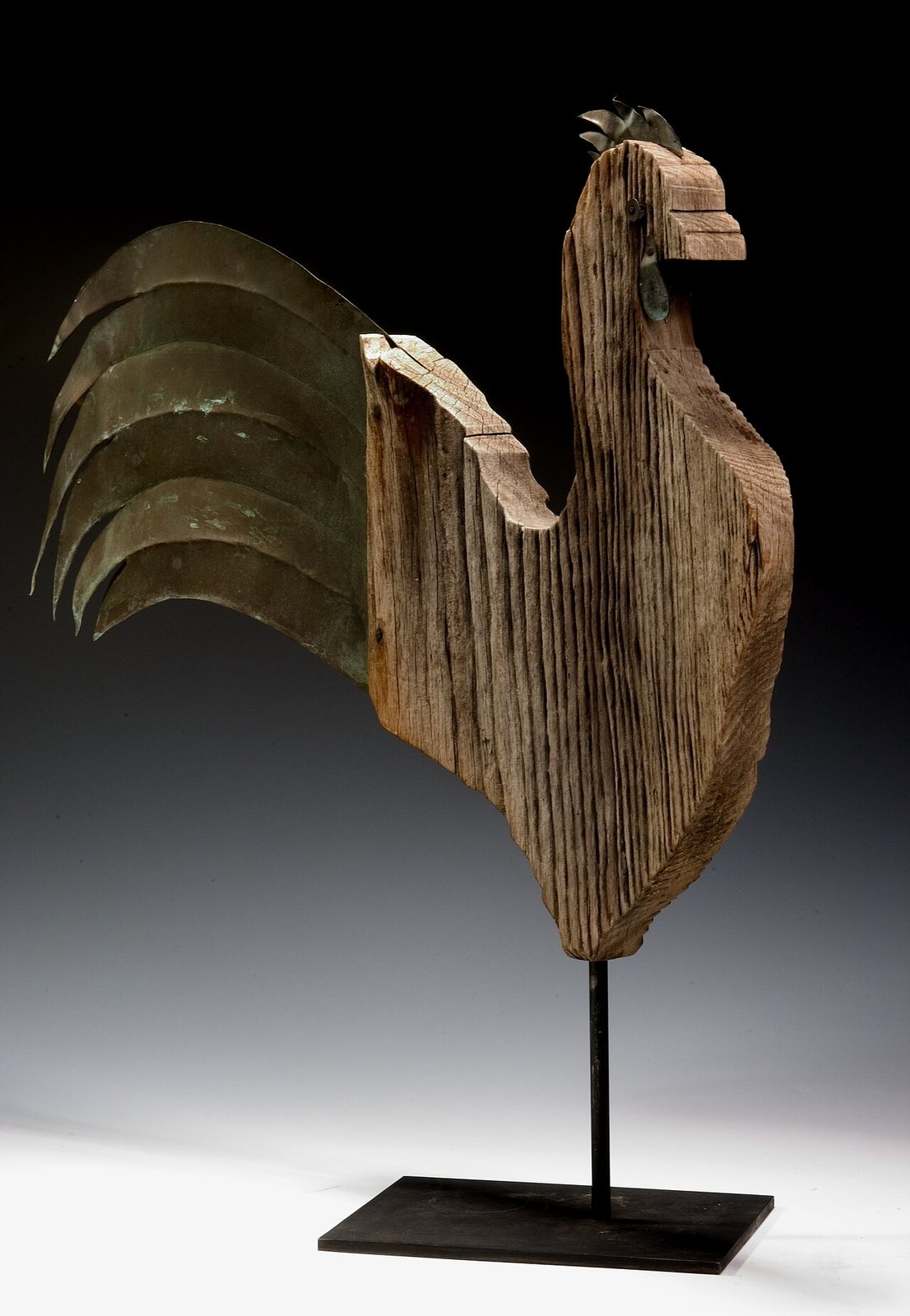
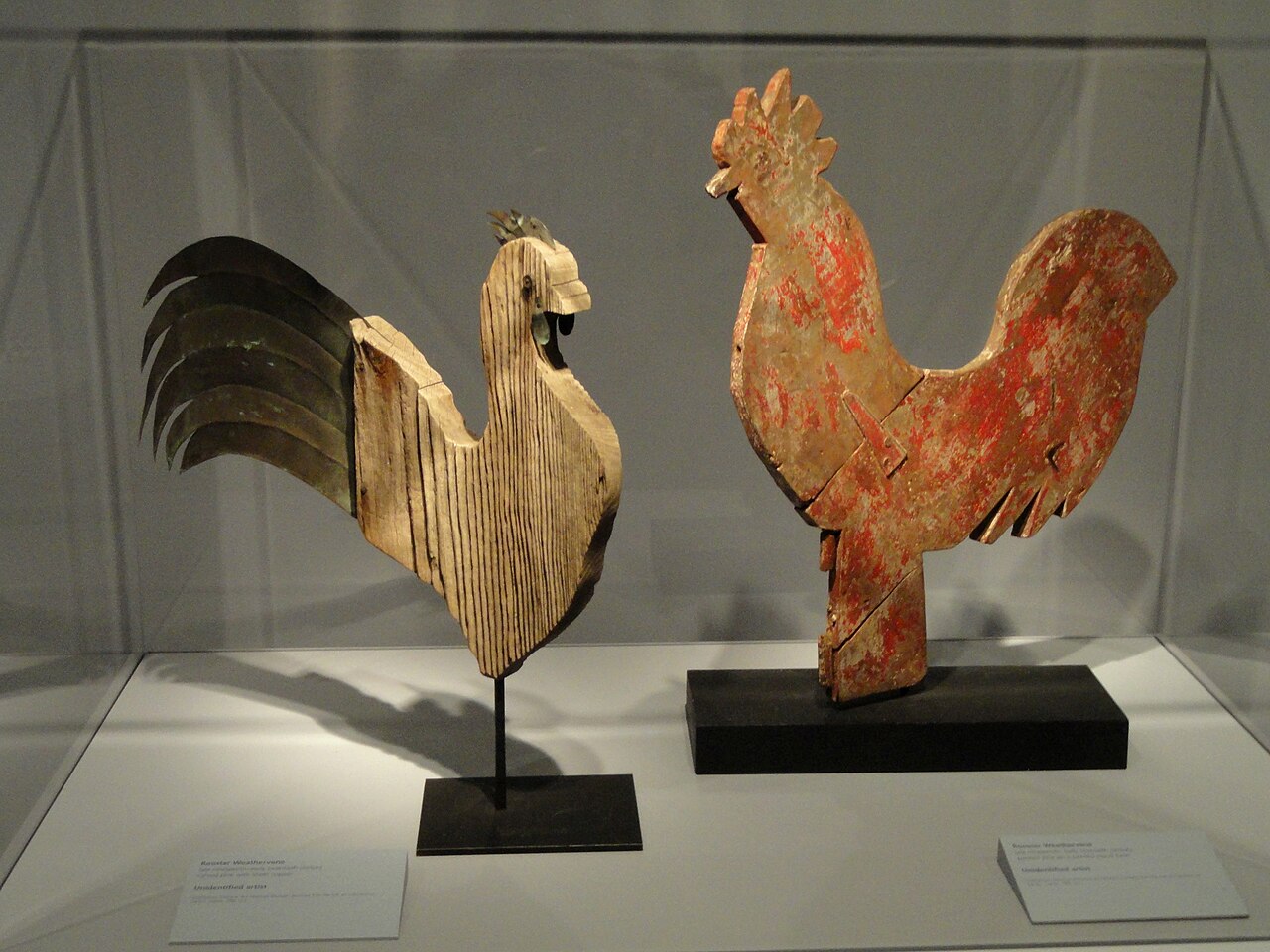
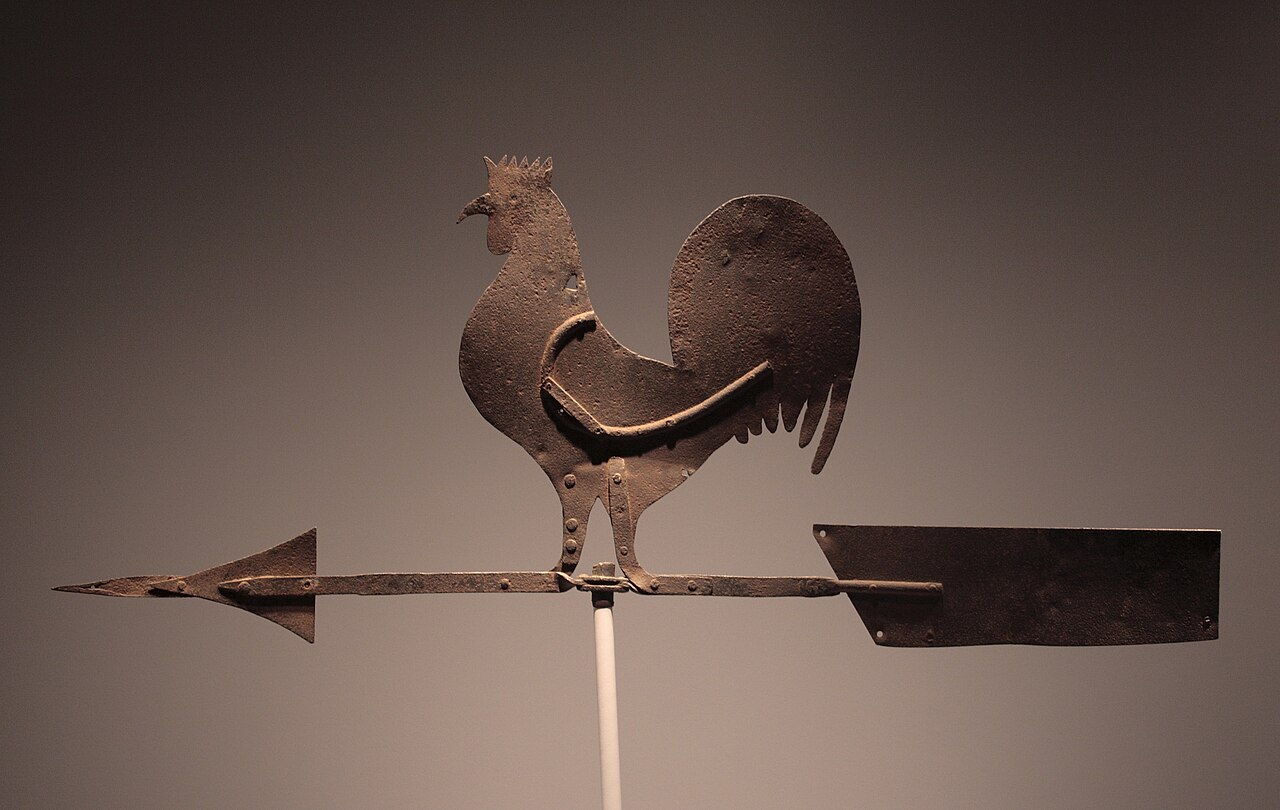
A rooster cut or moulded in sheet metal, balanced on a spindle, and put on a roof to show which way the wind blows. It is the oldest American use of a chicken as a public sign, it predates every wing counter by centuries, and the shape it settled into — flat body, raised comb, fanned tail, one leg forward — is the same silhouette a fried chicken sign draws today. American vanes were made in copper and zinc by nineteenth-century firms working from moulds, and museums now hold them as folk sculpture; the Smithsonian American Art Museum has released photographs of several under CC0.
What the object is
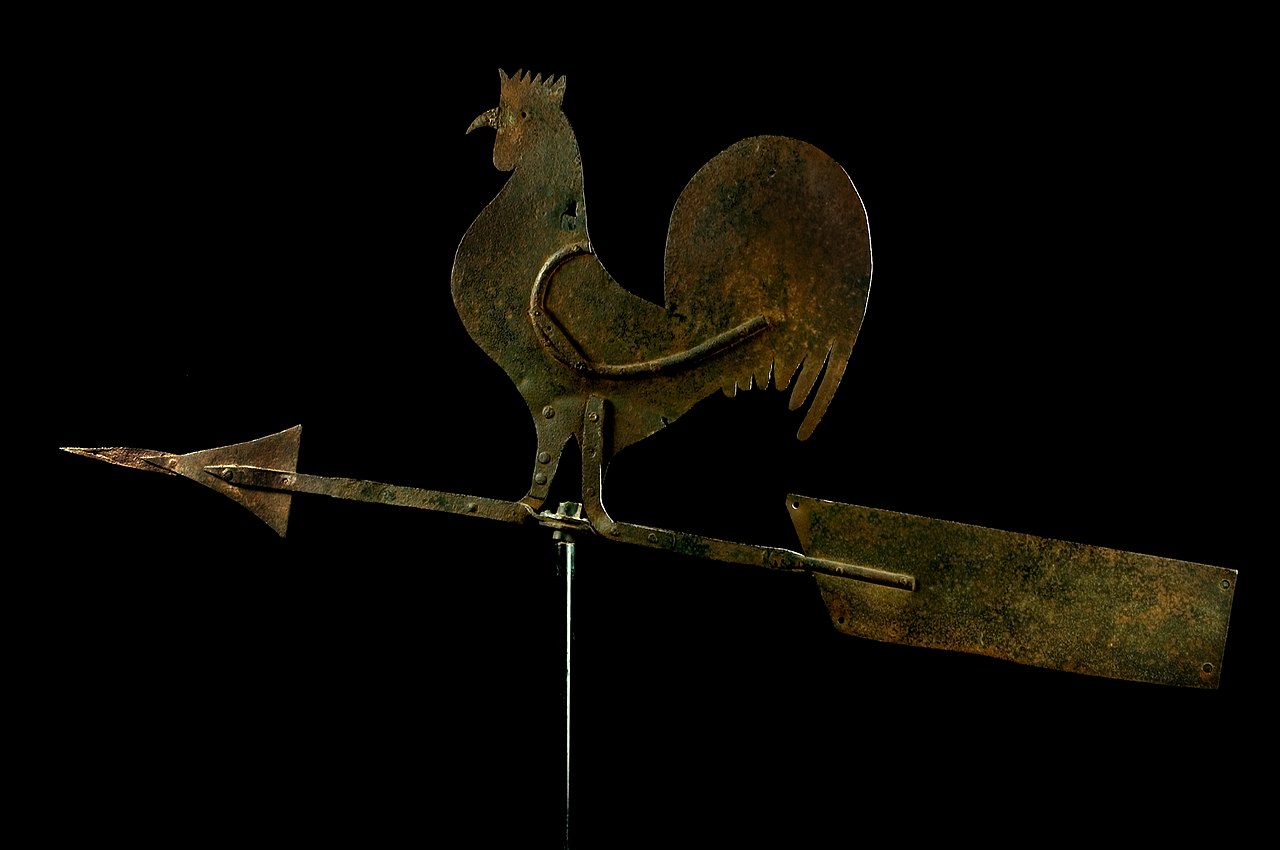
A vane is a shape mounted off-centre on a vertical spindle so the wind turns the larger surface downwind and the smaller end points into it. The rooster's tail is the sail; the head is the pointer. Beneath it sit the fixed direction letters, N, S, E, W, on rods.
It is a working instrument before it is decoration, and the shape has to earn its aerodynamics: the tail has to be broad, the body flat, the whole thing light enough to turn in a light breeze and strong enough to survive a gale.
How the bird got up there
Tradition holds — the cockerel came to European roofs through the church, where a weathercock on a steeple carried a religious reading, and the practice moved to civic and farm buildings and then across the Atlantic. The detail of that history is not something this project has sourced; what is documented is the American object that resulted.
Inference — by the time the rooster reaches an American barn it is no longer making an argument about anything. It is a shape everybody recognises at a distance, which is the only quality a roof ornament needs.
American manufacture
Nineteenth-century American vanes were commonly made of sheet copper hammered into carved wooden moulds in two halves and soldered together, sometimes gilded, sometimes zinc-headed for weight, and mounted on an iron rod. Some were carved in wood and cut in flat sheet iron by a local smith.
The Smithsonian American Art Museum holds rooster vanes of this kind — its nineteenth-century examples are catalogued to anonymous makers — and has released images under CC0 through the Smithsonian Open Access programme, which is why they can be shown here and most later signage cannot.
The silhouette, and where it went next
Inference — compare a copper vane to a painted chicken on a fry counter's sign and the drawing is nearly the same: body in profile, comb and wattles exaggerated so they read at distance, tail fanned to fill the space, legs simplified to two strokes. The vane's constraints produced that shape — it had to be flat, balanced and legible from the ground — and the sign painter inherited it, because the sign has the same problem.
The difference is what the bird is claiming. On a barn it points at the weather. Over a fry counter it points at the menu.
Weather, and what a vane cannot do
A vane gives direction and nothing else. It does not measure speed, it lags in gusts, and it reads the wind at roof height rather than at ground level, which on a built-up street is a different wind altogether.
Tradition holds — farmers read them in combination with everything else they watched, and a vane's value was that it was visible from the field without going anywhere.
Collected, and copied
Tradition holds — old American vanes moved from roofs into the folk art market over the twentieth century, which pulled them off buildings and into rooms, and produced a reproduction trade making new vanes with artificial weathering. A vane indoors is a sculpture; a vane outdoors is an instrument; the same object is being valued for two different things, and the price is set by the first.
The particulars
| kind | mascot |
|---|---|
| region | The United States, New England |
| confidence | medium · needs verification · updated 2026-09-16 |
Who it runs with
Pictures





Where we got it
- Wikimedia Commons file search (MediaWiki API, action=query&list=search, namespace 6) · link
- Commons:Licensing · link
Where it came from: Cited a source we name · Harvested pulled from an open dataset · Tradition what the tradition says, hedged · Inference this project's reasoning · Field somebody stood there. This record as JSON.