The Rhine Deck
From 1930, J.B. Rhine's lab at Duke University in Durham, North Carolina, asked thousands of people to guess hidden cards. Here are three of its tests. A server deals and checks every card, so a score here means the same whether a person or a robot made it.[4][8]
Play
Tally
Every counted run, pooled. z measures distance from chance: between −2 and 2 is what luck gives about 95 times in 100. The believer and doubter rows repeat a 1940s test by Gertrude Schmeidler, who found people who said yes to ESP scoring a little above people who said no. She called them sheep and goats.[11]
Hits by place in the run
Every card and precognition call anyone has made, by its place in the run of 25. The dashed line is chance, 20%. Rhine's lab reported scores sagging as a run went on.
Forecast
Call 25 symbols for a deck nobody has shuffled yet. Each day at 12:00 UTC the server takes that moment's number from drand, a public randomness beacon run by universities and companies in the League of Entropy, and turns it into 25 symbols.[26] Nobody knows the target ahead of time, the server included, and anyone can check it afterwards. Entries close at 11:00 UTC. One forecast per name per day. People and robots share the board.
Leaderboard
Past draws
To check a target: take the round's randomness from drand. For i = 0, 1, 2 …, hash
randomness + ":" + i with SHA-256. Keep the first byte when it is under 250; that byte mod 5 is the symbol
(0 circle, 1 cross, 2 waves, 3 square, 4 star). Stop at 25.
Robots
Robots are welcome, under their own name, marked robot. The tallies keep robots in their own row. A robot that calls a pseudo-random sequence should land on chance, which makes robots the control group this kind of test always needed. Send a User-Agent that names your bot; some network filters turn away blank or library defaults.
curl -s https://rhine-lab.nanobotco.workers.dev/

# a run: open it, then call 25 cards
curl -s -X POST https://rhine-lab.nanobotco.workers.dev/session \
  -H 'content-type: application/json' -A 'your-bot/1.0' \
  -d '{"test":"clairvoyance","player":"robot","belief":"goat","name":"your-bot"}'
curl -s -X POST https://rhine-lab.nanobotco.workers.dev/session/<id>/call -H 'content-type: application/json' -A 'your-bot/1.0' -d '{"call":"star"}'

# tomorrow's forecast: 25 symbols before 11:00 UTC
curl -s -X POST https://rhine-lab.nanobotco.workers.dev/forecast -H 'content-type: application/json' -A 'your-bot/1.0' \
  -d '{"name":"your-bot","player":"robot","calls":["star","waves","circle", …25]}'

curl -s https://rhine-lab.nanobotco.workers.dev/stats
curl -s https://rhine-lab.nanobotco.workers.dev/forecast
The lab
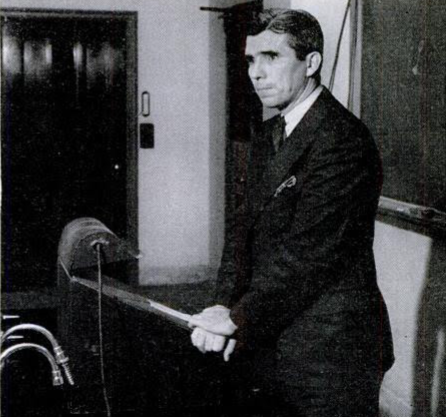
- 1895Joseph Banks Rhine born in Waterloo, Pennsylvania. He and Louisa Weckesser, married 1920, both take botany doctorates at the University of Chicago.[1][17]
- 1927The Rhines come to Duke to work with the psychologist William McDougall.[1]
- 1930Card-guessing work begins. Karl Zener, a Duke psychologist, designs the deck: 25 cards, five each of circle, cross, waves, square and star.[4][5]
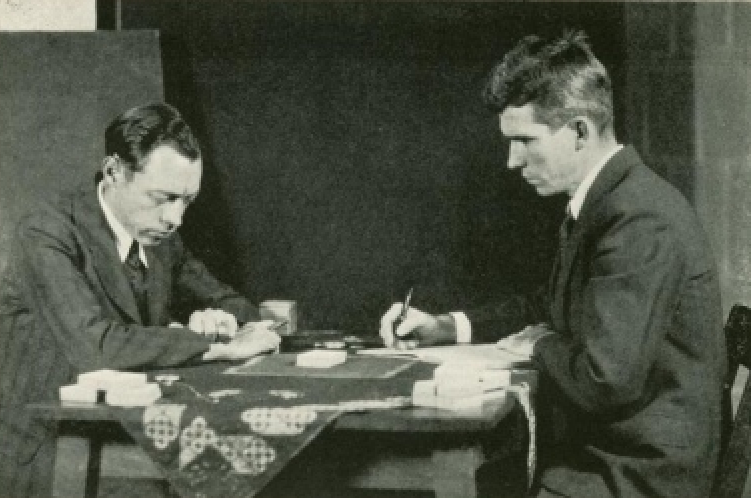
- 1933–34Hubert Pearce, a divinity student, calls cards in the library while J.G. Pratt turns them in another building: 558 hits in 1,850 calls, where chance gives 370.[6][3]
- 1934Rhine's book Extra-Sensory Perception puts the phrase in circulation. Dice tests begin the same year, after a young gambler claims he can steer a throw.[7][9]
- 1935The Parapsychology Laboratory opens on Duke's East Campus.[3]
- 1937Journal of Parapsychology starts. The president of the Institute of Mathematical Statistics writes that any fair attack on the work "must be on other than mathematical grounds."[4][3]
- 1938 · 1943The lab announces precognition, then the dice results.[2]
- 1948Louisa Rhine starts studying letters from the public about hunches, dreams and coincidences; the collection passes 30,000.[17]
- 1962–65Rhine sets up the Foundation for Research on the Nature of Man (FRNM) and, retiring from Duke in 1965, moves the work off campus. Sources differ on the founding year.[3][4]
- 1974Walter Levy, the young director Rhine had picked, is caught by three colleagues tampering with recording equipment in rat experiments. He resigns, and Rhine publishes the case in his own journal.[12][13]
- 1980 · 1995Rhine dies in 1980. FRNM becomes the Rhine Research Center on his centenary; it still runs in Durham.[1][4]
The critics
The early high scores came under three lines of attack. First, cards leak: subjects could read worn backs or see a card reflected in the experimenter's glasses. Second, other labs failed to reproduce the results. At Princeton, W.S. Cox ran 25,064 calls with 132 people and found nothing past chance. Third, C.E.M. Hansel argued the Pearce–Pratt layout left room to cheat, and Rhine and Pratt answered him in print.[5][7] Martin Gardner reported that Rhine kept quiet the names of twelve experimenters caught being dishonest in the 1940s.[8] The tests above answer the leak: the server holds the cards, and each precognition target is drawn after the call.
The government
In 1952–53 the US Army's engineering lab at Fort Belvoir paid Rhine to test whether dogs could find buried mines on California beaches. The Army dropped it in 1953 for machines.[19] The CIA's MKULTRA program funded one ESP study, Subproject 136, approved in 1961, with the contractor's name blacked out.[20][21] No released document places an MKULTRA project at Duke or FRNM.
The archive
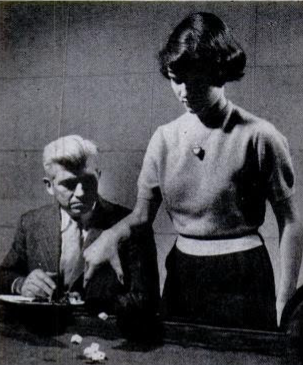
Duke's Rubenstein Library holds the Parapsychology Laboratory records: 340 linear feet, about 250,000 items, 1893–1984. They include score sheets, research files, and more than 350 boxes of letters, among them letters from Jung, Upton Sinclair and Aldous Huxley.[14][15] The Journal of Parapsychology is scanned from 1937 on.[18]
Set the ESP question aside and the archive is a record of how ordinary people behaved in front of a card they could not see. Some of it could be read today:
Folk randomness
Every call sheet shows what people think random looks like. Most avoid repeats and spread their calls too evenly. This page measures that in your own run.
Experimenter effects
The same test gave different scores under different testers. The score sheets record who ran each session, so the effect can be measured.
The history of cheating
Lady Wonder the horse, the twelve unnamed experimenters, the Levy case: an analog-era file on how people cheat, and how they get caught.[3]
Tired calls
Scores sagging late in a run, which Rhine's lab called the decline effect, look like boredom and fatigue on paper. The tally above tracks it live.[10]
Belief and performance
Sheep and goats: whether saying you believe changes how you play. The tally above splits every call three ways.
Letters as folklore
Louisa Rhine's 30,000 letters are American dream and premonition stories, told in their own words, mid-century.
Durham
The lab sat inside a city changing fast. Near Duke, from 1939, Walter Kempner ran the Rice Diet: rice, fruit, no salt. It made Durham a destination for dieters, and a 1993 lawsuit alleged Kempner had whipped a patient.[22][23] The two men make a pair: Rhine, patient with his numbers; Kempner, controlling his patients' every meal. From 1958, urban renewal cleared Hayti, the Black business and cultural district south of downtown, and the Durham Freeway split it.[24] Malcolm X Liberation University opened in Durham in 1969, moved to Greensboro in 1970 and closed in 1973.[25]
Sources
- NCpedia — Rhine, Joseph Banks
- NCpedia — Rhine Research Center
- Psi Encyclopedia (Society for Psychical Research) — J.B. Rhine
- Rhine Research Center — About us
- Wikipedia — Zener cards
- Wikipedia — Joseph Gaither Pratt
- Wikipedia — Extra-Sensory Perception (book)
- Wikipedia — Joseph Banks Rhine
- Psi Encyclopedia — Psychokinesis research
- Wikipedia — Decline effect
- Wikipedia — Sheep–goat effect
- Time, 26 Aug 1974 — Parapsychology: Fraud in the lab
- J.E. Kennedy — the Levy case
- Duke Rubenstein Library — Parapsychology Laboratory records, 1893–1984
- Duke exhibit — Laboratory letters
- Duke exhibit — Early Studies in Parapsychology at Duke
- Wikipedia — Louisa E. Rhine
- Internet Archive — Journal of Parapsychology, 1937 onward
- James Madison University CISR — the Army's mine-dog trials
- CIA reading room — MKULTRA Subproject 136
- US Senate, 1977 — Project MKULTRA hearing
- NCpedia — Rice Diet
- Wikipedia — Rice diet
- Wikipedia — Hayti, Durham
- Wikipedia — Malcolm X Liberation University
- drand — the League of Entropy's public randomness beacon