pig artthe pig mascot
also: the smiling pig · the house pig · Little Joe · the roof pig
A place with a pig on it does not need to say what it sells.
One pig, drawn once, used everywhere a barbecue business puts its name: the sign, the menu, the sauce label, the takeout box, the trailer door, the roofline, the weather vane. It is standing, smiling and usually dressed. It has no job in the picture — it is neither cooking nor eating — and that is what separates it from the pig that serves itself. A mascot is an identity: a customer who sees a pig on a bottle in a grocery aisle is meant to think of a particular pit in a particular town.
Little Joe, and what a mascot is for
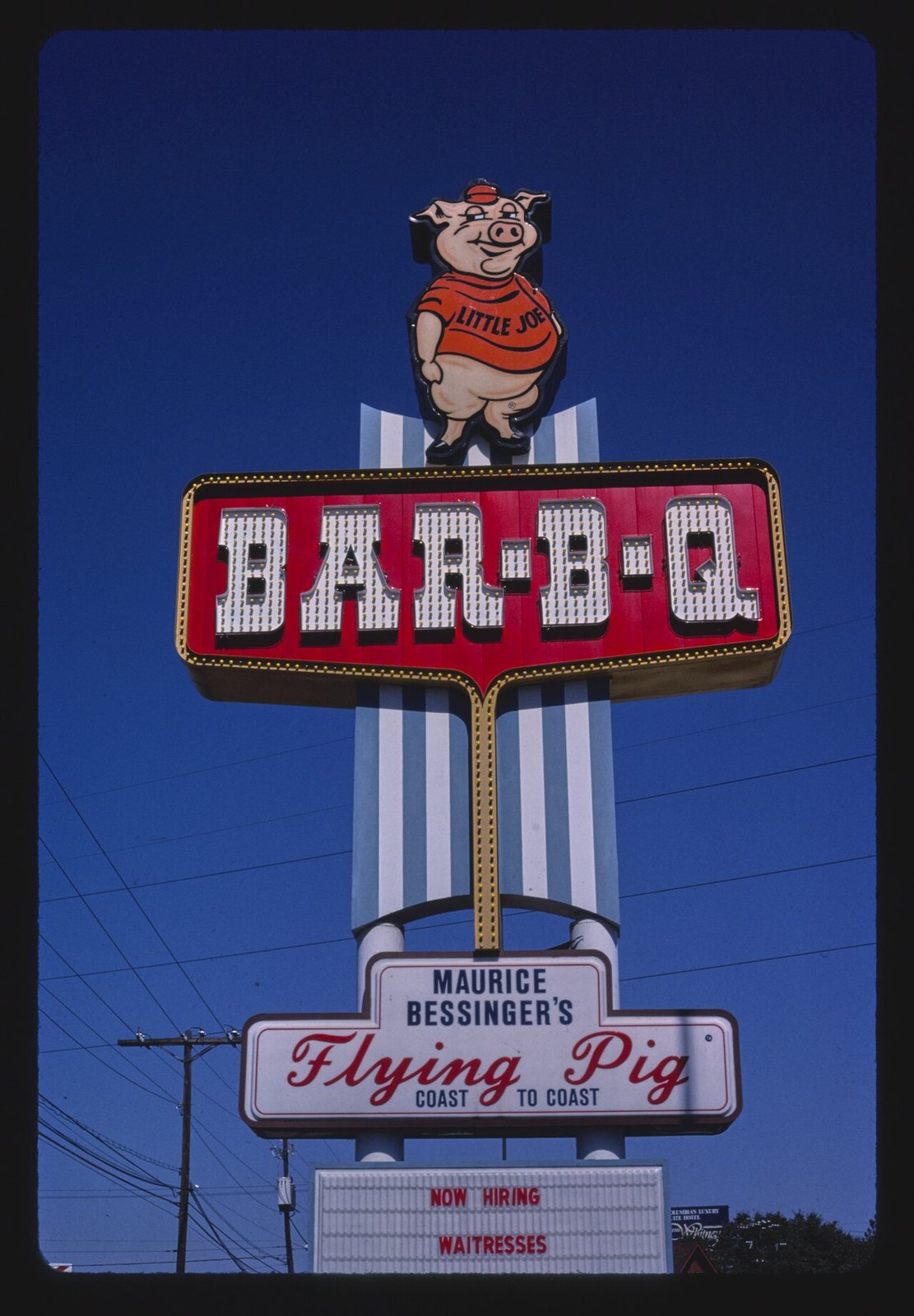
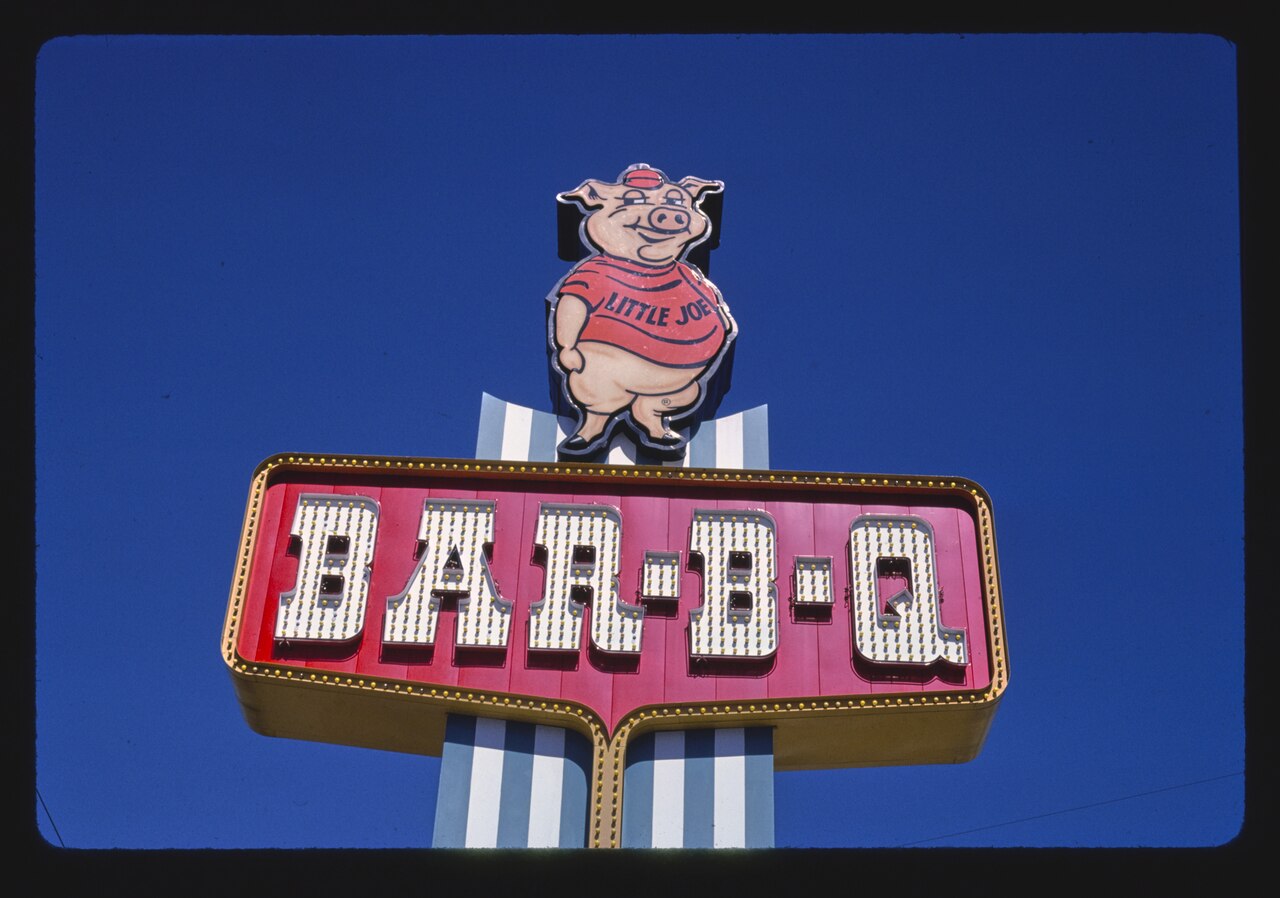
Maurice Bessinger's pig is the clearest Carolina case because it was photographed under a public-domain licence. John Margolies shot the West Columbia sign in 1988: at the top of a tall pylon, above illuminated block letters reading BAR-B-Q, a pink pig stands on two trotters in a red shirt with LITTLE JOE across the chest, a small cap on its head, hands tucked behind its back. The panel beneath reads Maurice Bessinger's Flying Pig, Coast to Coast, and under that a changeable letterboard was advertising for waitresses on the day of the photograph.
Coast to Coast is the point. The same pig went on the Carolina Gold sauce bottles that by 1999 made this the largest barbecue operation in the country, which is how a pig painted for one drive-in in West Columbia ended up on shelves in states with no barbecue of their own. When grocery chains pulled the sauce in 2000 over the Confederate flags Bessinger raised at his restaurants, what came off the shelf was the pig.
On a roof, and on a rod
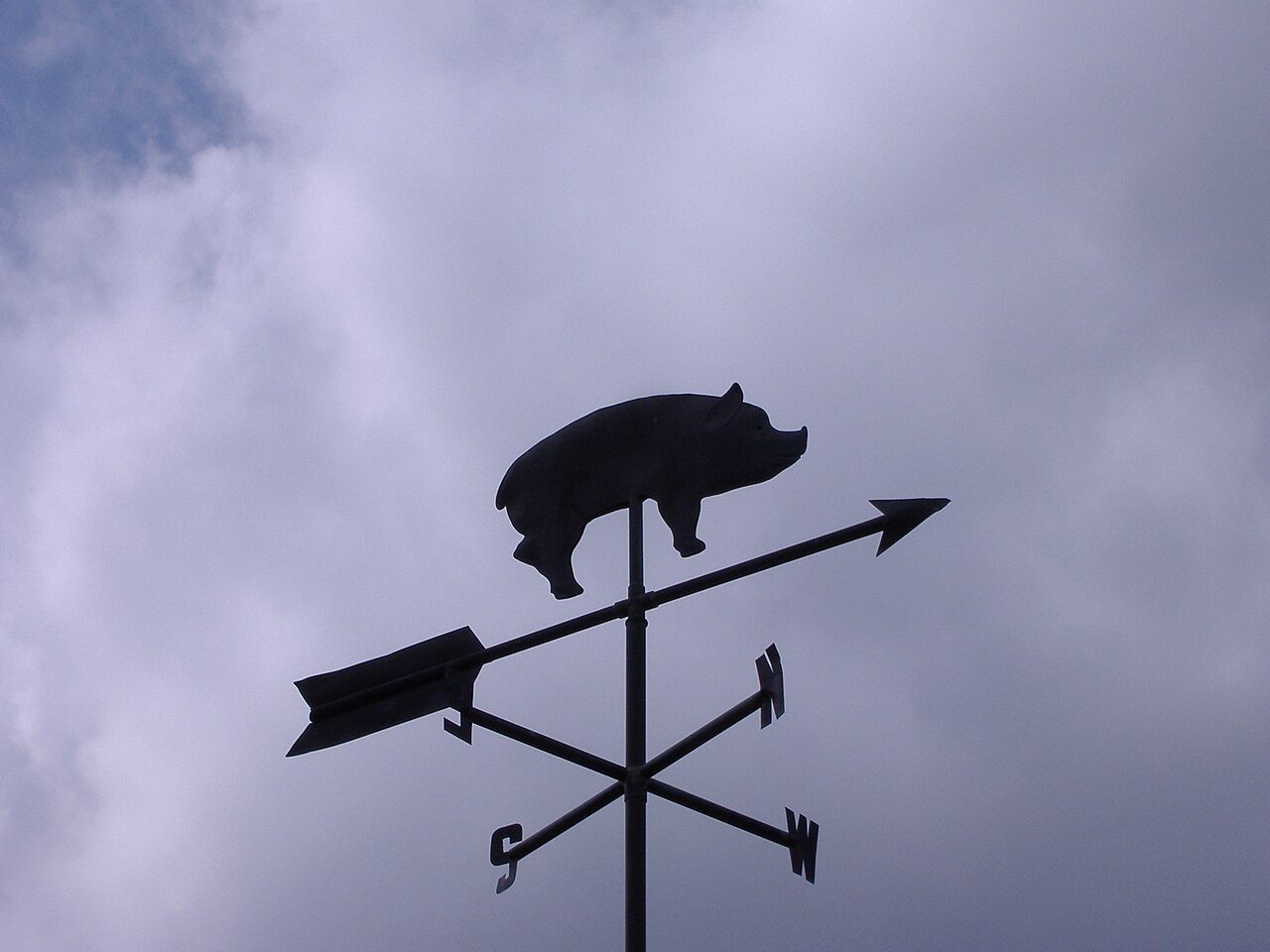
The mascot does not stay on the sign. Wilber's Barbecue in Goldsboro put a pig on a weather vane, cut flat from sheet metal, turning above the roof of a restaurant that opened in 1962 — a running pig in silhouette, nose into the wind, with the four cardinal letters under it.
Inference — a weather vane is a particular choice. A sign faces the road and can be read only from one direction; a vane is visible from every direction and points nowhere in particular, so it says a building is here rather than pointing at a door. Putting the pig up there treats it less as advertising than as the thing on top of a church.
The form recurs: a fibreglass pig on a porch, a pig on a trailer, a pig outline in neon over an entrance. The animal ends up in the place a weathercock, a cross or a name would otherwise go.

Where these pigs come from
Tradition holds — most house pigs are not commissioned. A sign shop keeps a book of pig artwork, a new pit buys one, the letters change and the pig does not, so a county can carry the same six or eight pigs across twenty businesses that have never met. The blog Suicide Food gave that recycling its own name across an eleven-part series: Repetitious Porcine Emblemology, the stock pig turning up again and again under different names.
A few are drawn once and stay drawn. Those are the ones that end up on a bottle, a T-shirt and a tattoo, and the ones people can describe from memory years after the restaurant closed.
Facts
| kind | mascot |
|---|---|
| state | both |
| region | The Carolinas, The American South |
| links | Maurice Bessinger — Wikipedia |
| confidence | medium · needs verification · updated 2026-09-16 |
Its kin
Who points back
Pictures
Sources
- John Margolies Roadside America Photograph Archive, 1972-2008 — John Margolies · link
- Wikimedia Commons · link
- Maurice Bessinger — Wikipedia · link
- Suicide Food — Ben (surname not given on the blog; named as Ben Grossblatt by The Stranger) · link
- Uncover Our Rich History — Maurice's Piggie Park BBQ · link
Where it came from: Cited a source we name · Harvested pulled from an open dataset · Tradition what the tradition says, hedged · Inference this project's reasoning · Field somebody stood there. This record as JSON.