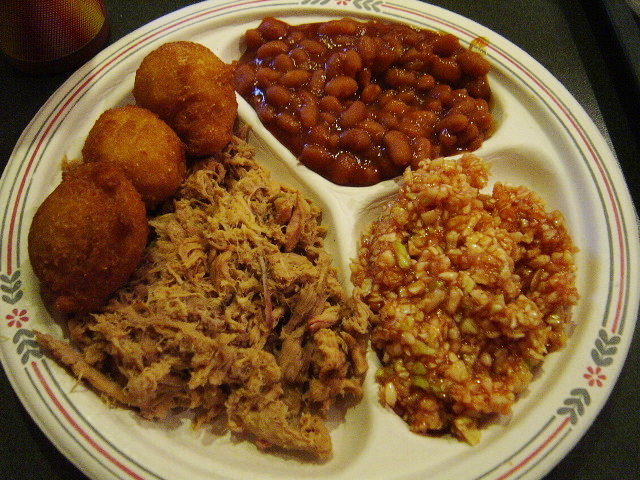
In Lexington you order a tray, chopped, coarse chopped or sliced; in the east you say plate or tray and the counter knows what comes with it.
Lexington style North Carolina barbecue served with hushpuppies, baked beans and red cole slaw. Lexington style North Carolina barbecue uses a vinegar and ketchup type sauce, and uses only the pork sh — Jeffery Loo, CC BY-SA 2.0
The unit of ordering at a Carolina barbecue counter: a paper boat or a plate with the chopped pork on one side and slaw on the other, and no bun. In Lexington the meat is pork shoulder and the order names the cut — chopped, coarse chopped (small chunks) or sliced — and the size, tray or large tray; in the east it is whole hog, and the tray or plate carries white slaw with cornbread, a corn stick or hushpuppies. A plate adds french fries and a choice of hushpuppies or rolls. A sandwich is the same meat and slaw on a bun.
The story Cited · web-carolinacountry-lexington
The tray is a counter word. At Melton's in Rocky Mount, the first sit-down barbecue restaurant in the state, a plate of barbecue with boiled potatoes cost 45 cents in 1929 and a sandwich 15 cents; the plate was the eastern form from the start. In Lexington the vocabulary grew around the shoulder. A regular quoted in Carolina Country in 2018 counted ten ways to order — coarse chopped, fine chopped, chopped, chopped brown, sliced — each dressed with the house dip, and the hushpuppies 'round, thin, fat, oblong, dense or light'. Regulars keep the order light, a paper tray with nothing but pork and slaw; the plate with fries is for visitors and big appetites. Tradition holds — the tray began as the cheapest way to sell barbecue from a tent or a curb-service window, and the cardboard boat is still the vessel at Lexington Barbecue and the Barbecue Center. In the east the whole hog gives the counter another set of choices: some pits chop the whole pig together, others let the customer ask for white meat, dark meat, or the 'middlin' from the belly, and Jane and Michael Stern wrote that the sound of the cleavers on the block is one of the pleasures of a Carolina whole-hog house.
How it is done Cited · web-leisuregrouptravel-lexington
The order names the cut first, then the form. Lexington Barbecue lists chopped, sliced and coarse chop trays in two sizes; the Barbecue Center fills a plate with two sides and hushpuppies or a potato bun. The meat is dressed on the block — with dip in the Piedmont, with the vinegar-pepper sauce in the east — and more comes in a cup on the side. Slaw goes beside the meat, not under it. At Skylight Inn the tray is barbecue, slaw and a square of cornbread; at B's in Greenville a plate is pork, slaw, potatoes, green beans and corn sticks; at Sam Jones BBQ the family tray is pork, cornbread and one side.
Today Cited · web-lexbbq-menu
At Lexington Barbecue in September 2026 a chopped tray is $8.00 cash, a large chopped tray $13.40 and a chopped plate $13.40; sliced and coarse chop run a little more. At the Barbecue Center a small chopped tray is $9.00, a large $12.00 and a chopped plate $13.00. B's Barbecue's dinner was $7.75 in January 2016.
Public-domain cookbooks are printed here in full, spelling and all. Where a recipe is still in copyright, the page gives the ingredients — a list of what goes in is a fact — and links to the rest.
To Barbecue Shoat
Mrs. Lettice Bryan · The Kentucky Housewife · 1839 · p. 95–96 · source · Public domain
Take either a hind or fore quarter, rub it well with salt, pepper, and a small portion of molasses, and if practicable, let it lie for a few hours; then rinse it clean, and wipe it dry with a cloth, and place it on a large gridiron, over a bed of clear coals. Do not barbecue it hastily, but let it cook slowly for several hours, turning it over occasionally, and basting it with nothing but a little salt-water and pepper, merely to season and moisten it a little. When it is well done, serve it without a garnish, and having the skin taken off, which should be done before it is put down to roast, squeeze over it a little lemon juice, and accompany it with melted butter and wine, bread sauce, raw sallad, slaugh, or cucumbers, and stewed fruit. Beef may be barbecued in the same manner.
The tray, written down in 1839: the meat cooked slowly over clear coals, mopped with nothing but salt water and pepper, and sent to table with slaugh — slaw — and cucumbers beside it.
To Barbecue Any Kind of Fresh Meat (receipt 200)
Mrs. A. P. Hill · Mrs. Hill's New Cook-Book · 1867 · p. 145–146 · source · Public domain
Gash the meat. Broil slowly over a solid fire. Baste constantly with a sauce composed of butter, mustard, red and black pepper, vinegar. Mix these in a pan, and set it where the sauce will keep warm, not hot. Have a swab made by tying a piece of clean, soft cloth upon a stick about a foot long; dip this in the sauce and baste with it. Where a large carcass is barbecued, it is usual to dig a pit in the ground outdoors, and lay narrow bars of wood across. Very early in the morning fill the pit with wood; set it burning, and in this way heat it very hot. When the wood has burned to coals, lay the meat over. Should the fire need replenishing, keep a fire outside burning, from which draw coals, and scatter evenly in the pit under the meat. Should there be any sauce left pour it over the meat. For barbecuing a joint, a large gridiron answers well; it needs constant attention; should be cooked slowly and steadily.
The pit and the cloth swab on a foot-long stick, from a Georgia book of 1867. A few characters in this paragraph are damaged in the scan and are read from context; the line 'Gash the meat' runs straight into 'Broil slowly' in the printing.
To Barbecue Shote
Mrs. Mary Randolph · The Virginia House-Wife · 1824 · p. 61–62 · source · Public domain
This is the name given in the southern states to a fat young hog, which, when the head and feet are taken off, and it is cut into four quarters, will weigh six pounds per quarter. Take a fore quarter, make several incisions between the ribs, and stuff it with rich forcemeat; put it in a pan with a pint of water, two cloves of garlic, pepper, salt, two gills of red wine, and two of mushroom catsup, bake it and thicken the gravy with butter and brown flour; it must be jointed and the ribs cut across before it is cooked, or it cannot be carved well; lay it in the dish with the ribs uppermost; if it be not sufficiently brown, add a little burnt sugar to the gravy, garnish with balls.
Mrs. Randolph's footnote to the title: 'Shote being a Provincial term, and not a legitimate English word, Mrs. R. has taken the liberty of spelling it in a way that conveys the sound of the pronunciation more clearly than shoad, the usual manner of spelling it.' A shoat is a young hog. This one is baked in a pan rather than cooked over coals — the word 'barbecue' in 1824 still meant the animal and the occasion as much as the fire.
To Barbecue Shoat
Marion Cabell Tyree, editor · Housekeeping in Old Virginia · 1879 · p. 132 · source · Public domain
Lay the shoat in water till ready for use; if small, it will cook in an hour. Put in the oven with two spoonfuls of water, a piece of lard, and dredge with flour. When ready for use, pour in half a teacup of walnut catsup, and, if not fat, a piece of butter.
An oven receipt under the barbecue name, in a Virginia book of 1879 — the word had by then loosened away from the fire.
Not to be confused with
barbecue sandwich — A sandwich has a bun and the slaw sits on the meat; a tray has no bun, the slaw sits beside the meat, and rolls or hushpuppies come alongside.
NCpedia — Barbecue (Encyclopedia of North Carolina) · link
Holy Smoke: The Big Book of North Carolina Barbecue — John Shelton Reed, Dale Volberg Reed, with William McKinney, 2008 · link
The Kentucky Housewife, Containing Nearly Thirteen Hundred Full Receipts — Mrs. Lettice Bryan, 1839 · link
Mrs. Hill's New Cook-Book; or, Housekeeping Made Easy. A Practical System for Private Families, in Town and Country, Especially Adapted to the Southern States — Mrs. A. P. Hill (Annabella P. Hill), of Georgia, 1867 · link
The Virginia House-Wife, or Methodical Cook — Mrs. Mary Randolph, 1824 · link
Housekeeping in Old Virginia: Containing Contributions from Two Hundred and Fifty Ladies in Virginia and Her Sister States — Marion Cabell Tyree, editor, 1879 · link
Where it came from: Cited a source we name · Harvested pulled from an open dataset · Tradition what the tradition says, hedged · Inference this project's reasoning · Field somebody stood there. This record as JSON.