What it is supposed to be forPhysics
Everything up to here is settled mathematics. This page is not. It is a research programme with real results and real problems, and the problems are on the page.
The shape of the idea
The Standard Model of particle physics is a list: twelve force carriers, a Higgs, and three copies of a set of twelve matter particles. The copies are identical except for mass. Nobody knows why there are three.
The grand-unified idea is that the forces are one force seen through a broken symmetry, and
the standard big symmetry for that is so(10) — 45 dimensions, with one generation
of matter and its antimatter fitting exactly into a 16-component spinor. That part is
respectable and decades old.
The exceptional idea goes one further: put the forces and the matter in the same Lie algebra, as different parts of one connection. Bosons in the even half, fermions in the odd half. For that you need an algebra with the right two-way split, and the magic square hands you three candidates Lisi 2026 §10.
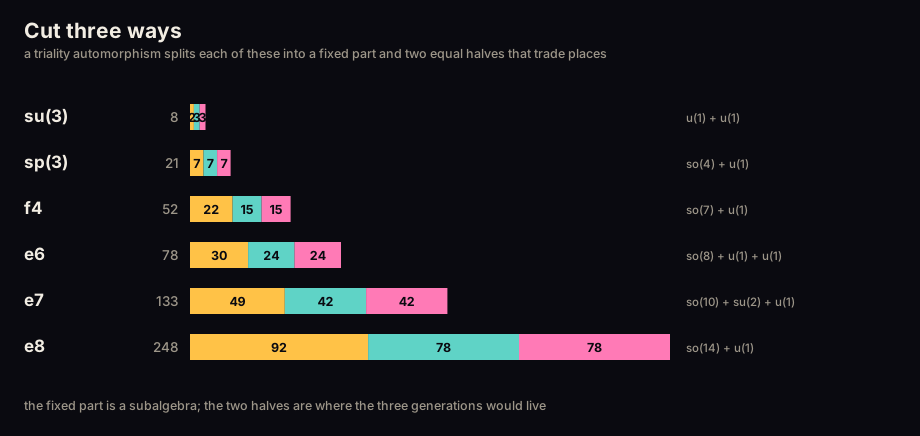
| algebra | dim | fixed part | dim | each moving part | dim |
|---|---|---|---|---|---|
su(3) | 8 | u(1) + u(1) | 2 | 1 + 1 + 1 | 3 |
sp(3) | 21 | so(4) + u(1) | 7 | 3 + 4 | 7 |
f4 | 52 | so(7) + u(1) | 22 | 7 + 8 | 15 |
e6 | 78 | so(8) + u(1) + u(1) | 30 | 8v + 8s+ + 8s- | 24 |
e7 | 133 | so(10) + su(2) + u(1) | 49 | 10 + 2x16 | 42 |
e8 | 248 | so(14) + u(1) | 92 | 14 + 64 | 78 |
The three-way split of each triality algebra, from Lisi eq. (6.1). Fixed part plus twice a moving part equals the whole, in every row — checked at build time.
Three candidates, three catches
e6 — 78 dimensions
The smallest one that works. so(10) and its 45 gauge directions fit, one
generation of left-handed matter fits in a 16, one generation of right-handed in the other 16,
and there are six directions of charge left over. The catch: one generation. Triality is
barely used. It is a tidy repackaging of a grand unified theory, not an explanation of three
T. Dray 2010.
e7 — 133 dimensions
This is where the ℂ ⊗ ℍ ⊗ 𝕆 programme lands — Dixon's algebra, and Furey and Hughes' work on
generations G. M. Dixon 1994 N. Furey 2022 N. Furey 2025. Three generations do fit, related by
triality. The catch: you cannot have all three generations and both handednesses
and the antiparticles at once. You must pick. Taking three generations forces a complex
form of e7, which then misbehaves for the gauge fields, and the gravitational frame
is missing altogether Lisi 2026 §10.
e8 — 248 dimensions
The whole thing: gravity's spin connection, the frame, the Higgs, the SO(10) gauge fields, and three generations of fermions related by triality. This is the 2007 paper A. G. Lisi 2007 brought up to date. The 2026 version puts the three generations in the moving parts of the three-way split, so all three carry identical charges — which is what the Standard Model actually shows Lisi 2026 §10.
The catches, plural. The compact version is Euclidean: no time direction, so it has to
be part of something bigger to describe the world we are in. The natural two-way split of
e8 does not line up with that particular assignment of fermions. And the three
generations are not independent of each other, so the model predicts generational mixing it
then has to account for.
What would settle it
Nothing on this page is a prediction yet in the sense that would settle anything. The state of play, as the paper itself puts it in its discussion, is that the mathematical scaffolding is now written down in enough detail that model-building can proceed — the point of the 2026 paper is the scaffolding, not a finished theory Lisi 2026 §12.
What makes it worth watching is the coincidence count. Eight is the last dimension with a division algebra. Eight is the only dimension with triality. Triality has order three; matter comes in three generations; the charges of the three generations are identical, which is what a symmetry of order three would produce. None of that is proof. It is a set of numbers that keep lining up.