Forty-nine boxes, one ruleThe Square
Put two division algebras together and a Lie algebra falls out. Do it for every pair and you get the magic square — which is magic because nobody ordered the exceptional algebras to show up in it, and there they all are.
A Lie algebra is the bookkeeping of a continuous symmetry: the list of
independent ways to nudge something, and the rule for what happens when you nudge twice in
different orders. Rotations in three dimensions give a three-dimensional one. Most of them come
in four tidy families that run forever. Five do not: g2, f4,
e6, e7, e8. Those five are the exceptional ones, and they
exist because the octonions do.
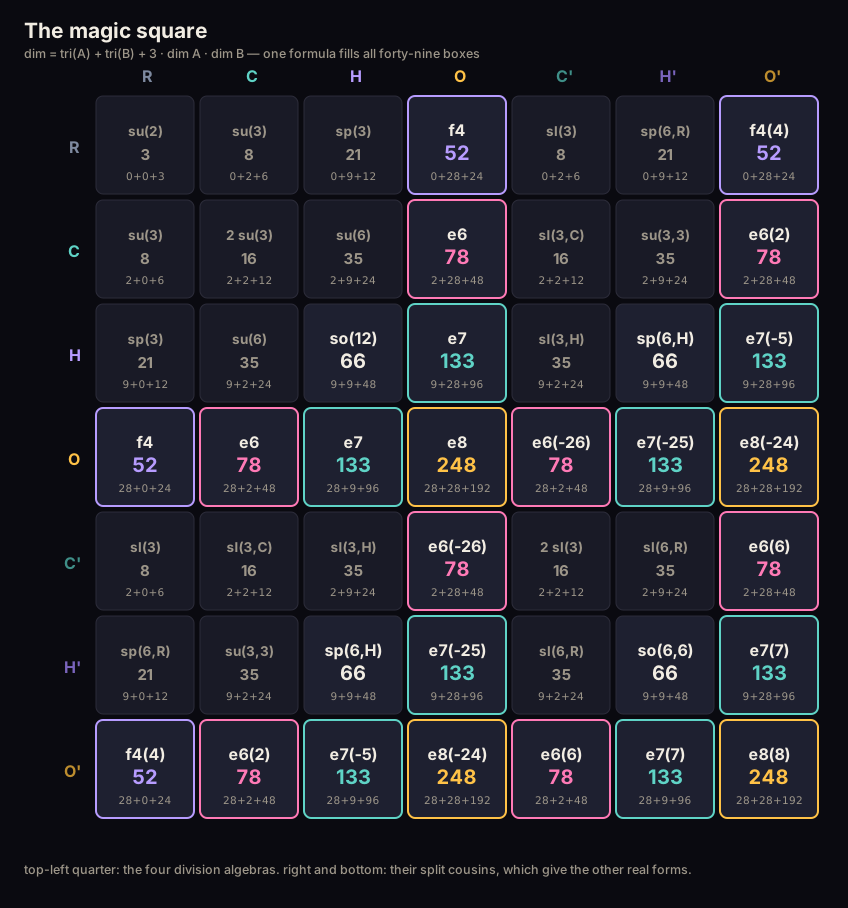
Freudenthal and Tits found the square in the sixties H. Freudenthal 1964 J. Tits 1966. The construction is: take the triality algebra of 𝔸, the triality algebra of 𝔹, and three copies of 𝔸 ⊗ 𝔹 — one for the vector, one for each spinor.
Every dimension in the table is computed from that formula by tools/algebra.py
and then checked against the known dimension of the algebra named in the box. All forty-nine
agree.
The square
| ℝ | ℂ | ℍ | 𝕆 | ℂ′ | ℍ′ | 𝕆′ | |
|---|---|---|---|---|---|---|---|
| ℝ | su(2)3 0+0+3 | su(3)8 0+2+6 | sp(3)21 0+9+12 | f452 0+28+24 | sl(3)8 0+2+6 | sp(6,R)21 0+9+12 | f4(4)52 0+28+24 |
| ℂ | su(3)8 2+0+6 | 2 su(3)16 2+2+12 | su(6)35 2+9+24 | e678 2+28+48 | sl(3,C)16 2+2+12 | su(3,3)35 2+9+24 | e6(2)78 2+28+48 |
| ℍ | sp(3)21 9+0+12 | su(6)35 9+2+24 | so(12)66 9+9+48 | e7133 9+28+96 | sl(3,H)35 9+2+24 | sp(6,H)66 9+9+48 | e7(-5)133 9+28+96 |
| 𝕆 | f452 28+0+24 | e678 28+2+48 | e7133 28+9+96 | e8248 28+28+192 | e6(-26)78 28+2+48 | e7(-25)133 28+9+96 | e8(-24)248 28+28+192 |
| ℂ′ | sl(3)8 2+0+6 | sl(3,C)16 2+2+12 | sl(3,H)35 2+9+24 | e6(-26)78 2+28+48 | 2 sl(3)16 2+2+12 | sl(6,R)35 2+9+24 | e6(6)78 2+28+48 |
| ℍ′ | sp(6,R)21 9+0+12 | su(3,3)35 9+2+24 | sp(6,H)66 9+9+48 | e7(-25)133 9+28+96 | sl(6,R)35 9+2+24 | so(6,6)66 9+9+48 | e7(7)133 9+28+96 |
| 𝕆′ | f4(4)52 28+0+24 | e6(2)78 28+2+48 | e7(-5)133 28+9+96 | e8(-24)248 28+28+192 | e6(6)78 28+2+48 | e7(7)133 28+9+96 | e8(8)248 28+28+192 |
Top-left quarter: the four division algebras, giving the compact real
forms. The right and bottom bands are the split algebras, which give the other real forms of the
same complex algebras — e8 and e8(8) and e8(−24) are the
same 248 dimensions with different signs in the metric Lisi 2026 §5.
Reading the corners
| pair | sum | dim | algebra | what it is |
|---|---|---|---|---|
| ℝ × 𝕆 | 0 + 28 + 24 | 52 | f4 |
the symmetries of the octonion projective plane |
| ℂ × 𝕆 | 2 + 28 + 48 | 78 | e6 |
big enough to hold the SO(10) grand unified theory and one generation of matter |
| ℍ × 𝕆 | 9 + 28 + 96 | 133 | e7 |
where ℂ ⊗ ℍ ⊗ 𝕆 fermions land G. M. Dixon 1994 N. Furey 2022 |
| 𝕆 × 𝕆 | 28 + 28 + 192 | 248 | e8 |
the largest exceptional Lie algebra. There is no sixth. |
Look down that column. 52, 78, 133, 248 — the whole exceptional series except
g2, produced by one arithmetic rule from the octonions and one other algebra.
g2 is the odd one out because it is not in the square at all: it is the symmetry
group of the octonions, the fourteen-dimensional set of ways to relabel them that
leaves every product where it was Lisi 2026 §11.
And the square is symmetric, which it had no right to be. L(𝔸, 𝔹) and L(𝔹, 𝔸) are built differently and come out the same. That is the part that earns the name.