One, two, four, eightNumbers
Four number systems let you divide. Nobody is going to find a fifth. Hurwitz shut that door in 1898, and the reason is the one law in the table below that the octonions still keep and the next rung does not.
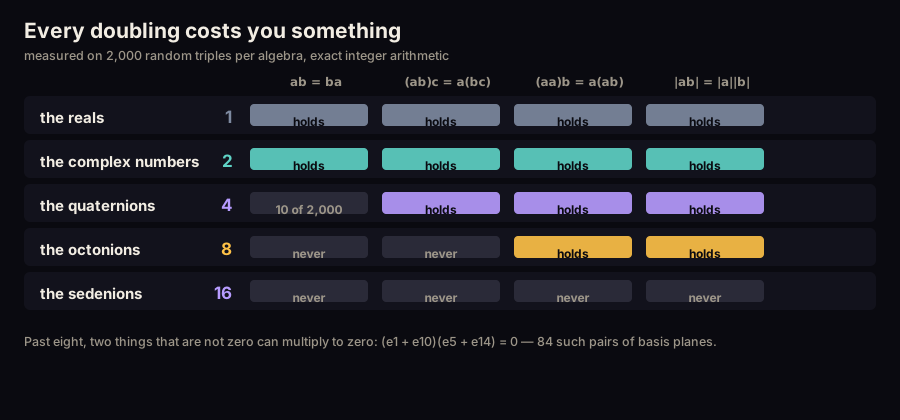
tools/algebra.py. A cell says holds only when every trial held.The ladder
Each algebra is the one before it, doubled. Take a pair of quaternions and call the pair an octonion; the rule for multiplying pairs is one line, and it is the same line at every rung:
Start with the reals, turn the crank, and you get the complex numbers. Turn it again: quaternions. Again: octonions. Again: sedenions, sixteen of them, and the bottom falls out.
What each turn costs
- 1 → 2. You lose the ordering. There is no saying whether
iis bigger or smaller than zero. - 2 → 4. You lose commuting.
e1 e2 = e3, bute2 e1 = −e3. Order of operations now matters, which is exactly why quaternions describe rotations — rotations do not commute either. - 4 → 8. You lose associating.
(ab)canda(bc)part company. What survives is the weaker alternative law: any two octonions still generate an associative patch, so(aa)b = a(ab)always. That is enough structure to build on, and it is the last rung where you get it. - 8 → 16. You lose the norm law,
|ab| = |a||b|— and with it, division. Two nonzero sedenions can multiply to zero. There are 84 such pairs of basis planes; the first one the search finds is(e1 + e10)(e5 + e14) = 0.
So the norm law, |ab| = |a||b|, is the thing that picks out 1, 2, 4 and 8 and
nothing else. It is also, read a different way, the triality form that runs the rest of this
site.
Break it yourself
The multiplier
Pick three basis units and watch the laws hold or fail. Everything is exact — these are integers, not decimals.
The split cousins
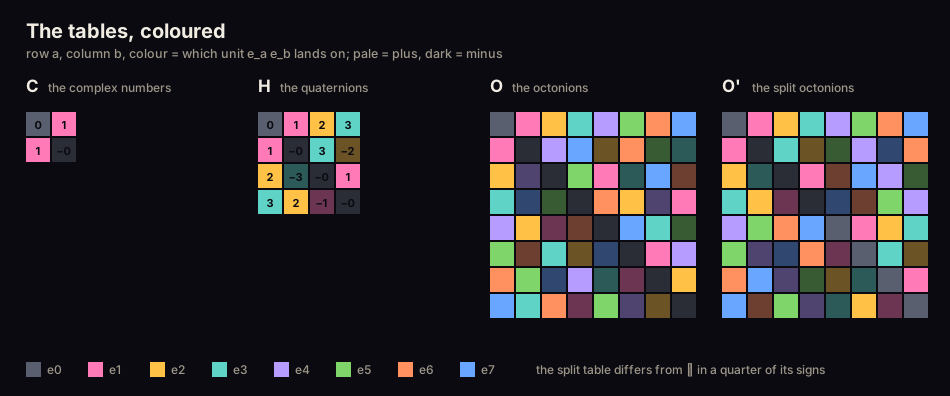
Beside each division algebra sits a split one of the same size, written ℂ′, ℍ′, 𝕆′. Same construction, one sign flipped, so the length of a thing can come out negative. They are not division algebras — some nonzero elements have length zero and cannot be divided by — but they multiply the same way, and they are how the same Lie algebra shows up in several real forms Lisi 2026 §2. Physics cares about that, because spacetime has a minus sign in it too.
Switch the multiplier above to 𝕆′ and watch |ab| = |a||b| keep holding while
the signs on the diagonal go the other way.