Seven posts, seven wiresThe Wheel
The octonion multiplication table looks like sixty-four entries to memorise. It is not. It is seven lines drawn through seven points, and once you can see the fence you never need the table again.
Take the seven imaginary units, e1 through e7. Put them at the
three corners of a triangle, the three midpoints of its sides, and the middle. Draw the three
sides, the three medians, and one circle through the midpoints. That is seven lines. Every line
touches three points; every point sits on three lines. Mathematicians call it the
Fano plane — the smallest projective plane there is.
Each line carries an arrow. Go with the arrow and the product is a plus; go against it and it is a minus:
The seven lines below were not drawn from a picture. tools/algebra.py walks the
table looking for triples where e_a e_b = e_c, e_b e_c = e_a and
e_c e_a = e_b, finds exactly seven, and the drawing is laid out afterwards to
match what it found Lisi 2026 §2.
Click two
The whole octonion table, in one picture you can hold in your head.
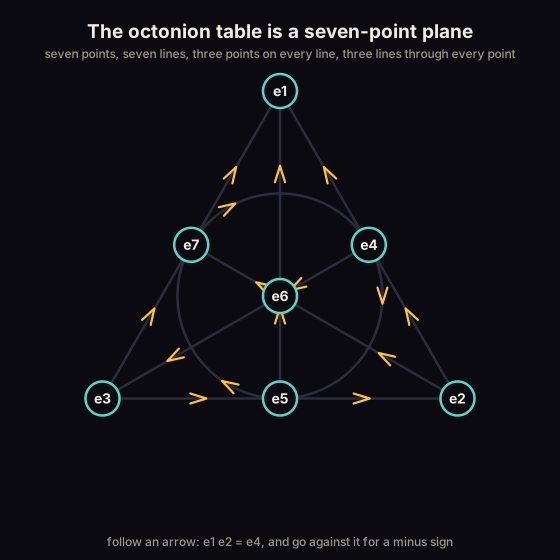
The seven lines
| line | read it | and backwards |
|---|---|---|
(1 2 4) | e1e2 = e4, e2e4 = e1, e4e1 = e2 | e2e1 = −e4 |
(1 3 7) | e1e3 = e7, e3e7 = e1, e7e1 = e3 | e3e1 = −e7 |
(1 5 6) | e1e5 = e6, e5e6 = e1, e6e1 = e5 | e5e1 = −e6 |
(2 3 5) | e2e3 = e5, e3e5 = e2, e5e2 = e3 | e3e2 = −e5 |
(2 6 7) | e2e6 = e7, e6e7 = e2, e7e2 = e6 | e6e2 = −e7 |
(3 4 6) | e3e4 = e6, e4e6 = e3, e6e3 = e4 | e4e3 = −e6 |
(4 5 7) | e4e5 = e7, e5e7 = e4, e7e4 = e5 | e5e4 = −e7 |
Seven lines, three units on each, every unit on three lines — 7 × 3 = 21 products, and the other forty-two entries in the table follow from the signs and the unit.
Why a plane at all
Because the octonions are built by doubling three times, and each doubling adds a new
independent direction: e1, then e2, then e4 in the
labelling used here. Everything else is a product of those, and the pattern of which products
give which is exactly the incidence pattern of a plane over the two-element field. Seven
nonzero triples of bits, seven points. The table has to be the Fano plane; there was no room
for it to be anything else.