The same thing, three waysTriality
In eight dimensions there are three different things with eight components: vectors, and two kinds of spinor. Triality is the symmetry that shuffles all three and leaves the arithmetic alone. It exists in eight dimensions and nowhere else.
First, the words.
A vector is an arrow: turn the world all the way round and an arrow comes back to itself. A spinor is the other kind of thing — turn the world all the way round and a spinor comes back with a minus sign; it takes two full turns to get home. Electrons are spinors. In eight dimensions, spinors come in two handednesses, and each one has eight components, same as the vector.
So you have three eight-dimensional objects that ought to be strangers, and they are not. There is one function of all three at once:
and it does not care which of the three you call which:
That cyclic symmetry is the octonion product, looked at from the side. You can go the other way and define the product from the form. Vector, spinor, other spinor: the labels come off.
Check it yourself
Three ways round
The last line reflects all three through a unit. A reflection turns the form into minus itself — the same size, the other sign — which is how you know a reflection is not one of the rotations. Two reflections make a rotation; four of them, through two different units, make a triality automorphism Lisi 2026 §3. Checked at build time on 1,920 exact cases and 3,000 random unit octonions, worst miss 2.1e-14.
A third of a turn
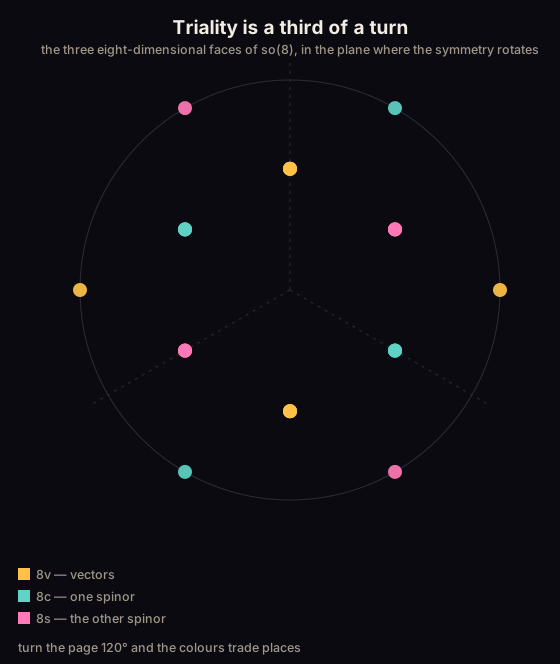
Here is the same fact in pictures. The rotations of eight-dimensional space form an algebra
called so(8), and it has three different eight-dimensional representations:
8v for the vectors, 8s and 8c for the two spinors.
Triality is a symmetry of so(8) that cycles them.
The matrix that does it is built here from the diagram symmetry and then checked orthogonal; order3; permutes roots; 8v to 8c; 8c to 8s; 8s to 8v: it is orthogonal, it cubes to the identity, it permutes all 24 roots among themselves, and it carries 8v → 8c → 8s → 8v.
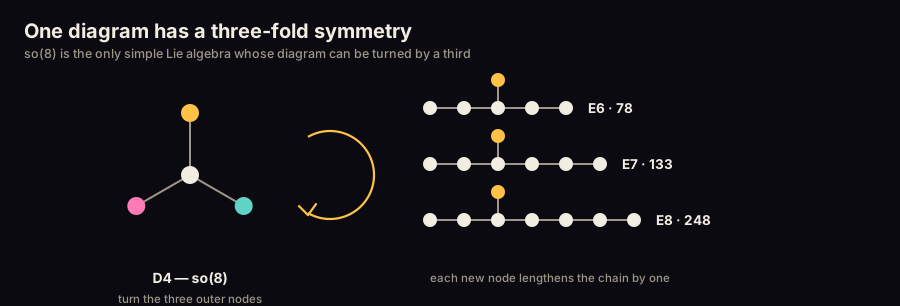
That picture on the left is the whole reason triality exists. A Lie algebra's diagram records
how its building blocks lean on each other, and symmetries of the diagram are symmetries of the
algebra. Most diagrams have a mirror at best. D4 — the diagram of so(8) — is a
three-pointed star, and you can turn it by a third.
Four algebras, four sizes of the same shape
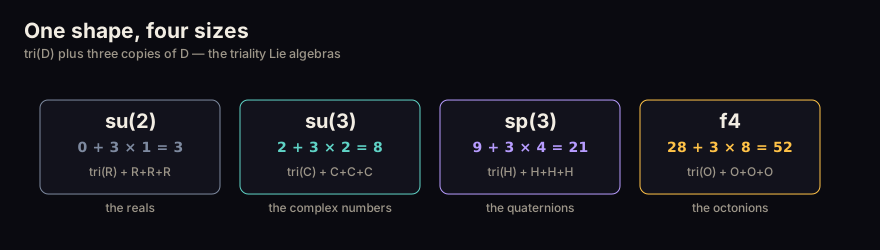
Every division algebra carries its own triality symmetry, and every one of them fits the same template: take the symmetry algebra, add one copy of the algebra for the vector and one for each spinor, and what comes out is a Lie algebra J. Evans 2009 C. H. Barton 2003 Lisi 2026 §4.
| algebra | dim | tri(𝔻) | dim tri | + three copies | total | which is |
|---|---|---|---|---|---|---|
| the reals ℝ | 1 | nothing | 0 | 3 × 1 = 3 | 3 | su(2) |
| the complex ℂ | 2 | u(1) + u(1) | 2 | 3 × 2 = 6 | 8 | su(3) |
| the quaternions ℍ | 4 | three copies of su(2) | 9 | 3 × 4 = 12 | 21 | sp(3) |
| the octonions 𝕆 | 8 | so(8) | 28 | 3 × 8 = 24 | 52 | f4 |
The bottom row is the point: so(8) has 28 dimensions, three
octonions make 24, and 28 + 24 = 52 — which is f4, an exceptional Lie algebra,
built out of nothing but the octonions and their own symmetry.
Why anyone in physics cares
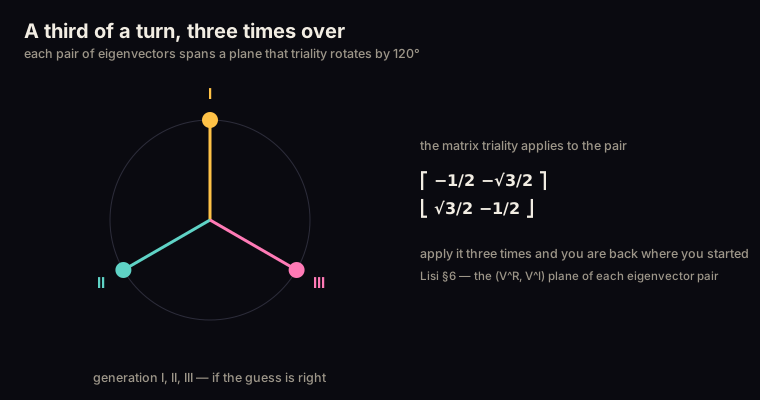
Matter comes in three generations. The electron, the muon and the tau are the same particle three times over with different masses, and nobody knows why there are three N. Furey 2025. Triality is a symmetry of order three that acts on exactly the objects spinors live in. The temptation is obvious, and it is old.
Whether the temptation pays off is a separate page, with the objections on it.