240 directions, 248 dimensionsE8
E8 is the biggest of the five exceptional Lie algebras and the end of the line. Two hundred and forty roots, each a direction in eight-dimensional space, each one knowing about all the others. Octonions times octonions.
A root is a direction in which the algebra can be stretched — one arrow per independent way the symmetry can act. E8 has 240 of them in 8 dimensions, plus the 8 directions of the stretching itself, and 240 + 8 = 248.
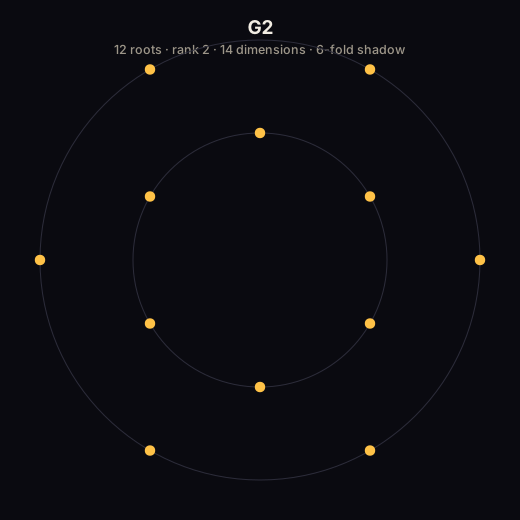
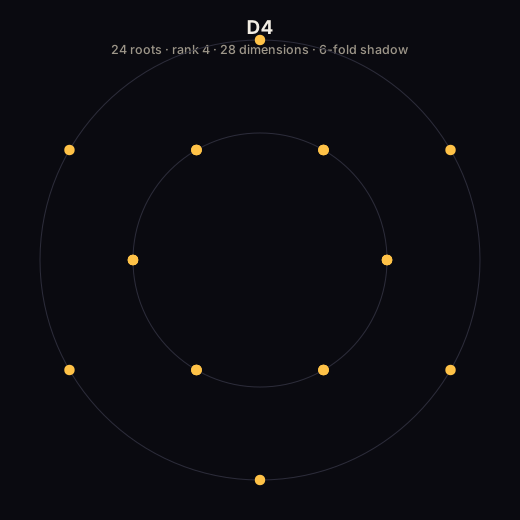
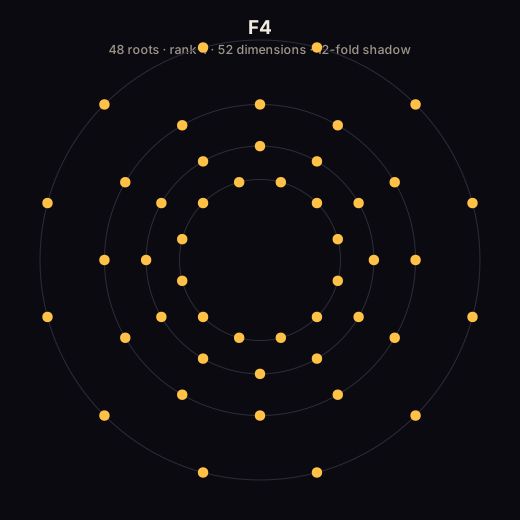
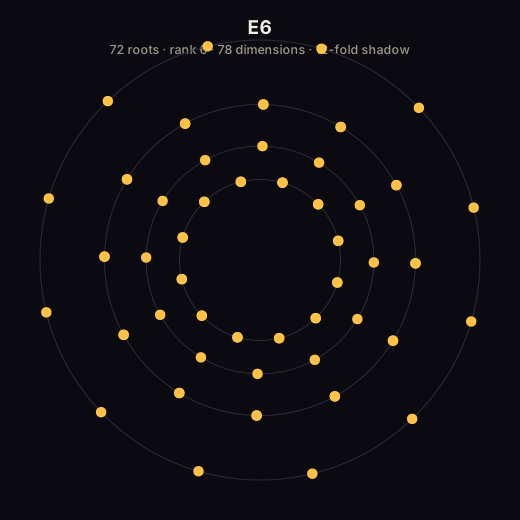
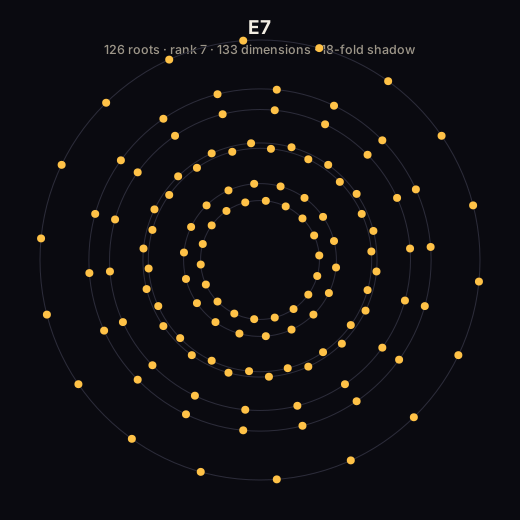
You cannot draw eight dimensions. What you can do is find the one plane the whole thing turns in — every root system has a Coxeter element, one grand rotation that carries the root system onto itself, and it turns one particular plane by the same angle every time. For E8 that angle is a thirtieth of a full turn. Flatten the roots onto that plane and they land on eight rings of thirty.
Turn it
Points and lines come from build/data/roots.json, computed by
tools/roots.py: the root system is built from its definition, the Coxeter element
is multiplied out from the simple reflections, and its eigenvector for e2πi/h gives
the plane.
Every one of them, counted
| system | roots | rank | dim | turn | rings |
|---|---|---|---|---|---|
g2 | 12 | 2 | 14 | 6 | 6 · 6 |
d4 | 24 | 4 | 28 | 6 | 18 · 6 |
f4 | 48 | 4 | 52 | 12 | 12 · 12 · 12 · 12 |
e6 | 72 | 6 | 78 | 12 | 24 · 12 · 24 · 12 |
e7 | 126 | 7 | 133 | 18 | 18 · 18 · 18 · 18 · 18 · 18 · 18 |
e8 | 240 | 8 | 248 | 30 | 30 · 30 · 30 · 30 · 30 · 30 · 30 · 30 |
Rank is how many independent directions of stretching; dim is roots plus rank; turn is the Coxeter number, how many clicks to the full rotation. E7 and E6 are pulled out of E8 here as the roots orthogonal to one root, and to a pair of roots meeting at 120 degrees.
Cut three ways
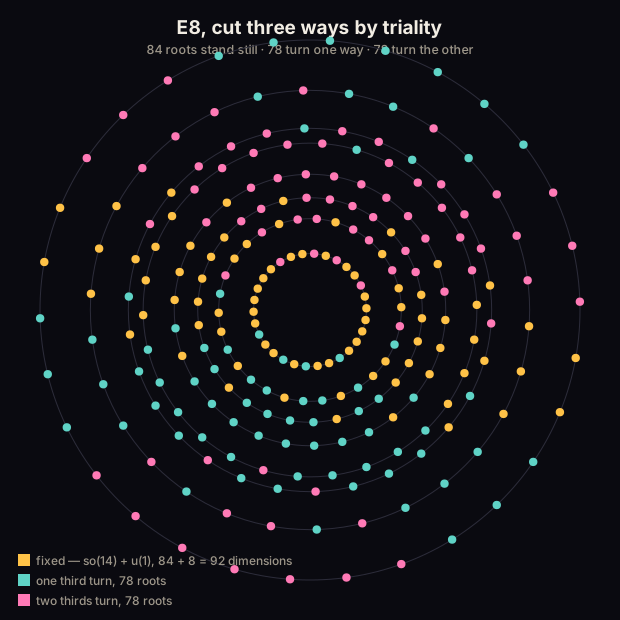
Apply a triality automorphism to E8 and every direction in it does one of three things: stands still, turns a third of the way round, or turns two thirds. The algebra splits into three pieces Lisi 2026 §6:
The split is not decorative. Brackets respect it: nudge in a third-turn direction, then in another third-turn direction, and you land in a two-thirds direction, every time. That was checked here on all 13,440 pairs of roots whose sum is again a root — 0 violations. Vinberg's Θ-groups are the general theory of these three-way splits E. B. Vinberg 1976, and Lisi's proposal is that the three generations of matter sit in the pieces that move.
Cut two ways
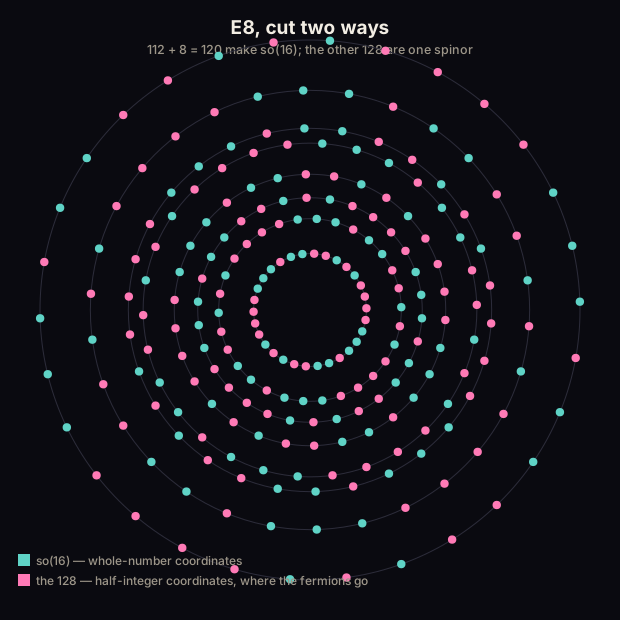
E8 also splits clean down the middle a different way: 120 + 128 =
248. The first part is so(16) — ordinary rotations in sixteen dimensions.
The second is one spinor of so(16), 128 components, and this is where
the bosons-and-fermions story wants to live: the even half is forces, the odd half is matter
Lisi 2026 §10.
The roots with whole-number coordinates are the first half; the ones with halves all the way across are the second. That is all the distinction amounts to, and you can see it in the picture.
The other four