futureFrom next year to 10¹⁰⁰
The near future is a list of instruments with dates. The far future is a calculation, and it belongs to black holes: after the stars and the stellar remnants are gone, they are the last things left, and they take a long time to leave.
Instruments, in order
| When | What | For |
|---|---|---|
| by May 2027 | Nancy Grace Roman Space Telescope | a survey of the Galactic bulge expected to catch isolated black holes by microlensing, dozens to hundreds of them, weighed |
| late 2020s | Event Horizon Telescope at 345 GHz, and more dishes | sharper rings; a movie of M87*'s gas over weeks |
| ~2030 | LIGO-India, at Aundha | a fifth detector; sky positions good enough to point a telescope at a merger in time |
| 2030s | Einstein Telescope (Europe, underground, triangle of 10 km arms) and Cosmic Explorer (US, 40 km arms) | every stellar-mass merger in the observable universe, back to the first stars |
| ~2031, proposed | Black Hole Explorer (BHEX) | a dish in orbit joined to the ground array: the photon ring's first subring, and spin from its shape |
| mid-2030s | LISA — three spacecraft, 2.5 million km apart | supermassive pairs merging, heard for months; small holes circling big ones for thousands of turns; a test of Kerr to a part in a thousand |
Roman[63] · Einstein Telescope[61] · Cosmic Explorer[62] · BHEX[56] · LISA, adopted by ESA in January 2024[55]. Dates are the programmes' own as of 2026 and move.
What they will test
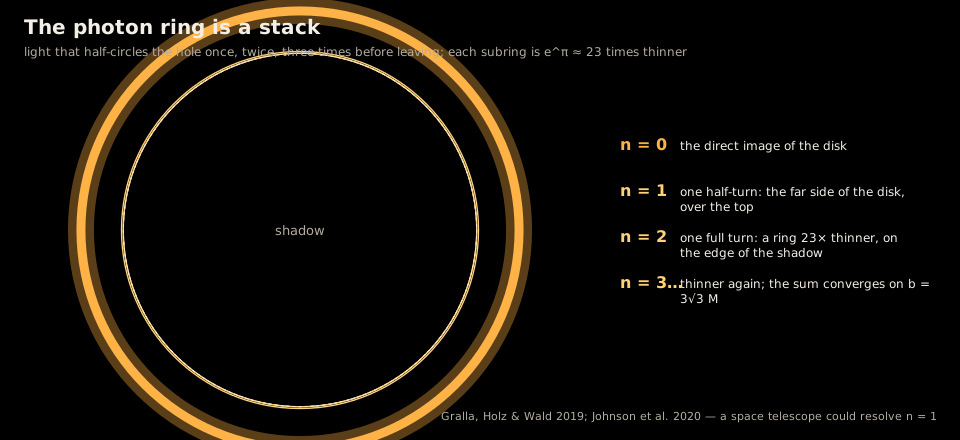
The photon ring. Its width and shape depend on the metric alone, not on the gas. Resolving the first subring would make a black hole's shadow a ruler for general relativity, independent of everything astrophysical[45, 56].
No hair, to three decimal places. A small hole circling a supermassive one for a hundred thousand turns, heard by LISA, maps the big hole's field the way a satellite maps the Earth's. Any feature beyond mass and spin shows up as a wrong note[55].
The first stars' remains. The Einstein Telescope and Cosmic Explorer would hear a 30-solar-mass merger at any distance in the observable universe, so the whole history of black hole formation becomes a catalogue[61, 62].
Hawking radiation. A primordial black hole finishing its evaporation would end in a burst of gamma rays; the HAWC and Fermi telescopes look for it. Nothing yet. If none is ever seen, the primordial window narrows[60].
10⁶⁷years: a Sun-mass black hole evaporates
The Sun will never be one; it stops at a white dwarf. But a hole of its mass, if made, outlives everything: the stars by 10⁵³ times, the protons — if they decay at all — by 10³⁰.
The eras
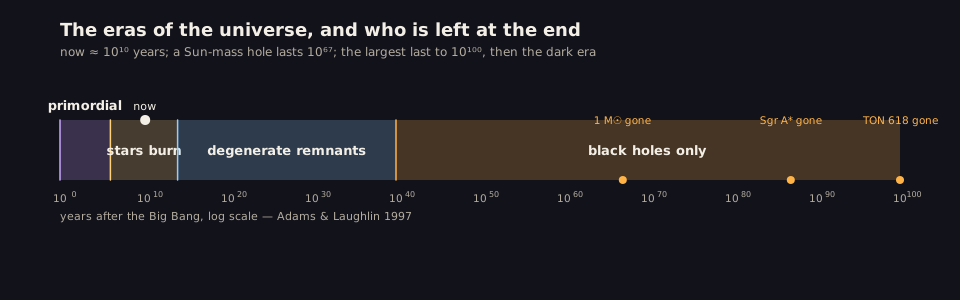
Adams and Laughlin laid out the long future in 1997[41]. Star formation ends around 10¹⁴ years, when the gas is used up. The last red dwarfs go out. What is left — white dwarfs, neutron stars, black holes, planets, the odd brown dwarf — drifts, collides on occasion, and is stripped from galaxies by close encounters over 10¹⁹ years. If protons decay, on a timescale of perhaps 10³⁴ to 10⁴⁰ years, the dead stars evaporate into leptons and light. Then the universe is black holes, and the radiation they make.
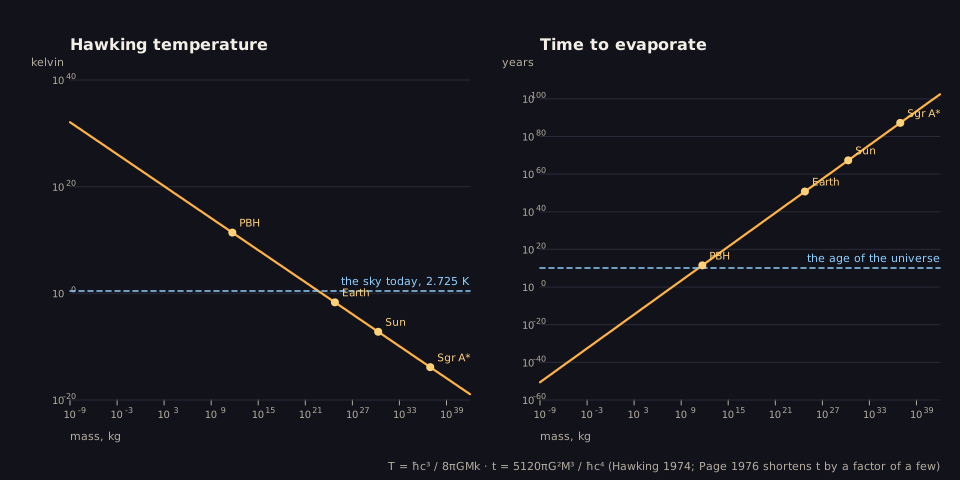
A black hole cannot shrink while the sky is warmer than it is. The cosmic background is 2.725 K now and cooling as the universe expands; a Sun-mass hole, at 6 × 10⁻⁸ K, begins to lose mass when the background falls below that, some 3 × 10¹¹ years from now. From then it is a slow leak: 2 × 10⁶⁷ years for one solar mass, 10⁸⁷ for Sagittarius A*, about 10¹⁰⁰ for the largest. The end of each is fast. In the last second a hole of 10⁹ kg gives off its remaining mass as a burst of gamma rays, brighter for that second than a galaxy. And then the dark era: photons, leptons, and the occasional positronium atom a light-year wide, decaying.
What might be wrong with this
Every line of the far future rests on three things not yet known: whether protons decay, whether the expansion keeps accelerating, and what quantum gravity does in the last moments of an evaporation. The eras are what the known equations give when run forward; the calculation is sound, and its premises are open.