pastWho discovered black holes?
Nobody, and about nine people. Each step below was taken by someone who did not know the next step existed, and several were taken twice. The first was a rector in Yorkshire, forty years before the word “scientist”.
| The step | Who | When |
|---|---|---|
| The idea: a star so heavy its light falls back | John Michell | 1783 |
| The same idea, in print, in French | Pierre-Simon Laplace | 1796 |
| Light bent by a mass, computed | Johann Georg von Soldner (Newton's value); Einstein (twice it) | 1801; 1915 |
| The equations of gravity | Albert Einstein | November 1915 |
| The exact solution around a mass | Karl Schwarzschild; Johannes Droste, independently | January 1916; 1916–17 |
| A star can have no support left | Anderson; Stoner; Chandrasekhar; Landau | 1929–32 |
| The surface at 2M is a place, not a fault | Lemaître; Finkelstein | 1933; 1958 |
| A collapsing star computed through its horizon | J. Robert Oppenheimer and Hartland Snyder | 1939 |
| The spinning solution | Roy Kerr | 1963 |
| Collapse must make a singularity — a theorem | Roger Penrose | 1965 |
| The name | Ann Ewing, reporting; John Wheeler, who made it stick | 1964; 1967 |
| The first one weighed | Louise Webster, Paul Murdin; Tom Bolton (Cygnus X-1) | 1972 |
| They have a temperature | Jacob Bekenstein; Stephen Hawking | 1972; 1974 |
| The first picture, computed | Jean-Pierre Luminet | 1979 |
| The first pair heard merging | LIGO | 2015 |
| The first photograph | Event Horizon Telescope | 2019 |
Before the equations
1783 — John Michell
Michell was the rector of Thornhill, near Dewsbury, and before that a Cambridge geologist who had worked out that earthquakes travel as waves. In a letter to Henry Cavendish, read to the Royal Society on 27 November 1783 and printed the next year, he took Newton's gravity and Newton's particles of light and asked what happens if a star is heavy enough. A star five hundred times the Sun's diameter at the Sun's density, he computed, would have an escape speed above the speed of light, and so “all light emitted from such a body would be made to return towards it by its own proper gravity”. He went further: such a star could still be found, because a companion orbiting it would show its pull. That is how Cygnus X-1 was found in 1972 and Gaia BH3 in 2024[1, 4].
His number was right for the wrong theory. In Newton's gravity the escape speed is √(2GM/r), and setting it to c gives r = 2GM/c² — the same radius Schwarzschild's metric gives, by a coincidence of the algebra. Michell had the size of a black hole a hundred and thirty-three years early.
1796 — Laplace
Laplace put the same argument in the Exposition du système du monde, with the same star and the conclusion that “the largest luminous bodies in the universe may be invisible”. He proved it in 1799 at the request of a German editor. Then Thomas Young's experiments made light a wave, a wave has no mass for gravity to pull on, and Laplace removed the passage from the third edition of 1808. The idea slept for a century[2].
1801 — Soldner
Johann Georg von Soldner, a Bavarian surveyor, computed how far a ray grazing the Sun would bend under Newton: 0.84 arcseconds. Einstein's 1911 paper got the same value by another route, and his 1915 theory doubled it. The 1919 eclipse chose between them[3, 5, 11].
Solved in a trench
Karl Schwarzschild was an artillery officer on the Russian front when Einstein's field equations were published in November 1915. He found their exact solution for a single mass within weeks, sent it to Einstein, and died of a skin disease in May. Einstein read the paper to the Prussian Academy for him.
1915–1917 — Einstein, Schwarzschild, Droste, Flamm
Einstein expected only approximate solutions to his equations. Schwarzschild's was exact, and it contained a radius at which the formula misbehaved, r = 2M in units where G = c = 1. He did not think it meant anything physical; nor did Einstein. Johannes Droste, a student of Lorentz in Leiden, found the same solution independently and wrote it in the form used today[7, 8]. Ludwig Flamm, in Vienna, drew it: the equatorial plane bent into a funnel, the picture every science documentary borrows[9]. Reissner and Nordström added charge[10].
1929–1935 — Anderson, Stoner, Chandrasekhar, Landau
A dead star is held up by the pressure of electrons packed as tightly as quantum mechanics allows. Wilhelm Anderson in Tartu and Edmund Stoner in Leeds found first that this pressure has a ceiling; Subrahmanyan Chandrasekhar, nineteen, on the boat from Madras to Cambridge in 1930, did the calculation with relativity in and got the limit right: 1.4 solar masses[13, 14]. Above it, nothing known held the star up. Eddington, his own sponsor, attacked the result in public in 1935 and called it “stellar buffoonery”. Lev Landau, in 1932, reached the same conclusion for neutron matter. Baade and Zwicky proposed neutron stars in 1934[16].
1933 — Lemaître
Painlevé, Gullstrand and Eddington had each written the Schwarzschild solution in coordinates where nothing went wrong at 2M, and none of them said what that meant. Georges Lemaître said it: the singularity there is “fictitious”, a fault of the map, not the territory[12, 15].
1939 — Einstein, wrong; Oppenheimer, right
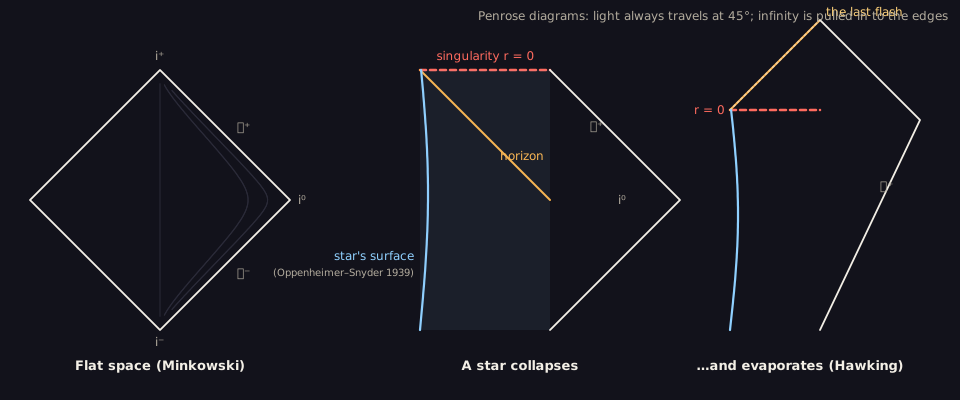
Einstein published a paper arguing that Schwarzschild singularities “do not exist in physical reality”, by showing that a cluster of particles cannot be squeezed inside 2M while staying in orbit. True, and beside the point: a collapsing star is not in orbit[17]. The same year Oppenheimer and Volkoff found the mass ceiling for neutron stars, and Oppenheimer and Snyder followed a collapsing star through its own horizon: to a far observer it slows and reddens and freezes at 2M; to a rider on the surface it crosses in finite time and keeps going[18, 19]. Then the war took everyone.
1958–1965 — Finkelstein, Kruskal, Kerr, Penrose
David Finkelstein described the surface at 2M as a one-way membrane[20]; Kruskal and Szekeres drew the whole spacetime on one map[21]. Maarten Schmidt measured the redshift of 3C 273 in 1963 and found a star-like point outshining a galaxy from two billion light-years away; Salpeter and Zel'dovich said within the year that gas falling onto a very massive compact object would do that, and Lynden-Bell in 1969 that most galaxies, ours included, should have one in the middle[22, 24, 30]. Roy Kerr found the spinning solution[23]. Roger Penrose proved in 1965 that once a collapse passes a certain point, a singularity is not a possibility but a theorem — the work his 2020 Nobel cites[26, 48].
1964–1967 — the name
The phrase was in print in January 1964, in Ann Ewing's report for Science News Letter of a meeting where, it seems, Robert Dicke had likened the objects to the Black Hole of Calcutta[25, 89]. John Wheeler used it in a lecture on 29 December 1967, after someone in an earlier audience shouted it at him when he tired of saying “gravitationally completely collapsed object”, and printed it in 1968. It stuck to him[29].
1971–1974 — found, and warm
Cygnus X-1 is an X-ray source found by rocket in 1964. In 1971–72 Louise Webster and Paul Murdin at Greenwich, and Tom Bolton in Toronto, measured the wobble of the blue supergiant beside it and weighed the unseen partner at more than the neutron-star limit — Michell's method, exactly[34]. Hawking bet Thorne it was not a black hole, as insurance, and conceded in 1990. Meanwhile Hawking proved horizons only grow[33], Bekenstein said that made them entropy[35], and Hawking, trying to prove him wrong, found in 1974 that they radiate[38].
1979 — the first picture
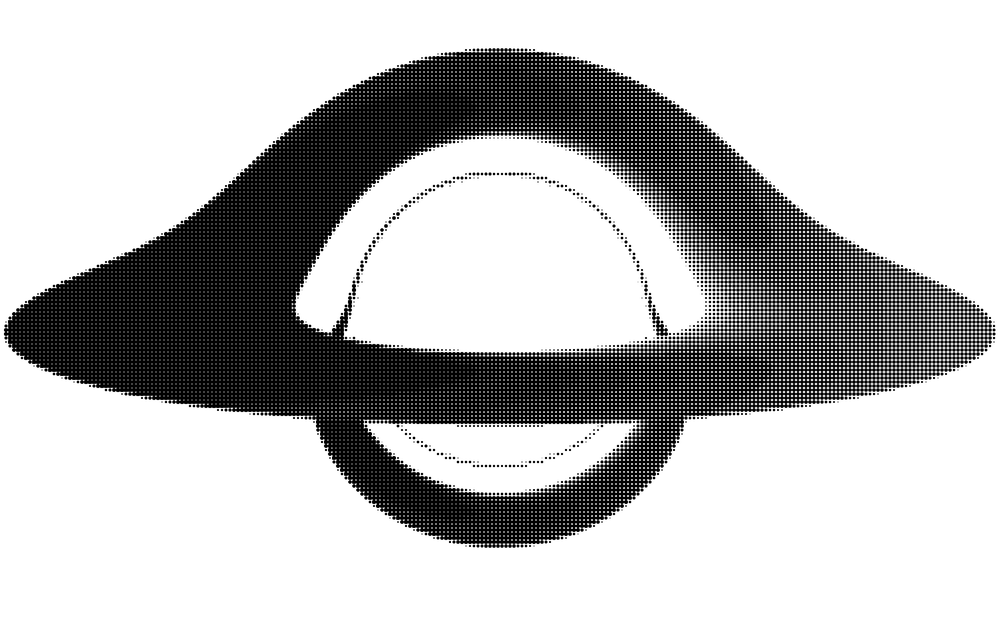
Jean-Pierre Luminet, at the Paris Observatory, traced rays from a thin disk around a Schwarzschild hole on an IBM 7040 and drew the output by hand as dots of India ink: denser where the disk is brighter, the far side lifted over the top, the near side under, one side brighter because it comes toward you[40]. The same calculation, redone here and drawn as dots:
1992–2020 — the stars round the centre
Reinhard Genzel's group in Garching and Andrea Ghez's at UCLA followed stars orbiting a point in Sagittarius for thirty years. S2 goes round every sixteen years at up to 3% of the speed of light. Its orbit gives the mass, 4.3 million suns, in a volume smaller than the Solar System; its 2018 pass showed the gravitational redshift and its 2020 analysis the Schwarzschild precession[46]. Nobel, 2020, shared with Penrose[48].
2015 and 2019 — heard, then seen
The rest is on the present page: GW150914 on 14 September 2015[43], the M87* ring on 10 April 2019[44].