generatorThrow something at it
Pick an angular momentum and an energy. The particle starts at its outer turning point and falls. Newton would draw one ellipse, forever. Einstein draws a rosette, or a whirl, or a plunge.
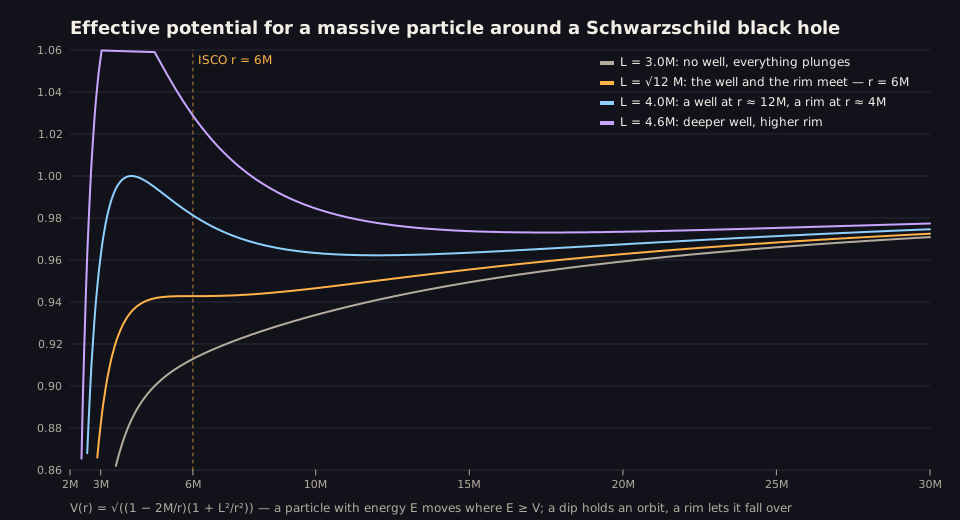
Units G = c = M = 1; L and E per unit mass of the particle. The right-hand panel is the effective potential V(r) for the chosen L, with E as the dashed line: where the line is above the curve the particle may be. A dip holds it; a rim it clears lets it fall.
Why the rosette
In Newton's gravity the force falls as 1/r², and a 1/r² force is the one case that closes its orbits. Einstein's extra term, 3Mu², is a 1/r⁴ correction. It is tiny far out and everything close in. Mercury's orbit turns 43 arcseconds a century from it; the star S2, passing Sagittarius A* at 120 au, turns 12 arcminutes an orbit, measured by the GRAVITY instrument in 2020[46].
Why the whirl
Just outside the rim of the potential a particle can hover at the edge of an unstable circular orbit, going round and round, before the smallest excess sends it back out. Orbits like that are what gravitational-wave detectors listen for from small things circling big ones; LISA will hear thousands of turns of them.
Why the plunge
Below L = √12 M there is no dip left in the potential. There is no speed, no direction, that keeps the particle out. That is a statement Newton cannot make: his potential has a well for every L above zero.