presentWhat is known, as of 2026
Two have been photographed. About three hundred pairs have been heard merging. One has been seen alone, by the way it bent a star behind it. A thirty-three-solar-mass one sits 590 parsecs away. And the James Webb telescope keeps finding ones that formed too early to explain.
Seen
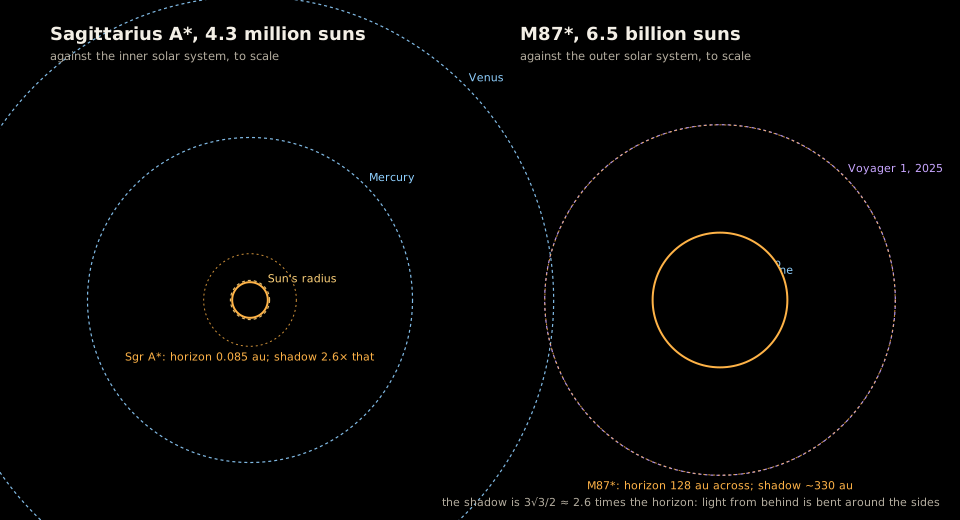
M87* — 6.5 billion solar masses, 16.8 megaparsecs away, photographed by the Event Horizon Telescope in April 2017 and published in April 2019: a 42-microarcsecond ring, brighter on the south side where the gas comes toward us[44]. Its polarisation, mapped in 2021, shows ordered magnetic fields at the edge of the horizon, the kind that launch its 5,000-light-year jet. A second image from 2018 data, published in 2024, shows the bright spot moved — the ring is the same, the gas is not.
Sagittarius A* — 4.3 million solar masses, 8.3 kiloparsecs, at the centre of the Milky Way, published May 2022: a 52-microarcsecond ring, the size the stars' orbits had predicted[49, 46]. It changes in minutes, so the picture is an average of the night.
OGLE-2011-BLG-0462 — a dark object that passed in front of a background star in 2011 and bent its light for 270 days, with the star's position shifting by a milliarcsecond as it did. Astrometry with Hubble weighed it at about seven solar masses, alone, in the bulge, 1.6 kiloparsecs away: the first isolated stellar-mass black hole, confirmed in 2022 and again in 2025[50].
Gaia BH1, BH2, BH3 — three dormant ones found by the wobble of a companion star in Gaia's astrometry, Michell's method with a space telescope. BH3, announced April 2024, is 33 solar masses and 590 parsecs away, in a stream of ancient metal-poor stars: the heaviest stellar-mass black hole known in the Galaxy, and a sign that the heavy mergers LIGO hears were made from stars like these[54].
Heard
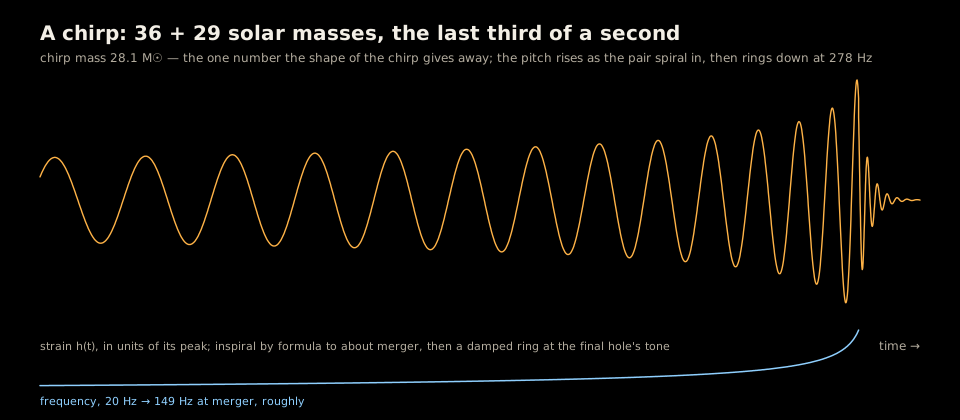
The LIGO–Virgo–KAGRA network ran its fourth observing run from May 2023 to November 2025 and roughly doubled the catalogue. Three from the run stand out. GW231123 (November 2023, announced July 2025): total mass 190–265 solar masses, both holes spinning near the limit, heavier than stellar collapse should make — probably each the product of an earlier merger[57]. GW250114 (January 2025): the loudest signal yet, signal-to-noise about 80, clean enough to hear the final hole ring in two tones and to test that the horizon's area grew — Hawking's theorem, confirmed at 99.999%[58]. And the neutron-star–black-hole pairs, which now number a handful.
At nanohertz, the pulsar-timing arrays' 2023 result stands: a background hum consistent with every supermassive pair in the universe, spiralling[52].
Found too early
The James Webb Space Telescope, since 2022, has found black holes in the first few hundred million years that are too heavy for their age. UHZ1, at redshift 10.1 — 470 million years after the Big Bang — holds about 40 million solar masses, as much as its whole galaxy of stars[53]. The little red dots, hundreds of faint compact red sources at redshifts 4 to 9, are read by most as small accreting black holes wrapped in dense gas[59]. A hole cannot grow from a stellar remnant to forty million suns in that time by feeding at the ordinary limit. Either it started heavy — a “direct collapse” of a gas cloud straight to a hole of ten thousand suns or more — or fed faster than the limit. Both are being argued.
Counted and weighed
An estimate from the history of star formation puts the number of stellar-mass black holes in the observable universe near 40 quintillion, 4 × 10¹⁹, and about a percent of all the mass in stars is now in them[51]. The heaviest with a measurement is a matter of method: TON 618, a quasar 10 billion light-years away, is 40 or 66 billion solar masses depending on which line is fitted[69]. Cygnus X-1, the first, was reweighed in 2021 at 21 solar masses[34].
Open
What happens to the information. Hawking radiation as he computed it is thermal, and thermal radiation carries nothing of what fell in; but quantum mechanics does not allow information to be destroyed. Since 2019 a line of work — “islands” and replica wormholes — computes the entropy of the radiation and gets the curve Page predicted in 1993, rising then falling, which is what a hole that keeps information would do[64]. How the information gets out is still not known.
What is at the centre. The theory says a singularity; the theory also says its own equations fail there. No observation reaches inside a horizon.
Whether the ones we see are Kerr. The ringdown tones of GW250114 match Kerr. The shadow sizes match. Deviations, if any, are below the current precision.
Whether the small ones exist. Primordial black holes in the asteroid-mass window, 10¹⁷ to 10²² grams, are not ruled out and would be all of the dark matter if they exist in the right number[60]. Nothing found.