generatorA chirp you can hear
Two black holes in orbit lose energy to ripples in space and spiral in. The ripples arrive at Earth as a strain — a stretching of a 4-kilometre laser arm by a thousandth of a proton's width — with a pitch that rises as the pair close in. For stellar masses the pitch runs through the range of a cello. This plays it.
The inspiral is the leading-order formula: the frequency runs as f ∝ (t_c − t)⁻³ᐟ⁸ and depends on the two masses only through the chirp mass (m₁m₂)³ᐟ⁵/(m₁+m₂)¹ᐟ⁵. The cut near merger is a rough one, at about 2.2 times the last-stable-orbit frequency; the ringdown is the fundamental tone of the final Kerr hole from Berti's fits. The sound is the frequency track itself, not sped up: a 36 + 29 pair sweeps 20 → 150 Hz and rings at about 250 Hz.
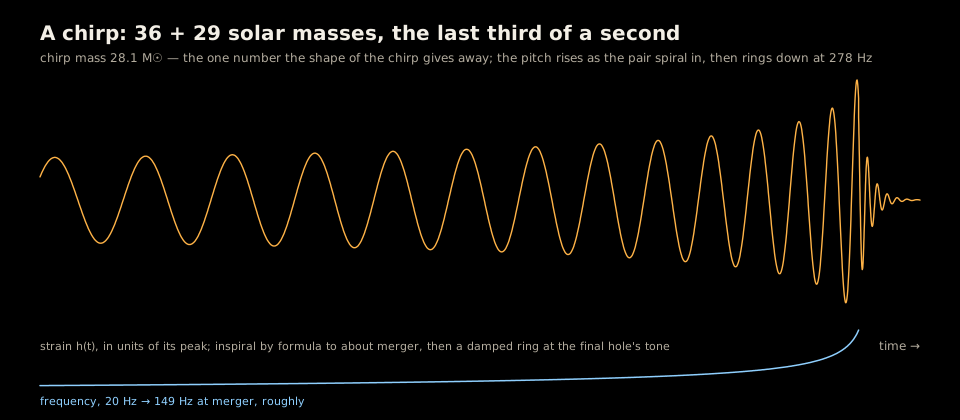
What was heard
On 14 September 2015 the two LIGO detectors, in Louisiana and Washington, recorded the same 0.2-second chirp seven milliseconds apart: 36 and 29 solar masses becoming 62, with three solar masses turned into waves, from 1.3 billion light-years away[43]. It was the first direct detection of gravitational waves, the first pair of black holes seen merging, and the first evidence that black holes of thirty solar masses exist. Weiss, Barish and Thorne got the 2017 Nobel for the detectors.
By the end of the fourth observing run in November 2025 the count was about three hundred mergers. GW190521 made a 142-solar-mass hole, the first of intermediate mass[47]. GW231123 was heavier still, 190–265 solar masses in total, with both partners spinning near the limit[57]. GW250114, in January 2025, was loud enough to hear the final hole ring in two tones and confirm that its horizon area was larger than the sum of the two that made it — Hawking's 1971 theorem, tested to five sigma[58, 33].
And at the other end of the scale
Pairs of supermassive black holes, in merging galaxies, chirp too — over years, at billionths of a hertz. In June 2023 four pulsar-timing arrays reported the hum of all of them together, read off the tick of millisecond pulsars across the Galaxy[52]. LISA, in the 2030s, will hear the individual ones[55].