the modelThree numbers and a horizon
General relativity says how mass shapes space and time. A black hole is the simplest thing it describes: after the collapse settles, a black hole is fixed by its mass, its spin and its electric charge, and by nothing else. Everything on this page follows from that.
The metric
A metric is the rule for measuring distance. Flat space has Pythagoras. Around a mass M that does not spin, Schwarzschild found in 1916 that the rule becomes:
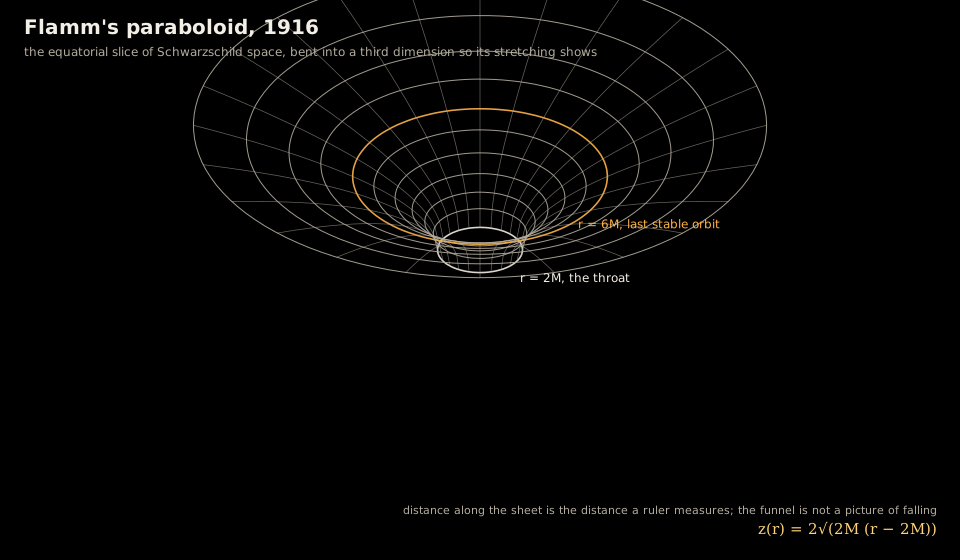
Two things happen at r = 2M. The first coefficient goes to zero: clocks there, seen from far away, stop. The second blows up. For twenty years this was read as a place where the theory broke. Painlevé (1921), Gullstrand (1922) and Eddington (1924) each wrote coordinates in which nothing broke there, without saying so; Lemaître said so in 1933; Finkelstein explained in 1958 what the surface is — a membrane light can cross one way[7, 12, 15, 20].
The horizon
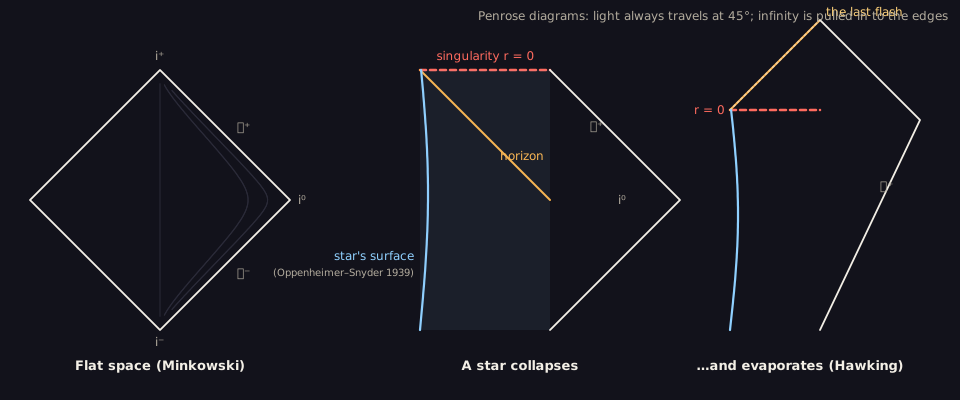
The event horizon at r = 2GM/c² is not a surface of anything. A falling observer crosses it and notices nothing there; the tide across a body is 2GMh/r³, and for a big enough hole that is gentle. What the horizon is, is a fact about the future: from inside, every direction points inward. In the Penrose diagram below that is drawn as light cones that all lean toward the centre.
Light
Light follows the straightest lines the metric allows. In the plane of a ray, with u = 1/r:
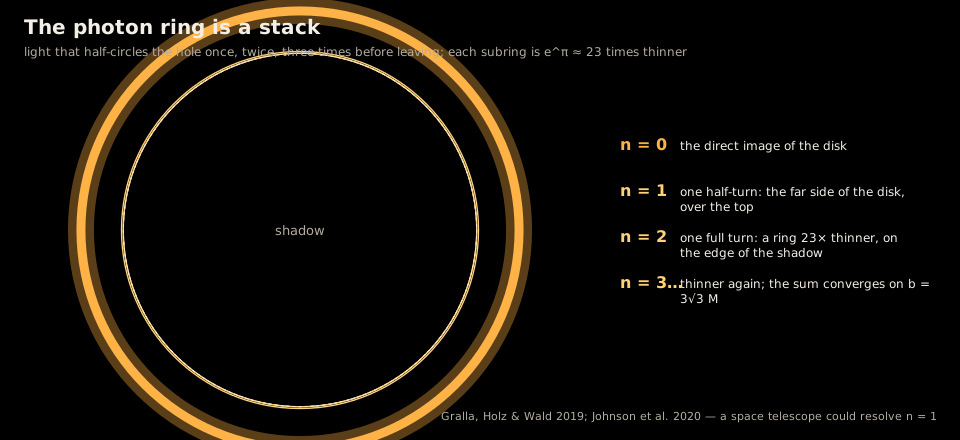
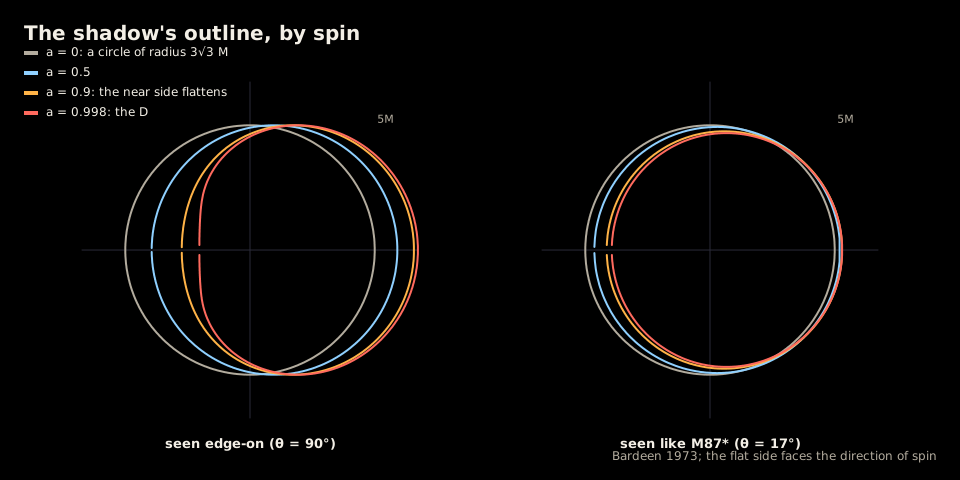
Three consequences, each visible in every picture on this site. A ray can orbit at r = 3M, the photon sphere. A ray from far away with impact parameter below 3√3 M ≈ 5.196 M falls in, so the shadow is 2.6 times wider than the horizon. And a ray passing at distance b far out turns by 4M/b — for the Sun, 1.75 arcseconds at the limb, which is what the 1919 eclipse expedition measured, twice Soldner's 1801 Newtonian value[3, 11].
Orbits
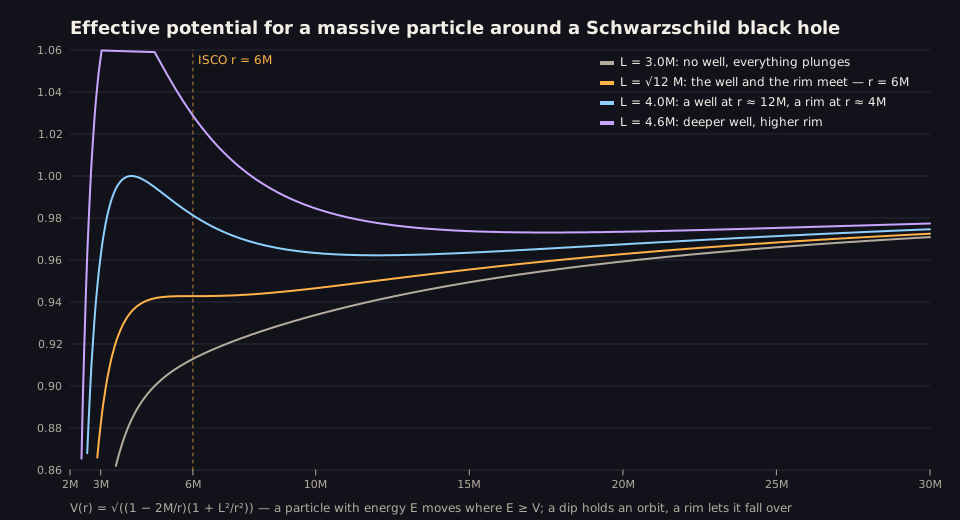
A massive particle with angular momentum L and energy E (both per unit mass) moves where E is at least the effective potential:
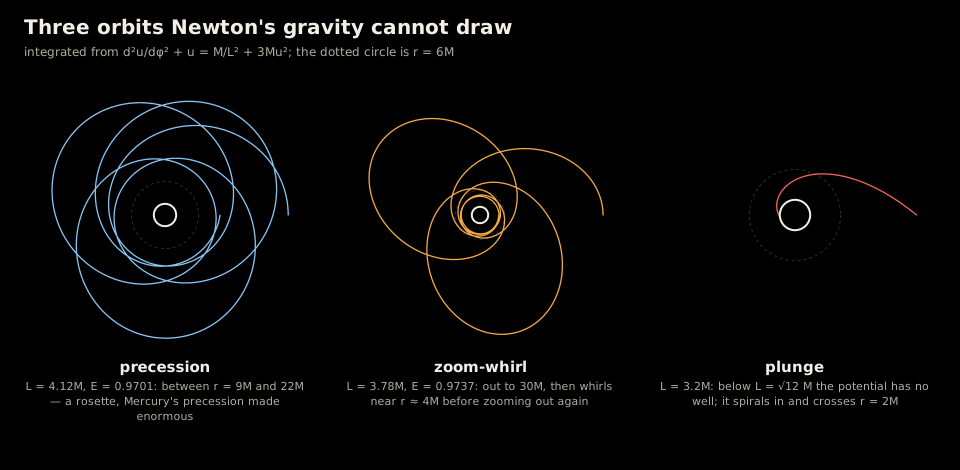
The rim and the well meet when L = √12 M, at r = 6M: the ISCO. No circular orbit inside it lasts; gas spiralling inward lets go there, which is why the disks in the pictures have a hole in them at 6M. Between 3M and 6M circular orbits exist but a nudge sends them in or out. Outside, bound orbits do not close: each pass turns the ellipse a little, which for Mercury is 43 arcseconds a century and for a star near Sgr A* was measured in 2020[46].
Spin
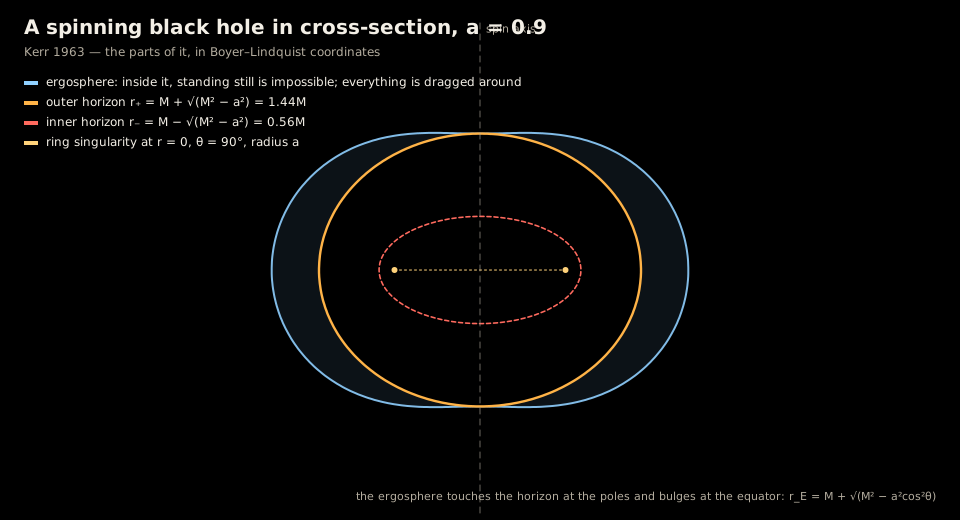
Real black holes turn. Roy Kerr found the spinning solution in 1963 — a page and a half in Physical Review Letters — after fifty years of failed attempts[23]. Spin a = J/M runs from 0 to M. It pulls the horizon in to r₊ = M + √(M² − a²), adds a second horizon inside, wraps the outside in an ergosphere, brings the last stable orbit in to r = M at maximal spin, and replaces the point at the centre with a ring. Penrose showed in 1969 that up to 29% of a spinning hole's mass can be drawn out of the ergosphere[31]. Gas fed from a disk can spin one up to a ≈ 0.998 M, not beyond.
No hair
Whatever fell in — a star, a library, a planet made of gold — the settled hole outside is described by mass, spin and charge, and nothing else. Israel proved it for the still case in 1967, Carter and Robinson for the spinning one by 1975[28]. Wheeler called it “a black hole has no hair”. The full family is Kerr–Newman[27]; in practice charge neutralises in moments and every black hole in the sky is Kerr, with two numbers.
Temperature
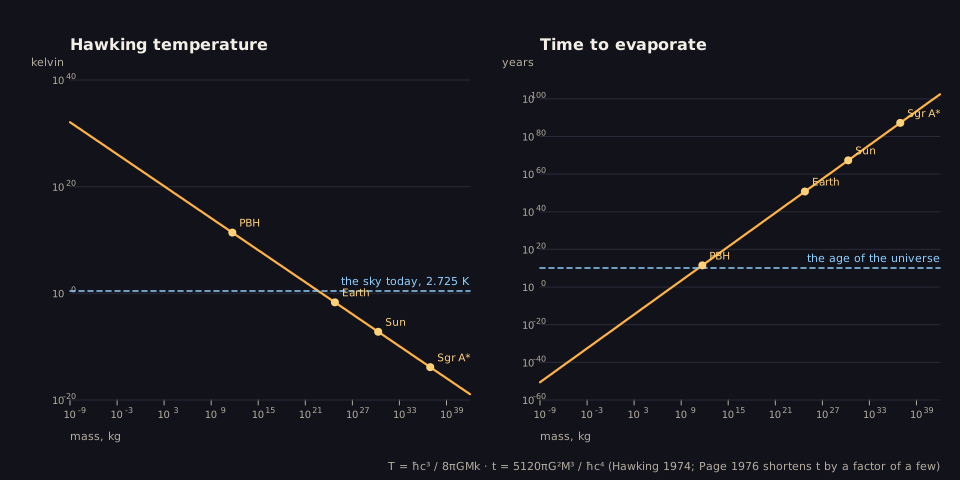
Hawking showed in 1971 that the total horizon area can only grow[33]; Bekenstein said that an area that only grows is an entropy[35]; Hawking then found in 1974 that a horizon radiates like a body at a temperature set by its size[38]:
A Sun-mass hole is colder than the sky (2.725 K) and so takes in more than it gives; it will not begin to shrink until the universe has cooled below sixty billionths of a kelvin. A hole of 2e+11 kg — a mountain — born in the first second of the universe would be finishing about now, in a burst of gamma rays. None has been seen[39, 68].
Penrose diagrams
A Penrose diagram squeezes all of space and time onto a page in a way that keeps light at 45°. Read the collapse one: the star's surface falls inward; the horizon is the 45° line; inside it, every future-pointing direction meets the wavy top, which is the singularity — a moment, not a place. The evaporating one is Hawking's guess at how it ends; what happens at the corner is the open question of the field[72, 64].