legendsThe ones who got there first
No myth knew about black holes. Several knew something a black hole is: a thing that eats light and cannot be seen; a dark shape drawn from where the stars are not; a whirlpool with a centre nothing leaves; a void before there was anything. Each is set beside the physics it rhymes with, and the place where the rhyme breaks.
He who fights with monsters should be careful lest he thereby become a monster. And if thou gaze long into an abyss, the abyss will also gaze into thee.Wer mit Ungeheuern kämpft, mag zusehn, dass er nicht dabei zum Ungeheuer wird. Und wenn du lange in einen Abgrund blickst, blickt der Abgrund auch in dich hinein.
Nietzsche meant people. The line fits a black hole better than he could have known: look long enough at one and you see yourself. Rays that leave your side of the hole, loop the photon sphere, and come back are the image of whatever stood behind you — including you. In the ray tracer on the draw page, a camera near the hole would find the back of its own head in the ring.
Rahu — the eater who is a point
In the Hindu story the demon Svarbhānu drank the nectar of immortality in disguise; the Sun and Moon saw him and told Vishnu, who cut off his head. The head, immortal now, is Rahu, and it swallows the Sun and Moon whenever it catches them — the eclipse — and they fall out of its severed throat. The body is Ketu. In Thailand and Lanna, พระราหู is one of the nine planets of the calendar, offered eight black things: black chicken, black jelly grass, black coffee, black sesame, black beans, black sticky rice, black grapes, black liquor[74].
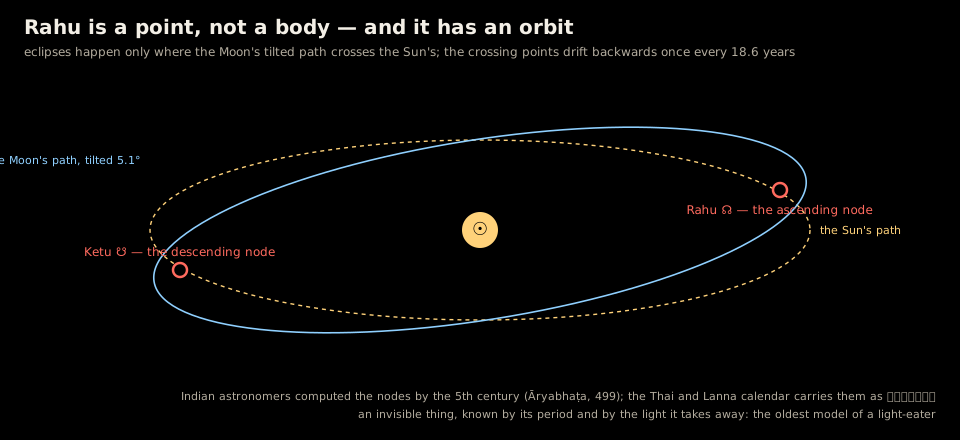
What the astronomers knew, and the story carries: Rahu and Ketu are the two lunar nodes, the points where the Moon's path, tilted 5.1°, crosses the Sun's. Eclipses happen only there. The nodes move backwards round the sky once every 18.6 years, and Āryabhaṭa had them computed by 499 CE[75]. So Rahu is a thing with no body, an orbit, a period, and the habit of taking the light away — known entirely by what it does to light. That is the definition of a black hole as the Event Horizon Telescope uses it.
Where it breaks: the node is a geometric point with no mass; an eclipse is a shadow, not a capture, and the light comes back.
The dark constellations — the Emu and the Llama
Most sky traditions join bright stars into figures. Aboriginal peoples across Australia drew a figure from the dark instead: the Emu in the Sky, whose head is the Coalsack nebula beside the Southern Cross and whose neck and body run along the dust lanes of the Milky Way toward Scorpius and Sagittarius — toward the Galactic centre, where Sagittarius A* is. Its position through the year told when to collect emu eggs[77]. The Inca did the same in the Andes: Yacana the llama, drinking from the river of the Milky Way, and the serpent, the toad, the tinamou, each a dark cloud with a name[78].
The rhyme is exact in one respect: a black hole's image is a dark shape against light — a shadow on the glow behind it — and the 2019 photograph is a dark constellation in miniature. Both traditions put their dark figure along the Great Rift, and our black hole sits at the end of it.
Where it breaks: the dark lanes are cold dust in front of stars, not a horizon; the emu's darkness is a foreground, the shadow's is an absence.
Charybdis and the maelström — the whirlpool with a centre
Homer's Charybdis, in the strait beside Scylla, swallows the sea three times a day and spits it out; Odysseus survives by clinging to a fig tree above the funnel until his mast comes back up[80]. Poe's fisherman in “A Descent into the Maelström” (1841) watches the walls of the whirlpool and notices that cylinders sink slower than spheres and that small things sink slower than large; he ties himself to a cask and lives[87].
An accretion disk is the whirlpool made of gas: a spiral of material orbiting faster the further in, shedding energy as heat and light, with an edge at 6M inside which nothing circles. Poe's observation is the right kind — a rule about who falls in, read off the shapes. Michell's is the same kind of rule.
Where it breaks: Charybdis gives things back. A black hole's ISCO is the last place a disk gives anything back, and below it the only return is Hawking's, 10⁶⁷ years later.
The spaces between the worlds
In the Pali canon, at the moment the Buddha-to-be enters his mother's womb, a light appears “even in those spaces between the worlds, vacant and abysmal, regions of blackness and utter darkness, where the light of the sun and moon, so mighty and powerful, cannot reach”[76]. The commentaries name them the lokantarika, the interstitial spaces where three world-spheres touch, dark because no sun of any of the three shines into them.
The picture — a region light cannot reach, defined by the geometry of the worlds around it — is closer to a horizon's definition than most. A horizon is the set of places from which light cannot reach out; the lokantarika is the set of places light cannot reach in. Each is drawn by geometry, not by any wall.
Where it breaks: the lokantarika are dark by distance; a horizon is dark by direction, and it is the falling in that no light survives, not the reaching.
The voids before
Ginnungagap, the yawning gap of the Norse creation, between the ice of Niflheim and the fire of Muspelheim, where the first being condenses from the meltwater[79]. Chaos, χάος, the gape in Hesiod, before Earth. Tehom, the deep of Genesis 1:2, with darkness on its face, and the Greek word for it, ἄβυσσος, which Nietzsche's Abgrund translates[83]. Te Kore, the nothing of Māori cosmogony, before Te Pō, the long night, before light[85].
These are voids of beginning, not of ending, and the rhyme is with Penrose's singularity theorem run backwards: the same mathematics that says a collapse must reach a singularity says the expanding universe came from one. The black hole's singularity is the Big Bang's, mirrored.
Where it breaks: a void is empty; a singularity is everything in no room.
The eaters of the sun
Apep, the Egyptian serpent of the underworld, attacks the sun's boat each night and swallows it on the days of eclipse, and the priests of Ra list spells against him[82]. Tiangou, the heavenly dog of Chinese tradition, eats the sun and moon; people beat drums to make it spit them out[84]. Sköll and Hati chase them across the Norse sky and catch them at Ragnarök. Louhi, in the Kalevala, steals the sun and moon outright and locks them in a mountain of iron[88]. And Xibalba, the Maya underworld, is reached by a black road: the dark rift of the Milky Way, again[81].
What the eclipse stories keep is the idea that the light can be taken — that a dark thing exists that removes a star from the sky. A black hole does that once, to whatever crosses in; and a hole passing in front of a star, the microlensing event of 2011, first brightens the star and then lets it go, which is the story's shape exactly[50].
Dante at the centre
At the bottom of the Inferno, climbing down Satan's body, Dante and Virgil pass a point where they must turn over, and Virgil explains: they have crossed the centre of the Earth, “the point to which all weights are drawn from every part”[86]. It is 1320. Gravity has a centre; the pit of the universe is where everything falls toward; and the way out is to keep going. Oppenheimer and Snyder's rider on the collapsing star would agree with the first two.
Where it breaks: Dante's centre can be passed. A black hole's is not a place in space to pass but a moment in the future, and from inside the horizon every road leads to it.
And the name
“Black hole” comes, by most accounts, from a prison: the Black Hole of Calcutta, a cell in Fort William where prisoners died overnight in June 1756. Robert Dicke, who had a house full of children and a habit of saying things had vanished “into the Black Hole of Calcutta”, is said to have used it in a lecture; a reporter printed it in 1964; Wheeler adopted it in 1967[89, 25, 29]. The astronomers of the Soviet Union preferred “frozen star”, for what a far observer sees, and “collapsar” had its decade. The prison won.