how drawing with math worksOne dot, one ray, run backwards
A photograph works because light leaves things and lands on a camera. A computer can run that film in reverse: start at the camera, at one dot of the picture, and ask where the light that lands here must have come from. Near a black hole the answer bends.
In easy words
- A picture is a grid of dots. A phone photo is a few million of them. Each dot needs one colour.
- Each dot is a direction. The dot in the middle looks straight ahead; the dot in the top-left corner looks up and to the left. So each dot is a question: what is out there, in that direction?
- Send a ray out and follow it. In empty space it goes straight, so the answer is whatever it hits: a star, or nothing. Near a heavy thing the ray curves. How much it curves is a rule you can write down.
- The rule is a short one. Take the ray's distance from the centre, r. Write u for 1/r. Newton's straight line obeys u″ + u = 0. Einstein adds one term: u″ + u = 3u². That term is the whole bend.
- Walk the ray in small steps. The computer cannot solve the curve in one go, so it takes a step, asks the rule how the direction changed, takes another. A few hundred steps per ray.
- Stop when something happens. Three things can: the ray drops inside the horizon (paint the dot black — nothing comes back out); it lands on the glowing disk (paint the disk's colour, shifted for the disk's speed and the pull it sits in); or it flies away (paint the star it points at).
- Do that for every dot. A million rays, a few hundred steps each. A laptop does it in a minute; a graphics card does it thirty times a second.
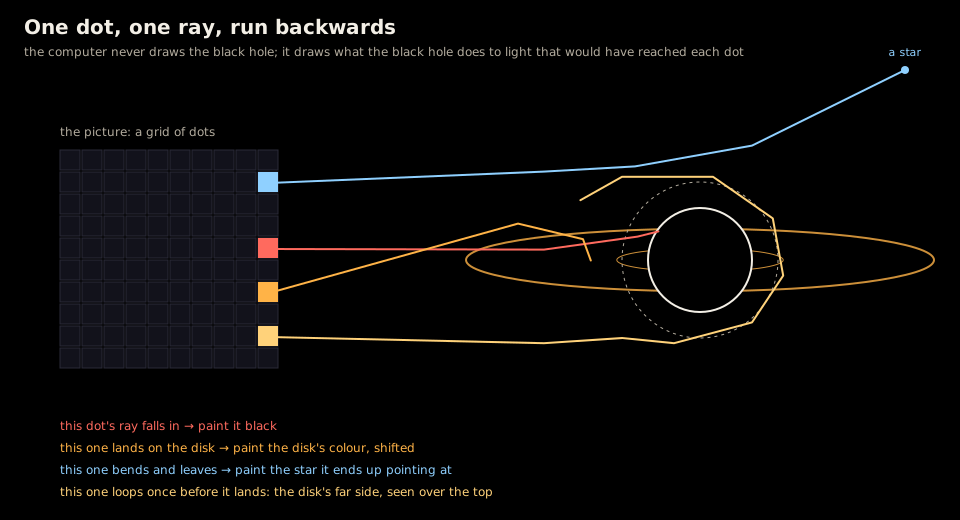
The trick is that the computer never draws the black hole. There is nothing there to draw. It draws what the black hole does to every ray that would have reached you, and the shadow is the set of dots whose rays never came back.
With the equation on, and off
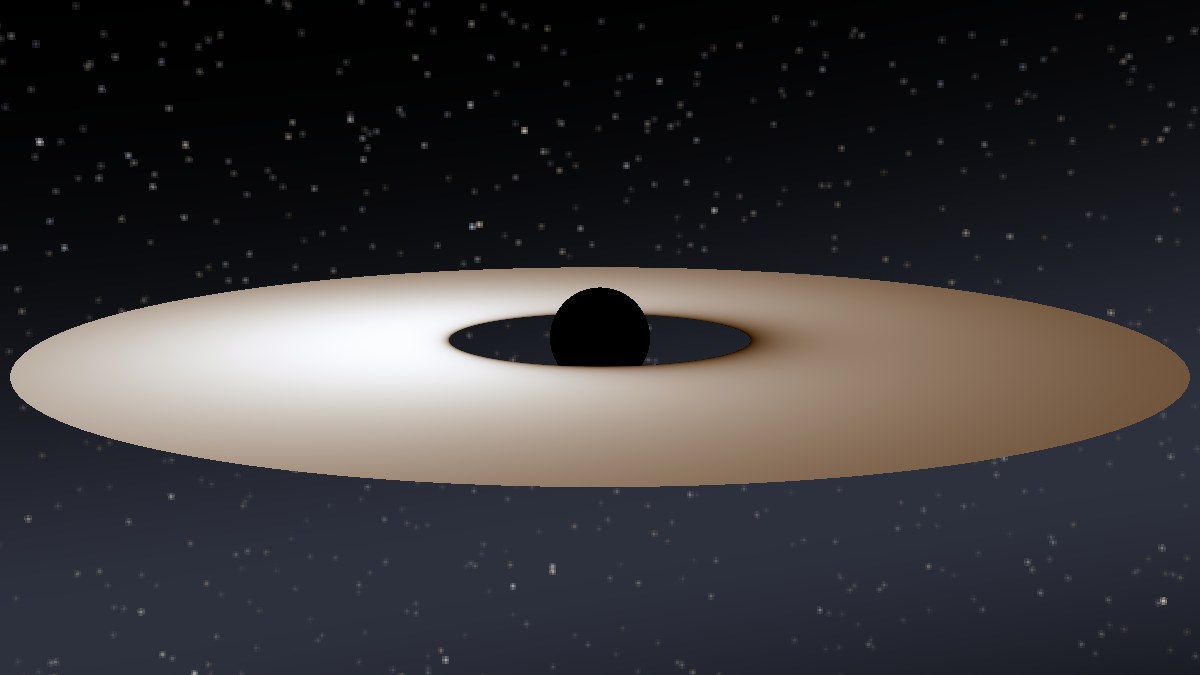
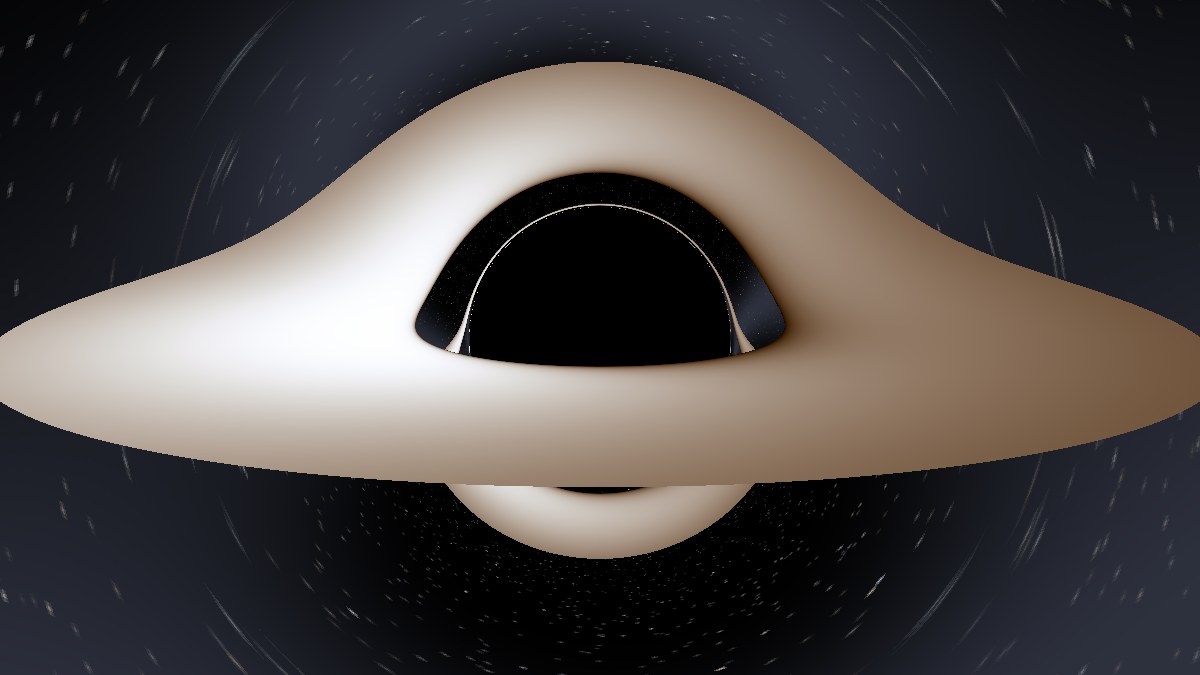
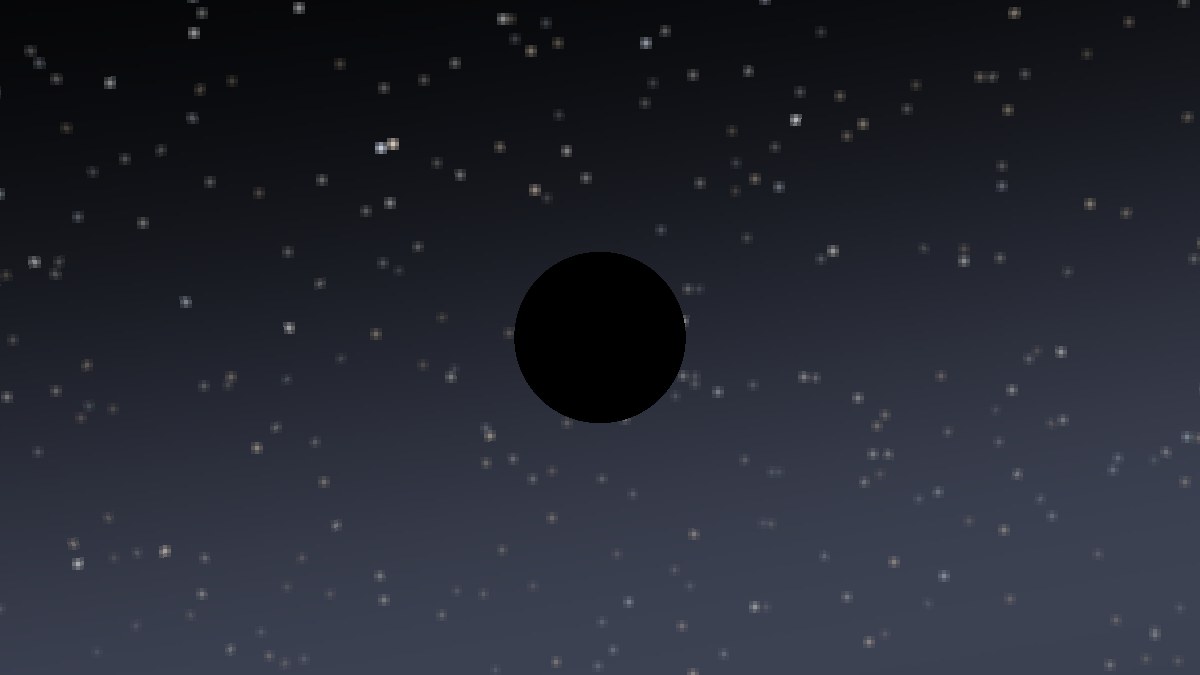
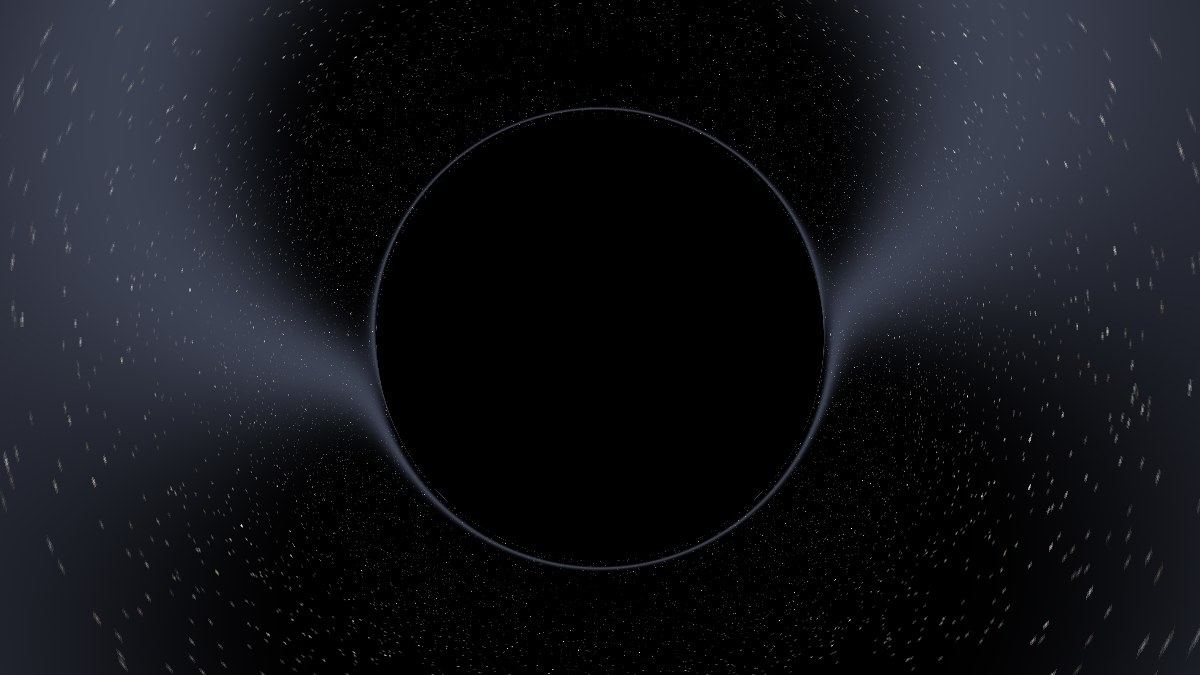
Same disk, same camera. On the left the rays go straight, as they would past a black sphere with no gravity: half the disk is hidden behind it, and the far edge is a plain ellipse. On the right the rays bend: the hidden half reappears as an arch over the top and a band underneath, and a thin ring hugs the shadow — light that circled the hole once before leaving.
Draw one yourself
This one runs on your graphics card, the same rule for every dot, redrawn when you move a slider. Tilt the camera, zoom, turn the physics off and on, save the picture.
Units: G = c = M = 1, so the horizon is at r = 2, the photon sphere at 3, the disk's inner edge at 6. The disk is a thin Novikov–Thorne sheet on circular orbits, brightness ∝ r⁻³(1 − √(6/r)), colour a black body shifted by g = √(1 − 3/r) / (1 + Ω b sin i) — Luminet's 1979 formula[40, 37]. The left side comes toward you and is brighter and bluer; the right side goes away. A phone draws this at a lower resolution than a desktop.
One ray at a time
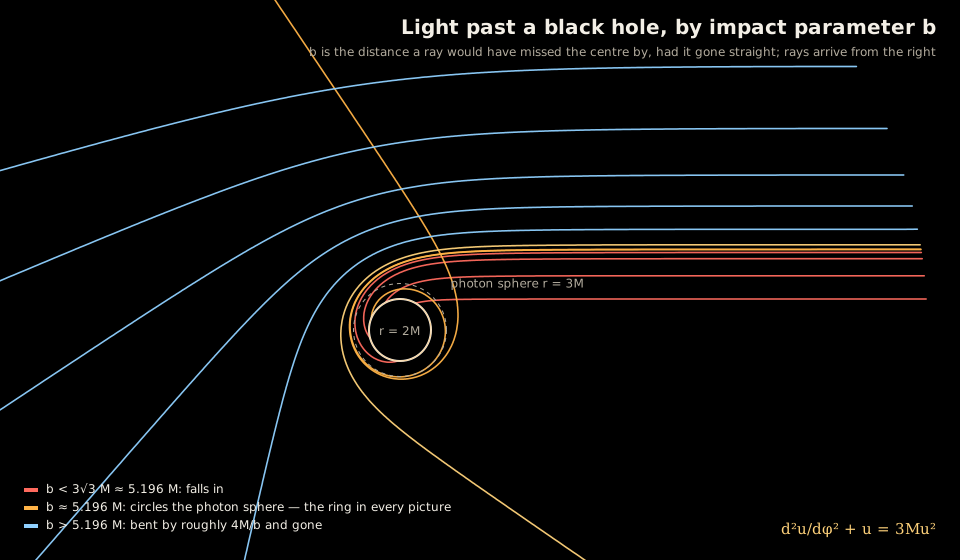
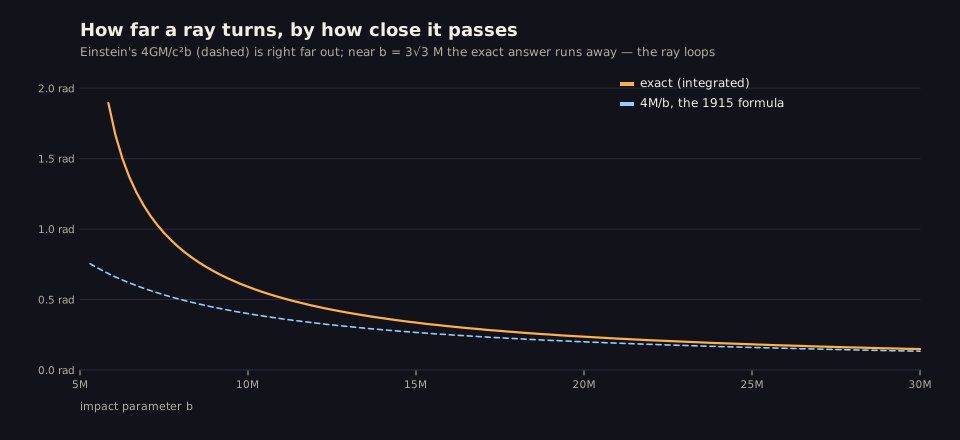
Slide the impact parameter — the distance the ray would have missed the centre by, had it gone straight — and watch the rule walk it. Below 3√3 M ≈ 5.196 M the ray falls in. Right at it, the ray circles. Above, it bends and leaves; far out, by about 4M/b, which is the number Einstein gave in 1915 and Eddington measured at the 1919 eclipse.
Where the picture came from
The first one was drawn in 1979 by Jean-Pierre Luminet at the Paris Observatory, on an IBM 7040 with punch cards, and then by hand: the machine printed numbers, and he placed India-ink dots on paper, denser where the disk was brighter[40]. The picture on the past page is that calculation redone here and drawn as dots the same way — not a copy of his, which is his. The film Interstellar (2014) drew a spinning one at cinema resolution with a code Kip Thorne and Double Negative wrote for it, and published the method[42]. The 2019 photograph of M87* was not drawn at all, but the ring in it is the same ring[44].